组成图示
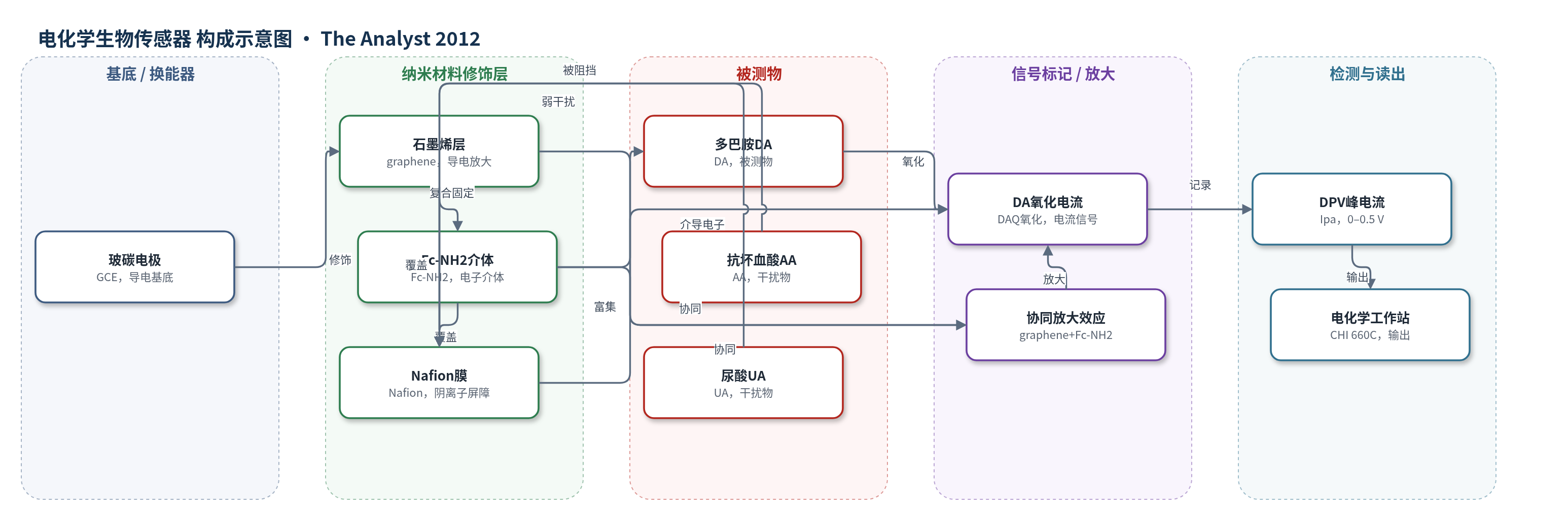
点击图片查看大图 · 依据论文自动绘制
传感器类型
电化学生物传感器
检测对象
多巴胺(dopamine, DA);样品基质:0.1 M PBS 缓冲液、血清、尿液
检测原理
该传感器基于 DA 在修饰电极表面的直接电化学氧化。带正电的 DA 通过 Nafion 膜中的磺酸基团被富集到电极界面,而带负电的 AA 被 Nafion 阴离子屏障排斥,从而降低干扰。DA 在石墨烯/Fc-NH2 复合层表面失去电子生成多巴胺醌(DAQ);石墨烯提供高导电通道和大比表面积,Fc-NH2 作为可逆氧化还原介体通过 π-堆积、氢键和静电作用固定在石墨烯上,加速 DA 与电极之间的电子转移。石墨烯与 Fc-NH2 的协同作用使氧化电流显著放大。差分脉冲伏安法(DPV)在 0–0.5 V 记录 DA 氧化峰,峰电流随 DA 浓度升高而增大,并在线性范围内呈正比关系。
检测灵敏度
LOD: 20 nM (S/N=3);线性范围: 5×10^-8–2×10^-4 M(无 UA 和 AA);LOD: 50 nM (S/N=3);线性范围: 1×10^-7–4×10^-4 M(1×10^-3 M AA 和 1×10^-4 M UA 存在下)
效应效果
传感器在 0.1–0.7 V 连续循环 30 次保持稳定;对 DA 的计时电流响应在 3 s 内达到稳态的 95%。当 AA 和 UA 浓度分别为 DA 的 1000 倍和 100 倍时几乎无干扰;在 1 mM AA 和 0.1 mM UA 存在下,AA 无氧化峰,UA 峰基本不变,DA 峰位保持 0.15 V。血清和尿液加标回收率为 97.3%、98.7%、102.5%,RSD 为 1.5%、1.1%、1.6%。作者称其检出限低于此前报道值,并认为该 Nafion/石墨烯/Fc-NH2 修饰电极可用于生物样品中 DA 的灵敏选择性检测。
传感器的构成
- 基底电极:玻碳电极(GCE),经氧化铝抛光、硝酸/乙醇超声及循环伏安活化,作为导电工作电极。
- 纳米复合修饰层:石墨烯(graphene)/Fc-NH2 纳米复合材料,滴涂于 GCE 表面;石墨烯提供高导电性、大比表面积和电子转移通道。
- 介体/界面稳定层:1-[(4-氨基)苯乙炔基]二茂铁(Fc-NH2),通过 π-堆积、氢键和静电作用与石墨烯结合,促进 DA 电子转移并防止介体泄漏。
- 阻隔/富集层:Nafion 膜(0.5% 乙醇溶液),覆盖于复合层外,阻挡阴离子 AA 干扰并富集带正电 DA。
- 检测介质:0.1 M 磷酸盐缓冲液(PBS,pH 7.0),提供 DA 电化学氧化反应环境。
中文摘要
本文首次合成了新型二茂铁衍生物 1-[(4-氨基)苯乙炔基]二茂铁(Fc-NH2)。该分子同时含有苯乙炔骨架、二茂铁和氨基,具有优异的电化学性质。作者通过一锅法混合石墨烯溶液与 Fc-NH2 溶液制备石墨烯/Fc-NH2 纳米复合材料,并将其用于构建 Nafion/石墨烯/Fc-NH2 修饰玻碳电极(GCE)。石墨烯上固定的 Fc-NH2 可增强纳米复合材料的电荷传输能力,稳定石墨烯并防止二茂铁泄漏。在 Nafion/石墨烯/Fc-NH2/GCE 上,多巴胺(DA)的检测信号被显著放大,实验证明该增强来自石墨烯与 Fc-NH2 的协同放大效应。在无尿酸(UA)和抗坏血酸(AA)时,DA 氧化峰电流在 5×10^-8–2×10^-4 M 范围内线性,检出限为 20 nM;在 1×10^-3 M AA 和 1×10^-4 M UA 存在下,线性范围为 1×10^-7–4×10^-4 M,检出限为 50 nM(S/N=3)。采用标准加入法,该电极成功用于实际样品中 DA 的测定。
英文摘要
A new ferrocene derivative (1-[(4-amino) phenylethynyl]ferrocene, Fc-NH(2)) was synthesized for the first time. The ferrocene derivative molecule contained the phenylethynyl skeleton, ferrocene and amino groups with excellent electrochemical properties. The graphene/Fc-NH(2) nanocomposite was prepared by mixing graphene solution and Fc-NH(2) solution in one pot and the nanocomposite was utilized to construct a Nafion/graphene/Fc-NH(2) modified glassy carbon electrode (GCE). The ferrocene derivative immobilized on the graphene can enhance the charge-transport ability of the nanocomposite, stabilize the graphene and prevent the leakage of ferrocene. The detection signal of dopamine (DA) was significantly amplified on the Nafion/graphene/Fc-NH(2)/GCE. It was experimentally demonstrated that the signal enhancement results from the synergy amplification effect of graphene and the Fc-NH(2). The oxidation peak currents of DA were linearly related to the concentrations in the range of 5 × 10(-8) to 2 × 10(-4) M with the detection limit of 20 nM in the absence of uric acid (UA) and ascorbic acid (AA). In the presence of 10(-3) M AA and 10(-4) M UA, the linear response range was 1 × 10(-7) to 4 × 10(-4) M, and the detection limit was 50 nM at S/N = 3. Using the proposed Nafion/Fc-NH(2)/graphene/GCE, DA was successfully determined in real samples with the standard addition method.