组成图示
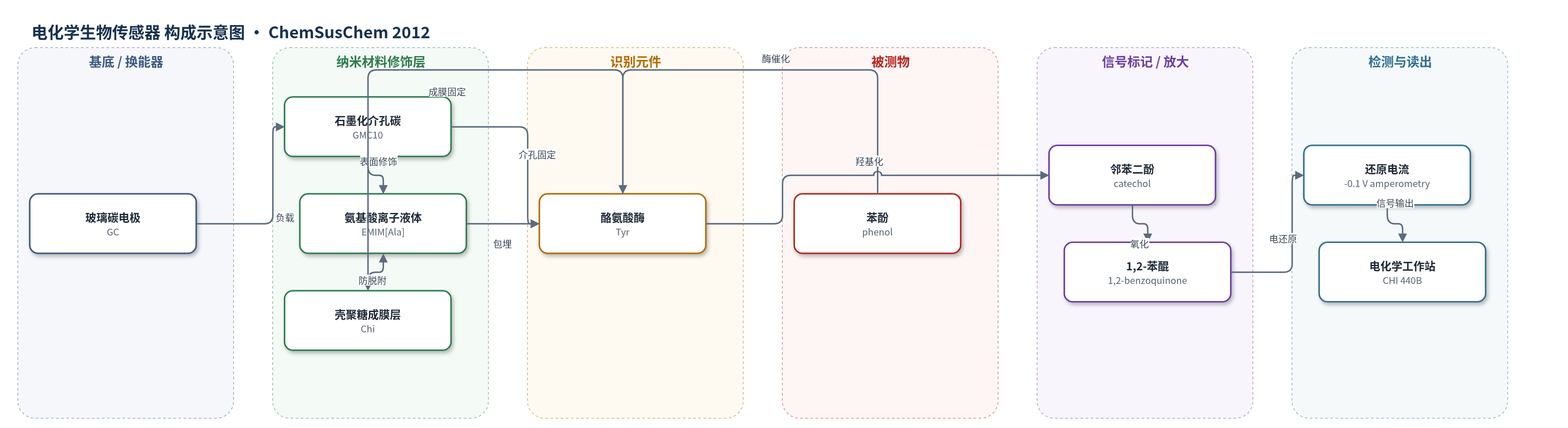
点击图片查看大图 · 依据论文自动绘制
传感器类型
电化学生物传感器
检测对象
苯酚(phenol);样品基质:PBS 缓冲液、污染水样(饮用水/环境水样)
检测原理
苯酚进入 GMC–AAIL–Chi/GC 电极后,被包埋的酪氨酸酶催化羟基化为邻苯二酚,并进一步氧化为 1,2-苯醌;1,2-苯醌在 -0.1 V 工作电位下于电极表面被电化学还原为邻苯二酚,邻苯二酚可再次被酶氧化,形成酶催化-电还原循环放大。GMC10 的介孔通道促进底物和产物扩散,EMIM[Ala] 提供亲水、生物相容和抗污微环境,壳聚糖成膜固定酶与纳米材料。稳态还原电流随苯酚浓度增加而线性增大,从而实现低电位、低背景电流的苯酚检测。
检测灵敏度
LOD: 20 nmol L−1;线性范围: 0.1–10 mmol L−1;灵敏度: 1385.1 mA cm−2 mM−1
效应效果
该传感器响应时间小于 5 s,信噪比、稳定性、重复性和使用寿命优于未修饰 GMC 电极。21 d 存储后,Tyr–GMC10–EMIM[Ala]–Chi/GC、Tyr–GMC10–BMIM[Ala]–Chi/GC 和 Tyr–GMC10–Chi/GC 分别保留 >90%、>90% 和 80% 初始响应,半衰期约 45、45 和 35 d。灵敏度分别为 1882.8、1385.1 和 1101.8 mA cm−2 mM−1,检出限分别为 40、20 和 30 nmol L−1。六氯苯、五氯苯酚、邻苯二甲酸酯、乙酸乙酯和碳酸二乙酯在 100 倍浓度下不干扰苯酚检测;儿茶酚等其他酚类会产生响应。作者认为其可用于水样中酚类污染物快速检测。
传感器的构成
- 基底/换能器电极:玻璃碳电极(GC, glassy carbon electrode),提供导电基底与电子转导
- 纳米材料修饰层:石墨化介孔碳(GMC10, graphitized mesoporous carbon,孔径约10 nm),提供高比表面积介孔固定化微环境和电子传导
- 界面修饰层:氨基酸离子液体(AAIL,EMIM[Ala],1-ethyl-3-methylimidazolium alanine;亦用 BMIM[Ala]),提高 GMC 亲水性、水相分散性、生物相容性和抗污性
- 识别/催化元件:酪氨酸酶(Tyr, tyrosinase),包埋于 GMC–AAIL 介孔中,催化苯酚羟基化和氧化
- 成膜固定层:壳聚糖(Chi, chitosan),将 Tyr–GMC–AAIL 悬浮液固定于 GC 表面并防止 AAIL 脱附
- 信号中间体:邻苯二酚/1,2-苯醌(catechol/1,2-benzoquinone),由酶催化生成并在电极表面电还原产生电流
中文摘要
本文通过用亲水性氨基酸离子液体(AAIL,1-乙基-3-甲基咪唑丙氨酸,EMIM[Ala])对有序石墨化介孔碳(GMC)进行可控表面修饰,获得 GMC–AAIL 纳米复合材料,并将其作为酪氨酸酶生物传感器平台用于检测苯酚。由于引入亲水且生物相容的 AAIL,GMC–AAIL 相比疏水性 GMC 具有更好的生物相容性和水相分散性。比较研究表明,在含 EMIM[Ala] 的磷酸盐缓冲液(PBS)中,酪氨酸酶对苯酚的催化活性约为纯 PBS 中的 10 倍。通过将酪氨酸酶包埋于 GMC 介孔中,并利用 GMC 与 AAIL 的协同效应(间隙限域效应、抗污能力和生物相容微环境),GMC–AAIL 基生物传感器在信噪比、稳定性、重复性和使用寿命方面优于 GMC 基传感器。21 天存储后,电极保留超过 90% 的初始响应,表明亲水生物相容 AAIL 修饰可显著延长酪氨酸酶体外寿命。GMC10–EMIM[Ala] 基传感器对 0.1–10 mmol L−1 苯酚呈线性响应,检出限为 20 nmol L−1,灵敏度为 1385 mA cm−2 mM−1。该纳米复合材料是酶基生物传感器和生物催化的有前景平台。
英文摘要
A novel nanocomposite based on ordered graphitized mesoporous carbon (GMC) and amino acid ionic liquids (AAIL) is obtained through controlled surface modification of GMC with hydrophilic AAILs (1-ethyl-3-methylimidazolium alanine, EMIM[Ala]), which is used as a platform for a tyrosinase biosensor to detect phenol. The GMC-AAIL nanocomposite possesses a better biocompatibility and improved aqueous-phase dispersion than hydrophobic GMC alone, owing to the introduction of hydrophilic and biocompatible AAILs. Comparative studies revealed that the catalytic activity of tyrosinase for phenol in phosphate buffer solution (PBS) containing EMIM[Ala] was about ten times higher than that in pure PBS. By entrapping tyrosinase molecules into the mesopores of GMC, making use of the synergy effect of GMC and AAIL (the "interspace confinement effect", the anti-fouling ability, and the biocompatible microenvironment), the GMC-AAIL-based biosensors display superior analytical performance to GMC-based ones in terms of signal-to-noise ratio, stability, repeatability, and working life. After 21-day storage, the electrode retained more than 90% of its initial response, indicating that surface modification of GMC with hydrophilic and biocompatible AAILs could significantly prolong the life of tyrosinase in vitro. The GMC10-EMIM[Ala]-based biosensor demonstrates a linear response for phenol concentrations from 0.1 to 10 µmol L(-1) with a low detection limit of 20 nmol L(-1) and sensitivity of 1385 mA cm(-2) M(-1). The GMC-AAIL nanocomposite proves to be a promising platform for enzyme-based biosensors and biocatalysis.