组成图示
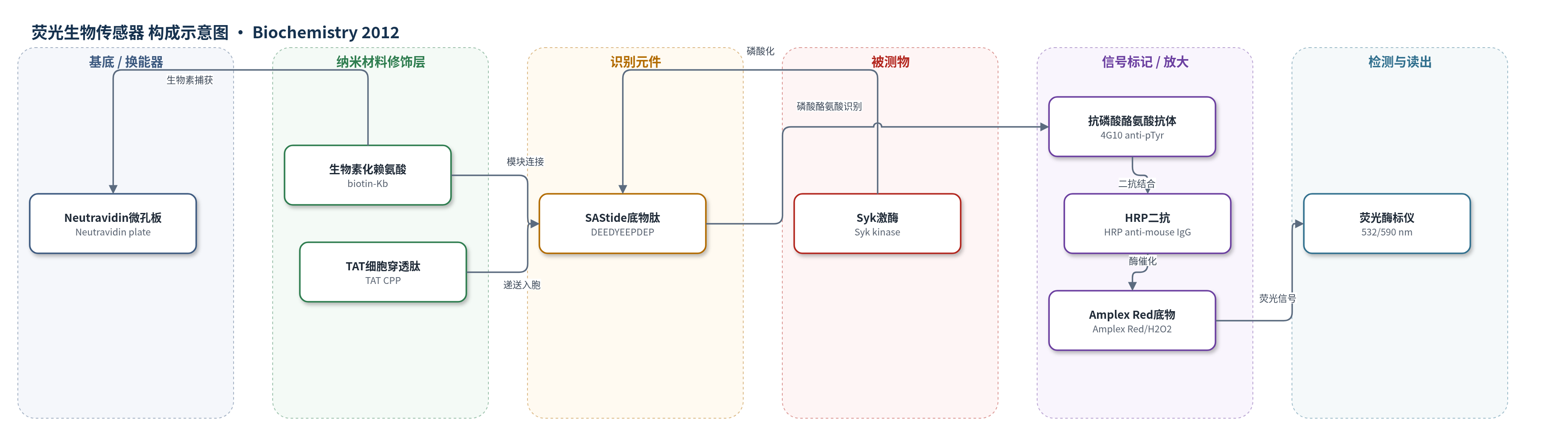
点击图片查看大图 · 依据论文自动绘制
传感器类型
荧光生物传感器
检测对象
Syk 激酶活性/抑制(spleen tyrosine kinase, Syk activity/inhibition);样品基质:活细胞裂解液(DG75、DT40 及小鼠脾脏原代 B 细胞)
检测原理
SAStide 经 TAT 细胞穿透肽进入活细胞后,其底物序列中的酪氨酸在 BCR 交联或 H2O2 氧化应激激活的 Syk 催化下被磷酸化;Syk 抑制剂会降低该磷酸化水平。裂解细胞后,生物素化 SAStide 被 Neutravidin 微孔板捕获,抗磷酸酪氨酸抗体 4G10 识别磷酸化位点,HRP 标记二抗结合后,Amplex Red 与 H2O2 在 HRP 催化下生成荧光产物。荧光强度与磷酸化 SAStide 量成正比,从而反映细胞内 Syk 催化活性或抑制程度。
检测灵敏度
线性范围: 至 0.5 pmol/孔(标准曲线)
效应效果
该 SAStide 在 25 μM 下无细胞毒性,可在 DG75、DT40 及小鼠脾脏原代 B 细胞中检测 Syk 活性。BCR 刺激和 H2O2 均引起剂量依赖的磷酸化增加;时间曲线显示 BCR 刺激后快速升高并维持,H2O2 单独处理 5 min 达峰。Syk 缺陷 DT40 中无显著磷酸化,Syk-EGFP 回补后 BCR 刺激约 2 倍、H2O2 处理约 12 倍,证明特异性。dasatinib 与 piceatannol 的表观 IC50 分别为 10.8 ± 9.3 nM 和 1.2 ± 1.5 μM;原代 B 细胞中抑制剂使信号降至背景。方法兼容多板 ELISA,可用于药效学监测。
传感器的构成
- 肽底物/识别元件:SAStide(DEEDYEEPDEP),含 Syk 底物基序与酪氨酸,被 Syk 磷酸化
- 细胞递送模块:TAT 细胞穿透肽,介导 SAStide 进入活细胞
- 亲和捕获模块:生物素化赖氨酸(biotin-Kb),用于 Neutravidin 微孔板捕获
- 光裂解连接子:photocleavable linker,用于释放底物以便质谱分析
- 固相捕获基底:Neutravidin 包被 96 孔板,结合生物素化 SAStide
- 磷酸化识别抗体:抗磷酸酪氨酸单克隆抗体 4G10,识别磷酸化 SAStide
- 信号标记抗体:HRP 标记山羊抗小鼠 IgG 二抗,放大磷酸化信号
- 荧光底物:Amplex Red 与 H2O2,HRP 催化生成荧光产物
中文摘要
脾脏酪氨酸激酶(Syk)与癌症、类风湿关节炎等多种疾病相关,但其复杂自磷酸化、支架蛋白及底物磷酸化使其功能难以明确。为直接检测完整细胞内 Syk 的催化活性与抑制,作者开发了一种 Syk 特异性人工肽生物传感器 SAStide。该肽由 Syk 底物偏好基序衍生序列与细胞穿透肽组成,可在活细胞内以 Syk 依赖方式被磷酸化,从而作为 Syk 催化活性的报告分子。该检测法与活的原代细胞兼容,可报告药物对靶点的药效学变化,有助于理解 Syk 在疾病中的作用及其抑制效果。
英文摘要
Spleen tyrosine kinase (Syk) has been implicated in a number of pathologies including cancer and rheumatoid arthritis and thus has been pursued as a novel therapeutic target. Because of the complex relationship between Syk's auto- and other internal phosphorylation sites, scaffolding proteins, enzymatic activation state and sites of phosphorylation on its known substrates, the role of Syk's activity in these diseases has not been completely clear. To approach such analyses, we developed a Syk-specific artificial peptide biosensor (SAStide) to use in a cell-based assay for direct detection of intracellular Syk activity and inhibition in response to physiologically relevant stimuli in both laboratory cell lines and primary splenic B cells. This peptide contains a sequence derived from known Syk substrate preference motifs linked to a cell permeable peptide, resulting in a biosensor that is phosphorylated in live cells in a Syk-dependent manner, thus serving as a reporter of Syk catalytic activity in intact cells. Because the assay is compatible with live, primary cells and can report pharmacodynamics for drug action on an intended target, this methodology could be used to facilitate a better understanding of Syk's function and the effect of its inhibition in disease.