组成图示
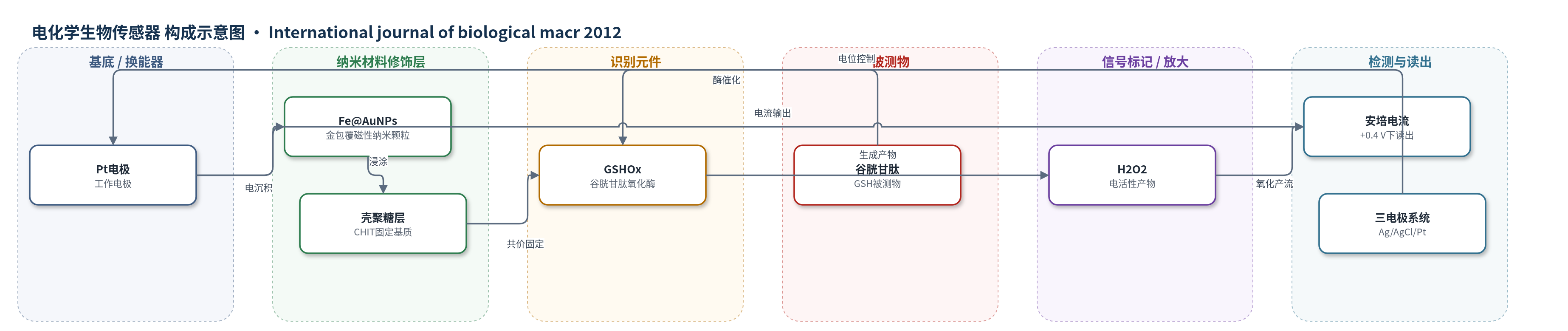
点击图片查看大图 · 依据论文自动绘制
传感器类型
电化学生物传感器
检测对象
谷胱甘肽(glutathione, GSH);样品基质:人红细胞裂解液/血液红细胞(hemolysated erythrocytes, blood RBCs)
检测原理
该传感器以 GSHOx 为识别元件,GSH 进入电极表面后在 GSHOx 催化下发生氧化反应,生成 GSSG 和 H2O2。H2O2 在 +0.4 V 工作电位下于 Pt 电极表面发生电化学氧化,释放电子形成安培电流。Fe@AuNPs 修饰层增大电极电活性面积并改善电子传递,CHIT 通过戊二醛共价固定 GSHOx,提高酶负载量与界面稳定性。因此,电流响应随 GSH 浓度增加而增大,在 5.0–4000 μmol L−1 范围内呈线性。
检测灵敏度
LOD: 0.1 μmol L−1;线性范围: 5.0–4000 μmol L−1;灵敏度: 0.48 mA/μmol L−1;LOQ: 0.303 μmol L−1
效应效果
该传感器响应时间为 4 s,在 +0.4 V、pH 7.0、25 ℃ 下表现最佳。对甲硫氨酸、半胱氨酸、谷氨酸、EDTA、抗坏血酸、尿酸和甘氨酸的干扰分别仅为 7.23%、5.0%、6.4%、9.2%、12.5%、7.5% 和 5.6%。红细胞裂解液加标回收率为 97.5±1.7%(50 μmol L−1)和 96.1±1.3%(100 μmol L−1),批内和批间 CV 分别为 2.14% 和 2.39%。4 ℃ 保存 4 个月、使用 150 次后活性损失 50%,优于此前 2–3 个月的报道。健康人红细胞 GSH 为 2.8 mmol L−1,处于 1–3 mmol L−1 正常范围,作者认为其可用于临床氧化应激相关检测。
传感器的构成
- 基底/换能器电极:Pt 电极(Pt wire),作为工作电极,提供电子传导与安培信号读出。
- 纳米材料修饰层:Fe@AuNPs(金包覆磁性纳米颗粒,Fe3O4@Au),通过循环伏安法电沉积,增大电活性面积并改善导电性。
- 聚合物固定层:chitosan(CHIT),浸涂于 Fe@Au/Pt 表面,提供氨基并作为酶固定基质。
- 交联固定剂:glutaraldehyde(GA),与 CHIT 氨基及 GSHOx 表面氨基反应,实现 GSHOx 共价固定。
- 识别元件:glutathione oxidase(GSHOx),特异性催化 GSH 氧化,产生电活性信号产物。
- 信号标记物:无外加标记物;以 GSHOx 催化 GSH 氧化产生的 H2O2 作为电活性信号。
中文摘要
本文报道了一种用于测定谷胱甘肽(GSH)的安培生物传感器。将谷胱甘肽氧化酶(GSHOx)共价固定于金包覆磁性纳米颗粒(Fe@AuNPs)修饰的铂(Pt)电极表面,壳聚糖(CHIT)用于在 Fe@AuNPs 表面引入氨基,以提高酶负载量并改善保存稳定性。采用扫描电子显微镜(SEM)、循环伏安法(CV)、傅里叶变换红外光谱(FTIR)和电化学阻抗谱(EIS)对酶电极进行表征。在 +0.4 V、pH 7.0、25 ℃ 下,电极在 4 s 内达到最大响应。电极响应与 GSH 浓度在 5.0–4000 μmol L−1 范围内呈线性关系,检出限为 0.1 μmol L−1。基于该传感器建立了 GSH 安培测定方法。评价表明方法可靠:50 μmol L−1 和 100 μmol L−1 GSH 的平均分析回收率分别为 97.5±1.7% 和 96.1±1.3%,红细胞内 GSH 测定的批内和批间变异系数分别小于 2.14% 和 2.39%。传感器在 4 ℃ 保存、使用 150 次后活性损失 50%,可维持 4 个月。健康人红细胞裂解液中 GSH 浓度为 2.8 mmol L−1。
英文摘要
A method is described for development of an amperometric biosensor for determination of glutathione (GSH), by immobilizing covalently a glutathione oxidase (GSHOx) onto the surface of gold coated magnetic nanoparticles (Fe@AuNPs) modified Pt electrode. Chitosan was used to introduce amino groups onto the surface of Fe@AuNPs. The morphology and covalent linkage of GSHOx led to high enzyme loading and better shelf life. The enzyme electrode was characterized by scanning electron microscopy (SEM), cyclic voltammetry (CV), Fourier transform infrared (FTIR) and electrochemical impedance spectroscopy (EIS). The electrode showed maximum response within 4s, when polarized at +0.4V, pH 7.0 and 25°C. There was a linear relationship between electrode response and glutathione concentrations in the range 5.0-4000 μmol L(-1) with a detection limit of 0.1 μmol L(-1). An amperometric method of GSH determination was developed using this biosensor. The evaluation studies showed that the method was reliable as mean analytic recoveries of 50 μM and 100 μM of GSH were 97.5±1.7 and 96.1±1.3 respectively and within and between CVs for glutathione determination in blood RBCs were <2.14% and <2.39% respectively. The biosensor showed 50% loss in its initial activity after its 150 uses over a period 4 months, when stored at 4°C. GSH concentration in hemolysated erythrocytes as measured by the present biosensor was 2.8 mmol L(-1) in apparently healthy persons.