组成图示
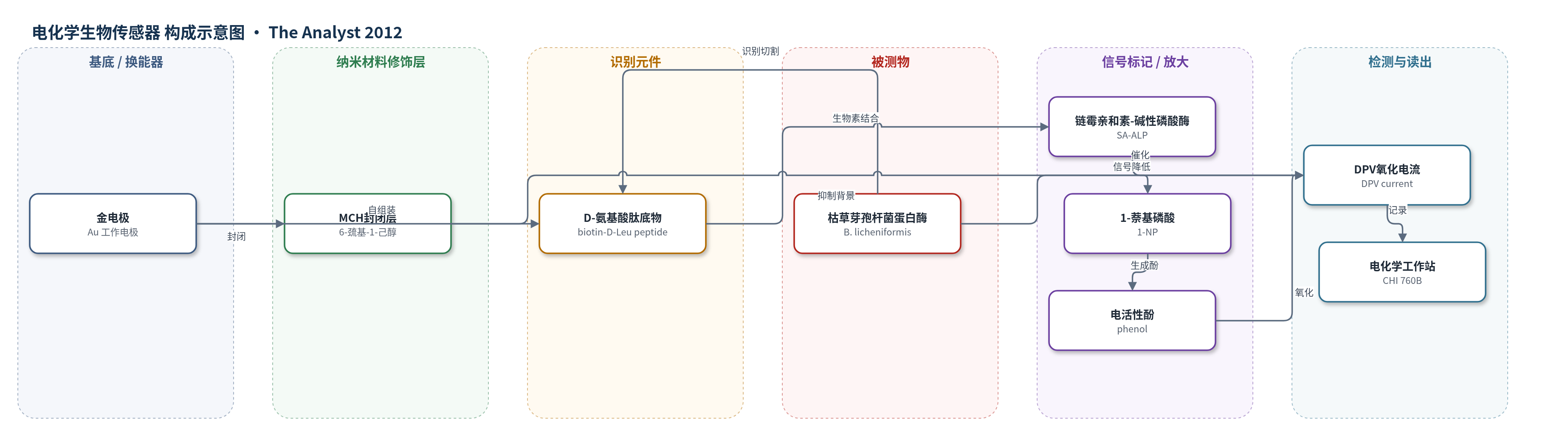
点击图片查看大图 · 依据论文自动绘制
传感器类型
电化学生物传感器
检测对象
枯草芽孢杆菌蛋白酶生物标志物(protease biomarker from Bacillus licheniformis);样品基质为 PBS 蛋白酶样品,选择性测试包括大肠杆菌/根癌农杆菌分泌物、人血清、唾液。
检测原理
含 D-氨基酸的肽底物通过 C 端半胱氨酸与金电极自组装形成单分子层,MCH 封闭未修饰区域。加入枯草芽孢杆菌蛋白酶后,其选择性识别并切割含 D-亮氨酸的肽键,使 N 端生物素从电极表面脱离;未被切割的肽仍保留生物素,可结合 SA-ALP。ALP 催化 1-NP 水解生成电活性酚,酚在 DPV 中发生氧化产生电流。蛋白酶浓度越高,肽被切割越多,电极表面可结合 SA-ALP 的生物素越少,氧化峰电流越低。D-氨基酸结构提高对细菌蛋白酶的种属选择性,ALP 催化转化提供酶促信号放大。
检测灵敏度
LOD: 0.16 mg mL−1;线性范围: 0.7–10 mg mL−1;检测范围: 0.5–100 mg mL−1;R^2 = 0.9954;回归方程: I (mA) = 1.3329 - 0.7062 × log([protease] (mg mL−1))
效应效果
该传感器对枯草芽孢杆菌蛋白酶具有较高选择性。人血清、唾液以及大肠杆菌和根癌农杆菌分泌物等干扰样品的 DPV 信号均接近空白,且明显高于 100 mg/mL 目标蛋白酶对应的低电流信号,表明 D-氨基酸肽底物可有效抵抗常见细菌分泌物和人体体液干扰。溶菌酶和凝血酶等常见动物/人体酶也未能显著切割底物,信号明显高于目标蛋白酶。方法在 0.7–10 mg/mL 范围内呈对数线性关系,R^2=0.9954,检出限 0.16 mg/mL。与荧光、MALDI-TOF-MS 等需酶分离纯化的方法相比,该法无需复杂样品前处理,操作简便、成本低,适合电化学阵列高通量检测细菌种属。
传感器的构成
- 基底/换能器电极:金电极(Au electrode,直径 2.0 mm),作为工作电极承载自组装肽并传导电子。
- 识别/底物层:含 D-氨基酸肽(biotin-ALNNd-Ld-LKNNLAC),C 端 Cys 与 Au 自组装,N 端生物素用于后续结合,被枯草芽孢杆菌蛋白酶选择性切割。
- 封闭层:6-巯基-1-己醇(MCH),封闭金电极未修饰区域,减少非特异吸附。
- 非特异封闭剂:牛血清白蛋白(BSA,1% w/v),封闭非特异位点,降低 SA-ALP 非特异结合。
- 信号标记/放大元件:链霉亲和素-碱性磷酸酶(SA-ALP),结合肽 N 端生物素,ALP 催化底物转化。
- 酶底物/电活性前体:1-萘基磷酸(1-NP,4 mM),电非活性底物,被 ALP 水解为电活性酚。
- 检测介质:100 mM tris-HCl(pH 9.8)、1 mM Mg2+、4 mM 1-NP,提供 ALP 催化和 DPV 氧化环境。
- 读出系统:CHI 760B 电化学工作站,采用差分脉冲伏安法(DPV)记录 0–0.5 V 氧化峰电流。
中文摘要
本文报道了一种用于检测枯草芽孢杆菌(Bacillus licheniformis)蛋白酶生物标志物的简单、高选择性和高灵敏电化学生物传感器。枯草芽孢杆菌是炭疽芽孢杆菌这一生化战剂的模型菌。传感器以含 D-氨基酸的底物肽为核心识别元件,通过 C 端半胱氨酸与金电极自组装固定,N 端标记生物素。链霉亲和素偶联碱性磷酸酶(SA-ALP)特异性结合完整肽上的生物素,并催化电非活性 1-萘基磷酸(1-NP)转化为电活性酚,从而产生可被差分脉冲伏安法(DPV)检测的氧化电流。当样品中存在枯草芽孢杆菌蛋白酶时,肽底物被选择性切割,生物素从电极表面脱离,导致电化学信号下降,信号降低程度与蛋白酶浓度相关。引入 D-氨基酸赋予传感器高种属选择性,并避免酶分离纯化步骤。优化条件下,该方法可在 0.5–100 mg/mL 范围内定量蛋白酶,检出限为 0.16 mg/mL。
英文摘要
A simple, selective and sensitive electrochemical biosensor has been developed to detect protease biomarker from Bacillus licheniformis, a recognized model of the biochemical warfare agent Bacillus anthracis. In this assay, the biosensor is constructed using a d-amine acid containing substrate peptide via self-assembly of cysteine residual at the C-terminal. A biotin modifier is labelled at the N-terminal of the substrate peptide. This enables sensitive electrochemical detection of the intact substrate peptide using a streptavidin-conjugated alkaline phosphatase, which catalyzes the conversion of electrochemically inactive 1-naphthyl phosphate into electrochemically active phenol. In the presence of the protease biomarker, the peptide is cleaved, and the biotin moiety is removed away from the electrode surface, which results in a decreased electrochemical signal corresponding to the concentration of the protease biomarker. This electrochemical biosensor is simple, sensitive and cost effective. The introduction of d-amino acids into the peptide substrate enables high species selectivity and eliminates the steps for enzyme isolation and purification. Under optimized conditions, the protease can be determined in the concentration range from 0.5 to 100 μg mL(-1) with a detection limit to 0.16 μg mL(-1).