组成图示
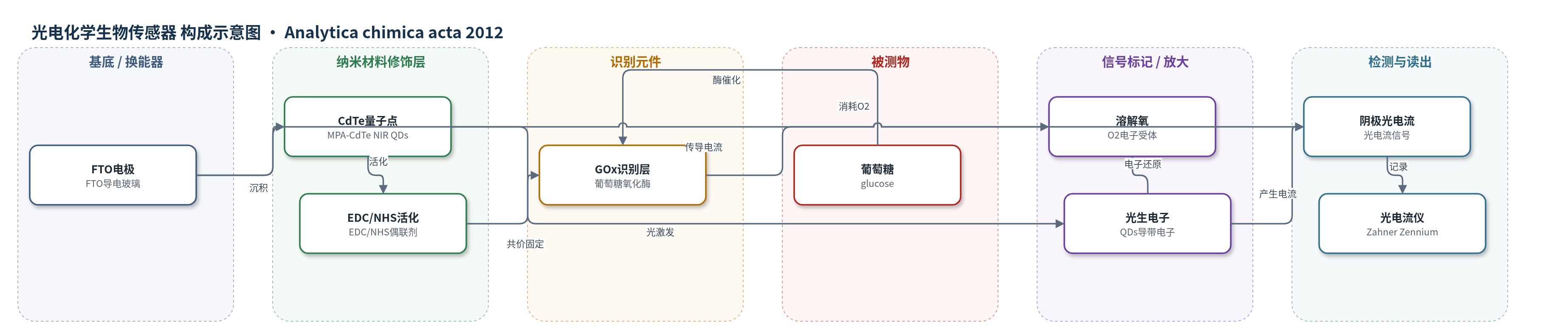
点击图片查看大图 · 依据论文自动绘制
传感器类型
光电化学生物传感器
检测对象
葡萄糖(glucose);样品基质:5%葡萄糖注射液(含氯化钠)、0.1 M Tris–HCl缓冲液
检测原理
在505 nm可见光激发下,CdTe QDs发生带间跃迁,产生导带电子和价带空穴。在-0.2 V vs. SCE负偏压下,导带电子转移给溶液中的溶解氧(O2)并将其还原,价带空穴由FTO电极补充电子,从而形成阴极光电流。GOx催化葡萄糖氧化:glucose + O2 → gluconolactone + H2O2,反应消耗O2。由于O2是比H2O2更有效的电子受体,葡萄糖浓度升高使局部O2减少,光电流随之下降。该策略以酶促氧消耗调制光电化学信号,无需额外标记或核酸放大,实现葡萄糖的负响应检测。
检测灵敏度
LOD: 0.04 mM (S/N = 3);线性范围: 0.1–11 mM
效应效果
该传感器上限11 mM,高于GOx/AuNP/ITO的4.8 mM和石墨纳米片-Nafion的1.4 mM;LOD 0.04 mM低于石墨烯-CdS的0.7 mM,线性范围宽于MIP胶束0.2–8 mM和QD FRET 0.1–2.0 mM。尿酸、抗坏血酸增强光电流,NaCl 100倍无干扰。5%葡萄糖注射液100倍稀释测得2.51±0.08和2.48±0.08 mM,回收率96.4%、96.0%;加标2.5 mM回收率>96.0%。5电极斜率RSD 5.1%,0.1/9 mM RSD 3.8%/5.4%;4周保留92.3%。作者认为适合血糖监测并拓展NIR QDs应用。
传感器的构成
- 基底/换能器电极:掺氟氧化锡(FTO)导电玻璃,作为工作电极并传导光电流
- 纳米材料修饰层:3-巯基丙酸(MPA)修饰的CdTe近红外量子点(NIR CdTe QDs),505 nm激发产生光生电子-空穴对
- 偶联活化层:1-乙基-3-(3-二甲基氨基丙基)碳二亚胺(EDC)和N-羟基琥珀酰亚胺(NHS),活化QDs表面羧基以共价固定GOx
- 识别元件:葡萄糖氧化酶(GOx),催化葡萄糖氧化并消耗溶解氧
- 电子受体:溶解氧(O2),接受QDs导带电子,其浓度决定阴极光电流强度
- 检测介质:0.1 M Tris–HCl缓冲液(pH 7.0),提供离子强度和酶反应环境
中文摘要
本文报道了一种基于氧敏感近红外量子点(NIR QDs)的可见光诱导光电化学生物传感平台,用于葡萄糖检测。NIR CdTe 量子点在水相中合成,以3-巯基丙酸(MPA)为稳定剂,并通过扫描电镜和X射线光电子能谱表征。将CdTe QDs修饰在掺氟氧化锡(FTO)电极上,在505 nm可见光激发下,QDs产生光生电子-空穴对;负偏压时导带电子还原溶解氧,价带空穴由电极补充电子,形成阴极光电流。实验证实光电流随溶解氧降低而受抑制。将葡萄糖氧化酶(GOx)经EDC/NHS共价固定于CdTe QDs表面,GOx催化葡萄糖氧化并消耗O2,使光电流随葡萄糖浓度增加而下降。在505 nm光照下,方法对葡萄糖的线性范围为0.1–11 mM,检出限为0.04 mM,具有较高上限、可接受的稳定性和准确性,为生物分子监测和近红外QDs应用提供了新途径。
英文摘要
A visible light induced photoelectrochemical biosensing platform based on oxygen-sensitive near-infrared quantum dots (NIR QDs) was developed for detection of glucose. The NIR QDs were synthesized in an aqueous solution, and characterized with scanning electron microscopy and X-ray photoelectron spectroscopy. The as-prepared NIR QDs were employed to construct oxygen-sensitive photoelectrochemical biosensor on a fluorine-doped tin oxide (FTO) electrode. The oxygen dependency of the photocurrent was investigated at as-prepared electrode, which demonstrated the signal of photocurrent is suppressed with the decreasing of oxygen. Coupling with the consumption of oxygen during enzymatic reaction, a photoelectrochemical strategy was proposed for the detection of substrate. Using glucose oxidase (GOx) as a model enzyme, that is, GOx was covalently attached to the surface of CdTe QDs, the resulting biosensor showed the sensitive response to glucose. Under the irradiation of visible light of a wavelength at 505 nm, the proposed photoelectrochemical method could detect glucose ranging from 0.1 mM to 11 mM with a detection limit of 0.04 mM. The photoelectrochemical biosensor showed a good performance with high upper detection limit, acceptable stability and accuracy, providing an alternative method for monitoring biomolecules and extending the application of near-infrared QDs.