组成图示
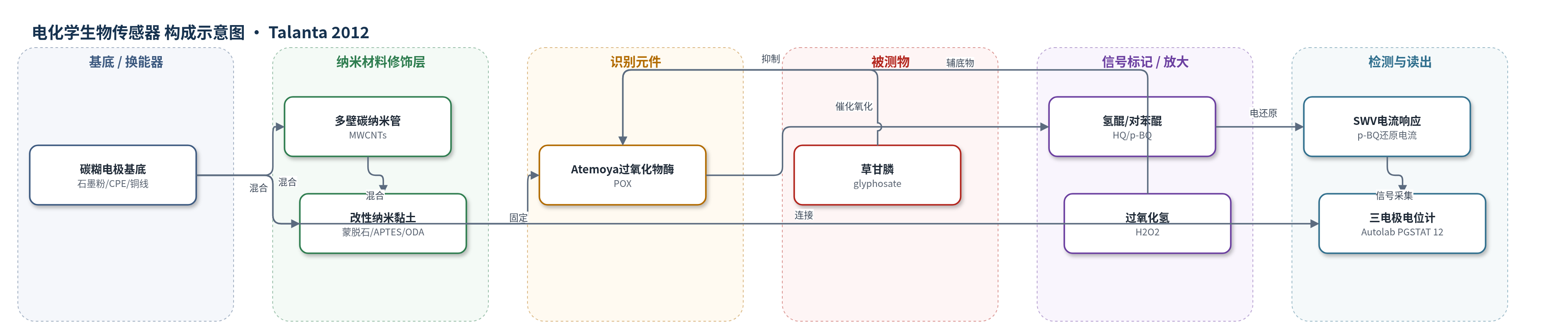
点击图片查看大图 · 依据论文自动绘制
传感器类型
电化学生物传感器
检测对象
草甘膦(glyphosate);样品基质:天然水样/加标水样(Monjolo Stream 水样)
检测原理
该传感器采用酶抑制法。Atemoya 过氧化物酶(POX)固定在改性纳米黏土上,在 H2O2 存在下催化氢醌(HQ)氧化为对苯醌(p-BQ);p-BQ 在约 -0.1 V 处发生电化学还原,产生与 HQ 浓度成正比的阴极电流 I0。草甘膦进入体系后,其氨基与 POX 催化中间体 Compound I 或羰基氧配位,形成酶-草甘膦复合物,抑制 POX 的氧化还原催化循环,使 p-BQ 生成减少,还原电流 I 下降。以抑制率 IR%=(I0-I)/I0×100 表征草甘膦浓度,电流下降越大表示草甘膦浓度越高。方法无需额外信号放大,依靠酶催化和碳纳米管促进电子转移提高响应。
检测灵敏度
LOD: 30 mg L-1;线性范围: 0.10–4.55 mg L-1;斜率: 30.83801 ± 0.28615(IR 对 log 浓度);r = 0.9955;QL: 90 mg L-1
效应效果
在优化条件下,传感器重复性 RSD 为 5.5%(同一传感器 8 次测量),重现性 RSD 为 8.7%(4 个独立制备传感器)。室温干存 8 周,电流响应保持在统计控制限内。天然水样加标 0.20、1.00、1.75 mg/L 时,生物传感器回收率为 108.9%、96.9%、94.9%,平均 94.9%–108.9%;离子交换色谱(IEC)回收率为 79.6%、79.5%,且 0.20 mg/L 未检出。生物传感器检出限 30 mg/L、定量限 90 mg/L,低于巴西 ANVISA 饮用水草甘膦限值 500 mg/L,且成本较低、操作简便,适合水样草甘膦筛查。
传感器的构成
- 基底/换能器电极:石墨粉(graphite powder)碳糊电极(CPE),内装于 1.0 mm 塑料注射器,铜线作外电接触。
- 导电修饰层:多壁碳纳米管(multiwalled carbon nanotubes, MWCNTs),提高导电性、电子转移和电化学可及面积。
- 酶固定化载体:改性纳米黏土(modified nanoclay, NC),蒙脱石(montmorillonite)含氨基丙基三乙氧基硅烷(aminopropyltriethoxysilane, APTES)和十八烷基胺(octadecylamine, ODA),增加孔隙与表面积并固定酶。
- 生物识别/催化元件:Atemoya 过氧化物酶(atemoya peroxidase, POX),来自 Atemoya 粗提物,催化氢醌氧化。
- 信号底物:氢醌(hydroquinone, HQ),被 POX/H2O2 氧化为对苯醌(p-benzoquinone, p-BQ),在电极还原产生电流。
- 酶辅底物:过氧化氢(H2O2),参与 POX 催化循环并氧化 HQ。
- 碳糊粘结剂:矿物油(mineral oil),使碳糊均匀并固定电极材料。
- 信号读出:方波伏安(square-wave voltammetry, SWV)三电极体系,铂辅助电极、Ag/AgCl 参比电极,Autolab PGSTAT 12 记录电流。
中文摘要
本文报道了一种基于固定在改性纳米黏土上的 Atemoya 过氧化物酶的电化学生物传感器,用于通过酶抑制法检测草甘膦。传感器以石墨粉碳糊电极为基底,掺入多壁碳纳米管、负载 Atemoya 过氧化物酶的改性蒙脱石纳米黏土和矿物油,采用方波伏安法进行优化与检测。草甘膦抑制过氧化物酶活性,使氢醌在过氧化氢存在下被催化氧化为对苯醌的电流响应降低。最佳条件为 0.1 mol/L 磷酸盐缓冲液(pH 7.0)、1.9×10^-4 mol/L 过氧化氢、30 Hz、50 mV 脉冲幅度和 4 mV 扫描增量。草甘膦在 0.10–4.55 mg/L 范围内线性,检出限 30 mg/L,加标水样平均回收率 94.9%–108.9%,传感器室温保存 8 周仍稳定。
英文摘要
A biosensor based on atemoya peroxidase immobilised on modified nanoclay was developed for the determination of glyphosate by the enzyme inhibition method. The inhibitor effect of the biocide results in a decrease in the current response of the hydroquinone that was used as a phenolic substrate to obtain the base signal. The biosensor was constructed using graphite powder, multiwalled carbon nanotubes, peroxidase immobilised on nanoclay and mineral oil. Square-wave voltammetry was utilised for the optimisation and application of the biosensor, and several parameters were investigated to determine the optimum experimental conditions. The best performance was obtained using a 0.1 mol L(-1) phosphate buffer solution (pH 7.0), 1.9×10(-4) mol L(-1) hydrogen peroxide, a frequency of 30 Hz, a pulse amplitude of 50 mV and a scan increment of 4 mV. The glyphosate concentration response was linear between 0.10 and 4.55 mg L(-1) with a detection limit of 30 μg L(-1). The average recovery of glyphosate from spiked water samples ranged from 94.9 to 108.9%. The biosensor remained stable for a period of eight weeks.