组成图示
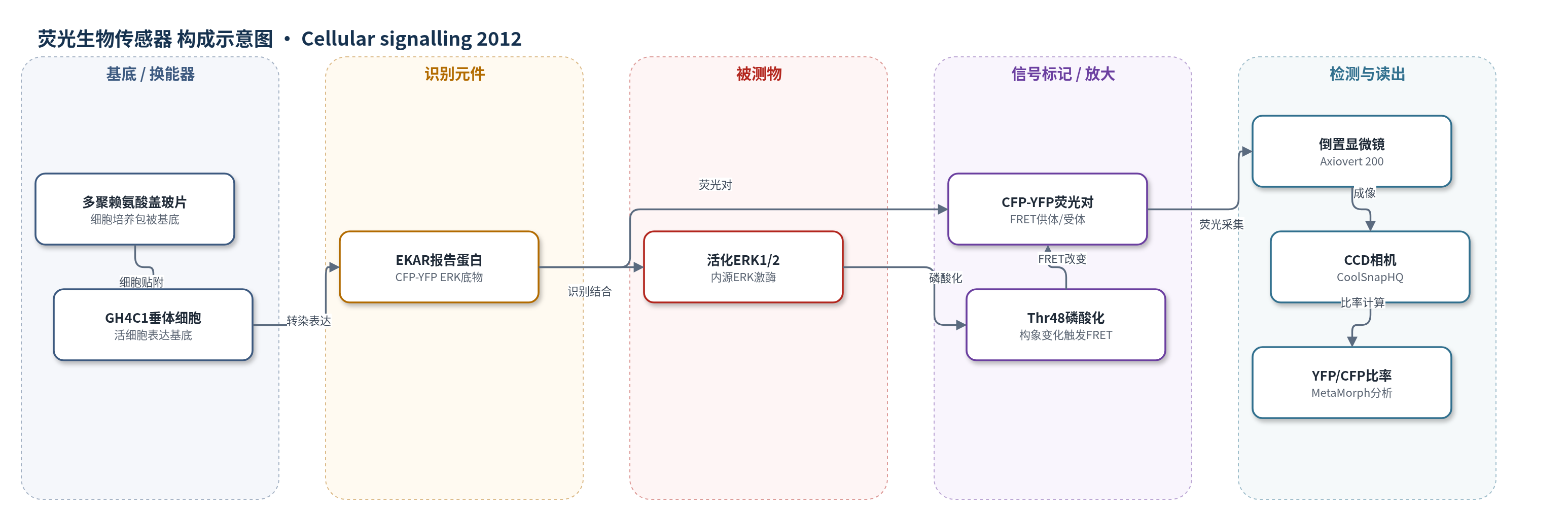
点击图片查看大图 · 依据论文自动绘制
传感器类型
荧光生物传感器
检测对象
活化细胞外调节激酶(activated ERK1/2 activity,P-ERK1/2);样品基质:垂体GH4C1活细胞(细胞质/细胞核区室),并用细胞裂解液验证。
检测原理
EGF 或 VIP 结合垂体 GH4C1 细胞表面受体后,经 Ras/Rap1–Raf–MEK–ERK 级联激活内源 ERK1/2。活细胞中表达的 EKAR 报告蛋白含有 ERK 磷酸化底物序列(cdc25 Thr48 位点),活化 ERK1/2 识别并磷酸化该位点。磷酸化引起 EKAR 构象改变,使 CFP 与 YFP 之间的 FRET 效率发生变化,表现为 YFP/CFP 发射比升高或降低。通过比率法以初始比值 R0 归一化,ΔR/R0 随 ERK 活性及刺激物浓度增加而增大;MEK 抑制剂 U0126 阻断级联后 FRET 信号回落。该传感器无需外源标记,利用 FRET 比率成像实现单细胞、实时、可逆地报告细胞质或细胞核区室 ERK 活性。
检测灵敏度
原文未报告LOD、线性范围、灵敏度斜率或相关系数。
效应效果
传感器在 GH4C1 细胞中的表达效率为 45±5%(EKARcyto)、47±4%(EKARnuc)和 46±6%(YFP-ERK);单细胞 FRET 记录每条件至少 30 个细胞,结果以均值±SEM 表示。1 nM EGF 和 0.1 μM VIP 分别产生最大 ΔR/R0,EGF 响应持续时间更长,VIP 下细胞质失活快于细胞核。U0126 处理后 FRET 信号回落,预抑制可完全消除 EGF 诱导响应;cAMP 和 EGF 不激活 P38/JNK,显示对 ERK 的选择性。FRET 信号与 P-EKAR、P-ERK1/2 免疫印迹一致。RasN17 使 EGF 细胞质 Tmax 从 3.57±0.25 min 增至 5.02±0.25 min,VIP 下 RasN17 使 FRET 幅度降低约 50%。作者认为该 FRET 传感器可实时解析垂体细胞 ERK 时空动态。
传感器的构成
- 培养基底:多聚赖氨酸包被盖玻片/六孔板,提供细胞贴附与成像平面
- 细胞载体:垂体GH4C1细胞,表达EKAR并维持垂体分泌表型
- 换能器/荧光对:CFP-YFP FRET对(EKAR内CFP供体与YFP受体),将ERK磷酸化事件转换为比率荧光信号
- 识别元件:ERK活性报告序列EKAR(含cdc25 Thr48磷酸化位点),被内源ERK1/2识别并磷酸化
- 定位元件:细胞质定位序列EKARcyto或核定位序列EKARnuc,将传感器分别限制在细胞质或细胞核
- 读出装置:倒置显微镜Axiovert 200、冷却CCD相机CoolSnapHQ与MetaMorph软件,采集CFP/YFP发射并计算YFP/CFP比率
中文摘要
Ras/Raf/MEK/ERK 是保守信号通路,ERK1/2 是垂体功能受多种胞外信号调控的整合点。作者此前发现 GTP 酶 Ras 和 Rap1 在 EGF 或 cAMP 依赖性神经肽 VIP 调控 ERK1/2 依赖的催乳素转录中起关键作用。本研究在垂体 GH4C1 细胞系中使用基于 FRET 的 ERK 活性生物传感器 EKAR,显示 EGF 和 VIP 以不同幅度和持续时间紧密控制活化 ERK 的时空动态。研究首次证明 Ras 和 Rap1 对细胞质与细胞核内活化 ERK 池存在差异调控:Ras 对 EGF 依赖的核 ERK 激活幅度和持续时间必需,并对 VIP 激活的细胞质和核 ERK 池均必需;Rap1 仅参与 VIP 激活的核 ERK 池。与 GTP 酶控制核 ERK 池一致,EGF 或 VIP 触发的 ERK 核转位也受 Ras 和 Rap1 差异调控。这些结果表明 Ras 和 Rap1 是塑造 EGF 和 VIP 响应中核与细胞质 ERK 动力学的决定因素,进而影响垂体分泌。
英文摘要
The Ras/Raf/MEK/ERK is a conserved signalling pathway involved in the control of fundamental cellular processes. Despite extensive research, how this pathway can process a myriad of diverse extracellular inputs into substrate specificity to determine biological outcomes is not fully understood. It has been established that the ERK1/2 pathway is an integrative point in the control of the pituitary function exerted by various extracellular signals. In addition we previously established that the GTPases Ras and Rap1 play a key role in the regulation of ERK1/2-dependent prolactin transcription by EGF or the cAMP-dependent neuropeptide VIP. In this report, using the FRET-based biosensor of ERK activity (EKAR) in the pituitary GH4C1 cell line, we show that both EGF and VIP tightly control the spatiotemporal dynamic of activated ERK with different magnitude and duration. Importantly, we provide the first evidence of a differential control of cytoplasmic and nuclear pools of activated ERK by the GTPases Ras and Rap1. Ras is required for nuclear magnitude and duration of EGF-dependent ERK activation, whereas it is required for both VIP-activated cytoplasmic and nuclear ERK pools. Rap1 is exclusively involved in VIP-activated ERK nuclear pool. Moreover, consistent with the control of the nuclear pool of activated ERK by the GTPases, we observe the same differential role of Ras and Rap1 on ERK nuclear translocation triggered by EGF or VIP. Together these findings identify Ras and Rap1 as determinant partners in shaping nuclear and cytoplasmic ERK kinetics in response to EGF and VIP, which in turn should control pituitary secretion.