组成图示
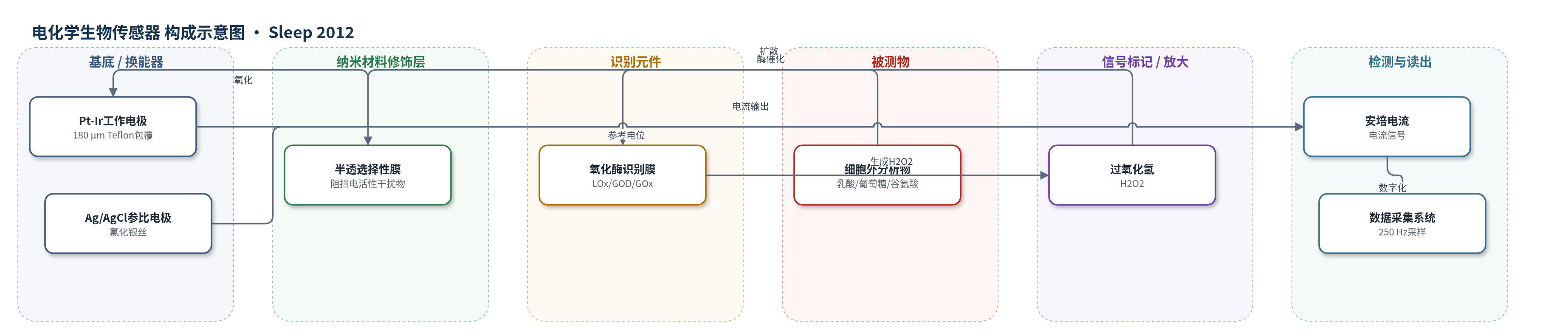
点击图片查看大图 · 依据论文自动绘制
传感器类型
电化学生物传感器
检测对象
乳酸(L-lactate)、葡萄糖(D-glucose)、谷氨酸(L-glutamate);样品基质:小鼠额叶皮层细胞外液(脑细胞外液)
检测原理
该传感器为酶-安培型电化学传感器。工作电极表面依次包覆半透选择性膜和含氧化酶的传感膜。细胞外乳酸、葡萄糖或谷氨酸扩散进入传感膜后,分别被乳酸氧化酶、葡萄糖氧化酶或谷氨酸氧化酶催化氧化,同时生成过氧化氢(H2O2)。H2O2穿过选择性膜到达Pt-Ir工作电极,在固定电位下发生氧化反应,产生与H2O2浓度成正比的安培电流。由于酶反应速率受底物浓度限制,电流变化可反映细胞外分析物浓度的秒级变化。选择性膜阻挡多巴胺、去甲肾上腺素、5-羟色胺、抗坏血酸等电活性干扰物,提高选择性。
检测灵敏度
R^2 = 0.989, P < 0.001(乳酸觉醒期);R^2 = 0.986, P < 0.001(乳酸睡眠期);R^2 = 0.939, P < 0.001(谷氨酸觉醒期)
效应效果
传感器选择性经空传感器和体外干扰试验验证:无氧化酶时电流无显著变化;乳酸、谷氨酸、葡萄糖传感器对去甲肾上腺素、5-羟色胺、多巴胺、抗坏血酸等干扰物无明显响应。体内记录稳定,漂移经一阶指数校正后峰谷变化无显著改变(P=0.77)。乳酸在觉醒后51±9 s内显著升高,谷氨酸需284±66 s;觉醒期乳酸持续高于基线5个标准差以上。6 h睡眠剥夺期间乳酸初始升高速率15.6±4.4 µM/min,30 min变化196±60 µM,高于自发清醒144±33 µM(P=0.22)。作者认为乳酸可独立于EEG快速判断睡眠/觉醒,适用于大规模睡眠表型筛选。
传感器的构成
- 工作电极:Teflon包覆Pt-Ir丝(180 µm),暴露1 mm传感腔,用于安培检测H2O2氧化电流
- 选择性膜:半透膜,允许H2O2扩散并阻挡脑内电活性干扰物
- 识别/传感膜:乳酸氧化酶(LOx, E.C.1.1.3.15)、葡萄糖氧化酶(GOD, E.C.1.1.3.4)或谷氨酸氧化酶(GOx),催化对应分析物生成H2O2
- 参比电极:同心缠绕银丝并氯化(0.3 M FeCl3/0.1 M HCl),形成Ag/AgCl参比电极,提供稳定电位
- 信号换能:H2O2在工作电极氧化产生电流,电流变化反映细胞外分析物浓度变化
中文摘要
本研究旨在寻找理想的睡眠生物标志物,其应在入睡时快速变化、睡眠期间维持可检测差异,并在觉醒时快速变化。作者采用安培生物传感器技术,结合脑电图(EEG)和肌电图(EMG)监测,在12只C57Bl/6J雄性小鼠额叶皮层中同步记录细胞外乳酸与葡萄糖(队列1)或乳酸与谷氨酸(队列2)的浓度变化,覆盖多个自然睡眠/觉醒周期及6小时睡眠剥夺。结果显示,觉醒和快速眼动(REM)睡眠时皮层乳酸浓度迅速且持续升高,约15 µM/min,并在持续清醒期间维持高水平;非快速眼动(NREM)睡眠时乳酸持续下降。谷氨酸变化趋势类似,但升降速率明显更慢,约0.03 µM/min。葡萄糖变化与睡眠或觉醒无明确相关。结论认为细胞外乳酸是可靠的睡眠/觉醒代谢生物标志物,可独立于EEG信号用于睡眠状态判断。
英文摘要
STUDY OBJECTIVES: An ideal biomarker for sleep should change rapidly with sleep onset, remain at a detectably differential level throughout the sleep period, and exhibit a rapid change with waking. Currently, no molecular marker has been identified that exhibits all three properties. This study examined three substances (lactate, glucose, and glutamate) for suitability as a sleep biomarker.
DESIGN: Using amperometric biosensor technology in conjunction with electroencephalograph (EEG) and electromyograph (EMG) monitoring, extracellular concentrations of lactate and glucose (Cohort 1) as well as lactate and glutamate (Cohort 2) were recorded over multiple sleep/wake cycles.
PATIENTS OR PARTICIPANTS: There were 12 C57Bl/6J male mice (3-5 mo old).
INTERVENTIONS: Sleep and waking transitions were identified using EEG recordings. Extracellular concentrations of lactate, glucose, and glutamate were evaluated before and during transition events as well as during extended sleep and during a 6-h sleep deprivation period.
MEASUREMENTS AND RESULTS: Rapid and sustained increases in cortical lactate concentration (approximately 15 μM/min) were immediately observed upon waking and during rapid eye movement sleep. Elevated lactate concentration was also maintained throughout a 6-h period of continuous waking. A persistent and sustained decline in lactate concentration was measured during nonrapid eye movement sleep. Glutamate exhibited similar patterns, but with a much slower rise and decline (approximately 0.03 μM/min). Glucose concentration changes did not demonstrate a clear correlation with either sleep or wake.
CONCLUSIONS: These findings indicate that extracellular lactate concentration is a reliable sleep/wake biomarker and can be used independently of the EEG signal.