组成图示
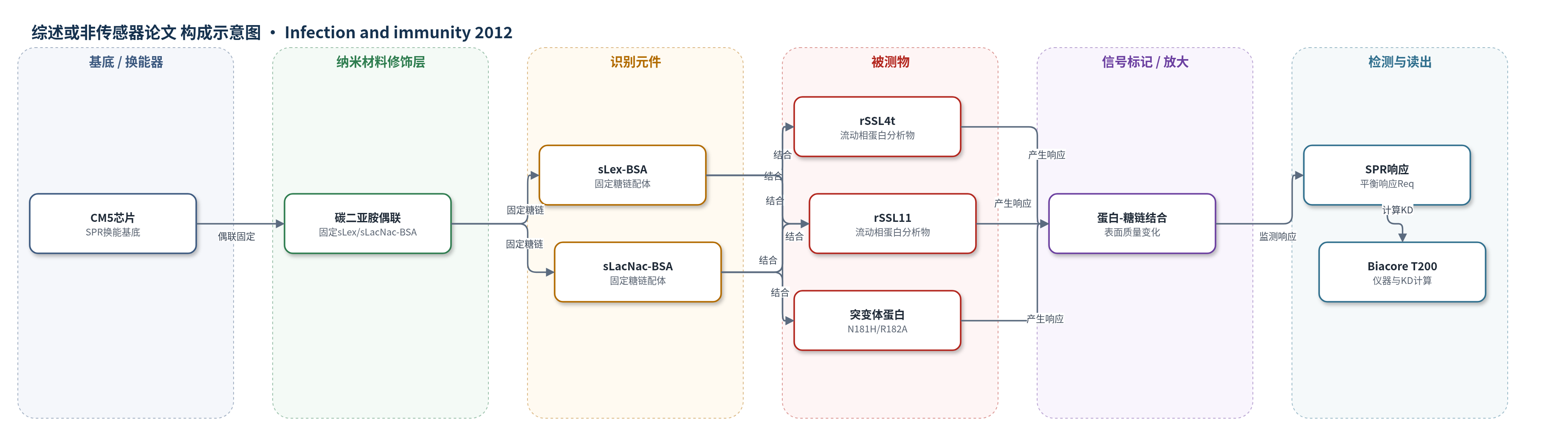
点击图片查看大图 · 依据论文自动绘制
传感器类型
综述或非传感器论文
检测对象
重组葡萄球菌超抗原样蛋白4(rSSL4t)、重组SSL11(rSSL11)及其突变体;固定配体为sLex、sLacNac;样品基质为HBS-EP+缓冲液中的纯化蛋白溶液
检测原理
该研究采用表面等离子共振(SPR)分析SSL4t与糖链的结合。sLex-BSA或sLacNac-BSA通过碳二亚胺化学偶联固定于CM5芯片表面,形成固定配体层。纯化后的rSSL4t、rSSL11或突变体蛋白以HBS-EP+缓冲液作为流动相流过芯片,蛋白与固定糖链发生特异性结合。结合使芯片表面质量增加,改变表面等离子共振条件,产生以响应单位(RU)表示的信号。平衡响应Req随蛋白浓度升高而增大,按单结合位点模型Req/Bmax=[protein]/(KD+[protein])拟合,得到平衡解离常数KD。该过程无酶促或核酸放大,信号直接反映蛋白-糖链结合量。
检测灵敏度
—
效应效果
SPR结果显示,rSSL4t对sLex的KD为87.0±4.5 nM,对sLacNac为471.7±18.7 nM;rSSL11对sLex和sLacNac的KD分别为2.32±0.20 μM和2.43±0.02 μM,说明SSL4t对sLex亲和力更高。N181H突变体对sLex和sLacNac的KD分别为90.8±6.4 nM和119.1±10.3 nM;R182A对sLex无检测结合。FITC-rSSL4t强结合人单核细胞和中性粒细胞,弱结合T细胞,不结合B细胞;神经氨酸酶处理降低结合,R182A无细胞结合。SSL4t可自身竞争,SSL11不能竞争,提示靶标糖蛋白不同。37°C下SSL4t被中性粒细胞和巨噬细胞内化,4°C仅表面结合。
传感器的构成
- 基底/换能器:CM5生物传感器芯片,作为表面等离子共振(SPR)检测基底
- 配体固定层:sLex-BSA或sLacNac-BSA,经碳二亚胺化学偶联固定于芯片表面
- 识别元件:sLex或sLacNac糖链,作为重组SSL4t/SSL11的配体识别元件
- 分析物:rSSL4t、rSSL11及突变体蛋白,作为流动相结合分析物
- 缓冲液:HBS-EP+(HEPES、NaCl、EDTA、P20),维持结合环境并降低非特异吸附
- 读出装置:Biacore T200 SPR仪器,监测平衡响应Req并计算KD
中文摘要
金黄色葡萄球菌是常见且重要的人体病原体,其毒力因子包括14种葡萄球菌超抗原样(SSL)蛋白。SSL4含有与SSL2、SSL3、SSL5、SSL6和SSL11共有的高度保守碳水化合物结合位点。由Newman株SSL4第109至309位氨基酸组成的重组SSL4t能以唾液酸(Sia)依赖方式结合并被人粒细胞和巨噬细胞内化,且可自身竞争细胞结合,表明结合具有靶标特异性。SSL4t与唾液酸Lewis X(sLex)复合物的2.5 Å晶体结构显示其结合位点与SSL5和SSL11相似。结合糖链阵列及sLex、唾液酸乳糖胺(sLacNac)生物传感器分析并与SSL11比较,发现尽管主链原子位置均方根差仅0.34 Å,二者在sLex和sLacNac亲和力及糖链偏好上存在差异。细胞结合数据表明金黄色葡萄球菌通过多种相关蛋白靶向含特定唾液酸乳糖胺的糖蛋白以作用于髓系细胞。
英文摘要
Staphylococcus aureus is a prevalent and significant human pathogen. Among the repertoire of virulence factors produced by this bacterium are the 14 staphylococcal superantigen-like (SSL) proteins. SSL protein 4 (SSL4) is one member of this family and contains a highly conserved carbohydrate binding site also found in SSL2, SSL3, SSL5, SSL6, and SSL11. Recombinant SSL4(t), comprising amino acids 109 to 309 of Newman strain SSL4 (SSL4-Newman), has been shown to bind and be internalized by human granulocytes and macrophages in a sialic-acid (Sia)-dependent manner. SSL4(t) can compete with itself for cell binding, indicating that binding is target specific. A 2.5-Å-resolution crystal structure of SSL4(t) complexed with sialyl Lewis X (sLe(x)) [sLe(x)-Neu5Acα2-3Galβ1-4(Fucα1-3)GlcNAc] revealed a similar binding site to SSL5 and SSL11. These data, along with data on SSL4(t) binding to a glycan array and biosensor analysis of sLe(x) and sialyllactosamine (sLacNac) binding are compared with those for SSL11. Although these proteins show great similarity in their carbohydrate binding sites, with a root mean square (RMS) difference between main chain atom positions of only 0.34 Å, these proteins differ in detail in their affinity for sLe(x) and sLacNac, as well as their glycan preference. Together with cell binding data, this shows how S. aureus produces multiple related proteins that target myeloid cells through specific sialyllactosamine-containing glycoproteins.