组成图示
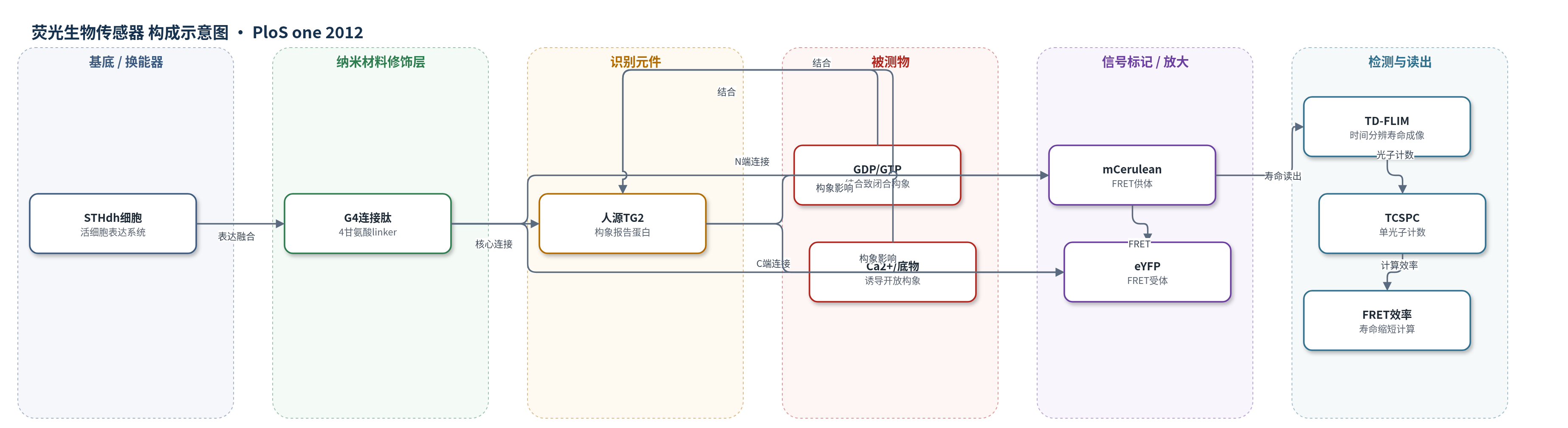
点击图片查看大图 · 依据论文自动绘制
传感器类型
荧光生物传感器
检测对象
TG2构象状态(Transglutaminase type 2 conformational state,闭合/开放);样品基质:活细胞(STHdhQ7/Q7小鼠纹状体细胞)
检测原理
该传感器将mCerulean与人源TG2 N端、eYFP与TG2 C端通过G4连接肽融合为1:1三重蛋白。当TG2结合GDP/GTP时,蛋白呈闭合构象,供体mCerulean与受体eYFP距离缩短,FRET效率升高,mCerulean荧光寿命缩短;当细胞内Ca2+升高、底物或NC9结合时,TG2转向开放构象,荧光蛋白距离增大,FRET效率降低,供体寿命恢复。检测采用TD-FLIM/TCSPC,以飞秒脉冲激光激发mCerulean,采集单光子时间分布,计算平均寿命τ,并按%FRET=1−τ_DA/τ_D定量。构象变化直接转换为寿命变化,无需外源标记或酶放大。
检测灵敏度
未报告LOD、线性范围、灵敏度斜率、R^2。
效应效果
阴性对照(eYFP、mCerulean-TG2及mCerulean-TG2/TG2-eYFP共表达)未引起寿命变化,排除分子间FRET。G4连接肽优化后FRET效率最佳(N=15,6次重复,p<0.001)。R580A突变显著降低FRET效率(N=15,4次重复,p<0.001),W241A基本无影响。42.5°C热激30 min或A23187处理10 min均显著降低FRET效率(N>10,4次重复,p<0.001)。NC9 10 mM 24 h时间曲线显示1 h后显著降低FRET效率;CP4d 500 nM–10 mM呈剂量依赖性升高FRET效率。作者认为其可快速评估应激、钙、突变和抑制剂对TG2构象/定位的影响,并筛选构象调节小分子。
传感器的构成
- 表达基质:STHdhQ7/Q7小鼠纹状体细胞,提供活细胞内表达与成像环境
- 供体荧光蛋白:mCerulean,融合于TG2 N端,作为FRET供体,自然寿命约2.8 ns
- 识别/报告蛋白:人源TG2(transglutaminase type 2),被监测构象变化,可结合GDP/GTP、Ca2+、底物或抑制剂
- 受体荧光蛋白:eYFP,融合于TG2 C端,作为FRET受体,与mCerulean形成1:1融合对
- 连接肽:4个甘氨酸(G4)linker,连接荧光蛋白与TG2,降低空间位阻并优化FRET效率
- 换能/读出系统:TD-FLIM与TCSPC,飞秒脉冲激光激发并测量mCerulean荧光寿命,计算FRET效率
- 阴性对照:eYFP单独、mCerulean-TG2单独及mCerulean-TG2与TG2-eYFP共表达,排除分子间FRET
中文摘要
组织转谷氨酰胺酶2(TG2)是广泛表达的转谷氨酰胺酶家族成员,可介导多种蛋白底物之间的转酰胺化反应,并作为具有GTP酶活性的G蛋白发挥作用。在GDP/GTP结合及细胞内钙水平升高时,TG2可发生显著构象变化,并相互调节其酶活性。本研究构建了一种TG2生物传感器,利用Förster共振能量转移(FRET)结合荧光寿命成像显微镜(FLIM),在活细胞中定量评估TG2构象变化。该传感器通过FRET效率提供稳健检测,可快速测量细胞应激、钙水平变化、点突变和化学抑制剂对TG2构象与定位的影响。作者利用已知TG2构象点突变及升高细胞内钙的细胞应激事件验证传感器,并证明TG2转酰胺化抑制剂可差异化影响酶构象:不可逆抑制剂NC9使TG2呈开放构象,可逆抑制剂CP4d使其保持闭合构象。该传感器为TG2抑制剂机制提供新见解,并有望用于筛选特异性改变TG2构象、影响GDP/GTP或钙结合的小分子。
英文摘要
Transglutaminase type 2 (TG2) is a ubiquitously expressed member of the transglutaminase family, capable of mediating a transamidation reaction between a variety of protein substrates. TG2 also has a unique role as a G-protein with GTPase activity. In response to GDP/GTP binding and increases in intracellular calcium levels, TG2 can undergo a large conformational change that reciprocally modulates the enzymatic activities of TG2. We have generated a TG2 biosensor that allows for quantitative assessment of TG2 conformational changes in live cells using Förster resonance energy transfer (FRET), as measured by fluorescence lifetime imaging microscopy (FLIM). Quantifying FRET efficiency with this biosensor provides a robust assay to quickly measure the effects of cell stress, changes in calcium levels, point mutations and chemical inhibitors on the conformation and localization of TG2 in living cells. The TG2 FRET biosensor was validated using established TG2 conformational point mutants, as well as cell stress events known to elevate intracellular calcium levels. We demonstrate in live cells that inhibitors of TG2 transamidation activity can differentially influence the conformation of the enzyme. The irreversible inhibitor of TG2, NC9, forces the enzyme into an open conformation, whereas the reversible inhibitor CP4d traps TG2 in the closed conformation. Thus, this biosensor provides new mechanistic insights into the action of two TG2 inhibitors and defines two new classes based on ability to alter TG2 conformation in addition to inhibiting transamidation activity. Future applications of this biosensor could be to discover small molecules that specifically alter TG2 conformation to affect GDP/GTP or calcium binding.