组成图示
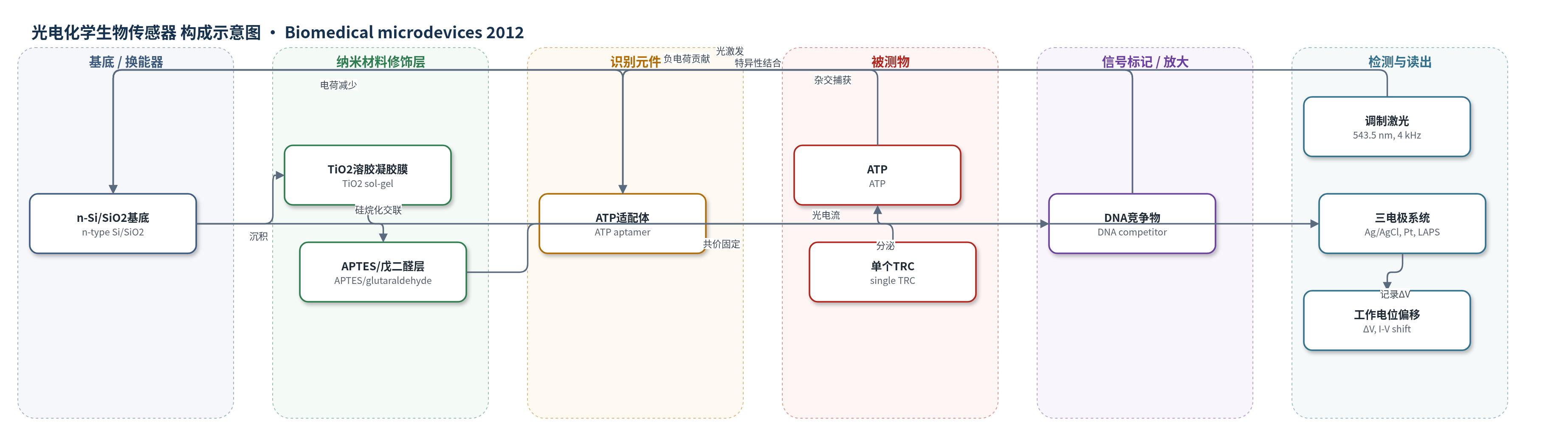
点击图片查看大图 · 依据论文自动绘制
传感器类型
光电化学生物传感器
检测对象
三磷酸腺苷(ATP);样品基质:单个味觉受体细胞(TRC)细胞外局部微环境(Tyrode’s 溶液/味觉混合物刺激)
检测原理
ATP 敏感 DNA 适配体通过杂交固定在 LAPS 表面的 DNA competitor 上,形成带负电的 DNA 层。当 TRC 受刺激释放 ATP 时,ATP 与适配体特异性结合,使适配体从表面解离,局部负电荷减少,改变 LAPS 硅/二氧化钛界面表面电位。在 543.5 nm 调制激光照射下,LAPS 半导体产生光电流,表面电位变化导致 I-V 曲线工作电位偏移 ΔV。ATP 浓度越高,解离适配体越多,ΔV 越大,从而定量反映局部 ATP 浓度。无酶或核酸扩增放大,依赖适配体识别与 LAPS 光寻址场效应。
检测灵敏度
LOD: 2.6×10⁻⁸M;线性范围: 10−8M–10−4M;灵敏度: 9 mV/μM
效应效果
该传感器对 ATP 选择性良好:5 μM ATP 偏移 43±3.2 mV,GTP 仅 12±2.6 mV(p=7.2×10⁻⁸,n=6)。对 Tyrode’s 液、辛醇、味觉混合物、5-羟色胺、乙酰胆碱、去甲肾上腺素、谷氨酸无明显响应。适配体可杂交再生,5 次内稳定,5 次后响应下降。单个 TRC 味觉混合物刺激下平均偏移 42±3.3 mV(n=6),换算局部 ATP 约 4.87×10⁻⁶ M,与既往生物传感器细胞结果相当;3 mM 辛醇预处理后降至 9±2.5 mV(p=8.1×10⁻⁷)。100 mM KCl 下 TRC 为 38±2.6 mV,HEK-293 为 9.5±2.1 mV(p=7.6×10⁻⁸)。作者认为可用于味觉细胞间通讯及其他 ATP 分泌细胞研究。
传感器的构成
- 基底/换能器:n 型硅片(n-type Si wafer)+50 nm SiO2+Al 欧姆接触,构成 LAPS 工作电极,光照射产生光电流并响应表面电位变化。
- 纳米材料修饰层:TiO2 溶胶-凝胶薄膜(TiO2 sol–gel film),旋涂烧结,提供可功能化表面并参与固定。
- 硅烷化/交联层:3-氨基丙基三乙氧基硅烷(APTES)硅烷化引入氨基,戊二醛(glutaraldehyde)交联,用于共价固定 DNA competitor。
- 信号转导元件:5′-C6-NH2 修饰 DNA competitor,共价固定于表面,通过杂交捕获 ATP 适配体,其负电荷状态决定表面电位。
- 识别元件:ATP 敏感 DNA 适配体(ATP aptamer),与 ATP 特异性结合,结合后从 LAPS 表面解离,引起表面电荷变化。
- 封闭剂:1% BSA/PBS,封闭未反应醛基和非特异结合位点。
中文摘要
三磷酸腺苷(ATP)被认为是味蕾中味觉信号转导与处理的关键神经递质。高灵敏、高特异测量单个味觉受体细胞(TRC)分泌的 ATP 对研究味觉细胞间通讯机制至关重要。本研究报道了一种基于 DNA 适配体的生物传感器,用于检测单个 TRC 局部分泌的 ATP。ATP 敏感 DNA 适配体作为识别元件,其完全互补的 DNA 竞争物作为信号转导元件共价固定在光寻址电位传感器(LAPS)表面。利用 LAPS 的光寻址能力,通过监测其工作电位偏移即可检测单个 TRC 的局部 ATP 分泌。结果表明,该传感器对 ATP 具有高灵敏度和高特异性,并能有效检测味觉混合物刺激下单个 TRC 的局部 ATP 分泌。该传感器可为味觉细胞间通讯研究以及其它 ATP 分泌单个细胞的局部 ATP 检测提供有前景的新工具。
英文摘要
Adenosine triphosphate (ATP) is considered as the key neurotransmitter in taste buds for taste signal transmission and processing. Measurements of ATP secreted from single taste receptor cell (TRC) with high sensitivity and specificity are essential for investigating mechanisms underlying taste cell-to-cell communications. In this study, we presented an aptamer-based biosensor for the detection of ATP locally secreted from single TRC. ATP sensitive DNA aptamer was used as recognition element and its DNA competitor was served as signal transduction element that was covalently immobilized on the surface of light addressable potentiometric sensor (LAPS). Due to the light addressable capability of LAPS, local ATP secretion from single TRC can be detected by monitoring the working potential shifts of LAPS. The results show this biosensor can detect ATP with high sensitivity and specificity. It is demonstrated this biosensor can effectively detect the local ATP secretion from single TRC responding to tastant mixture. This biosensor could provide a promising new tool for the research of taste cell-to-cell communications as well as for the detection of local ATP secretion from other types of ATP secreting individual cells.