组成图示
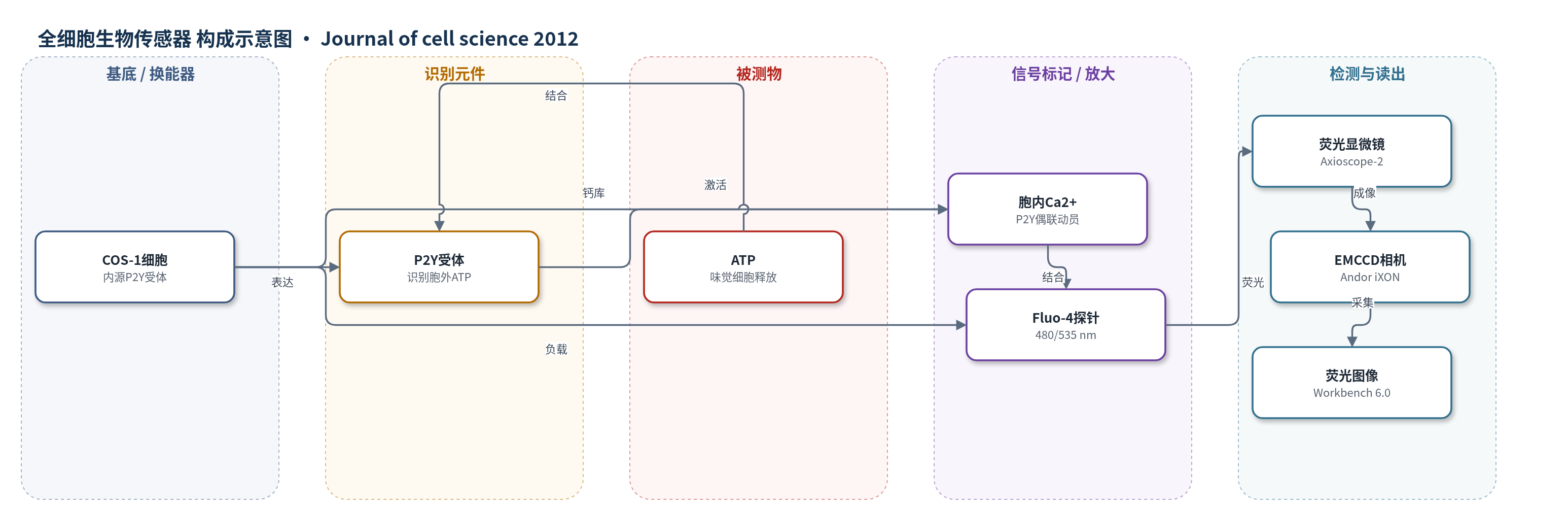
点击图片查看大图 · 依据论文自动绘制
传感器类型
全细胞生物传感器
检测对象
ATP(adenosine triphosphate,三磷酸腺苷);样品基质:细胞培养浴液/味觉细胞周围浴液(Hanks’s solution 或 NaCl 浴液)
检测原理
该检测以COS-1细胞作为全细胞ATP生物传感器。COS-1细胞内源表达P2Y受体,当周围浴液中的ATP扩散至细胞膜并与P2Y受体结合时,受体激活后偶联胞内Ca2+动员,导致内质网Ca2+释放,胞内Ca2+浓度升高。预先负载的Fluo-4AM进入细胞后与Ca2+结合,其荧光在480 nm激发、535 nm发射下增强。荧光显微镜和EMCCD相机以0.5-2 s间隔采集图像,荧光强度或Ca2+瞬变幅度随胞外ATP浓度升高而增大。原文报告该细胞传感器可响应50 nM-10 μM的胞外ATP,100 nM ATP可确认其工作性。
检测灵敏度
响应范围: 50 nM-10 μM;100 nM ATP可诱发响应
效应效果
该ATP生物传感器可检测50 nM-10 μM胞外ATP,100 nM ATP可确认响应。机械扰动未引起可检测ATP释放,提示响应主要来自去极化或味觉刺激诱导的ATP分泌。野生型味蕾中,70-100 mM KCl去极化均诱发ATP释放;味觉混合物在26个味蕾中10个(38%)产生可检测ATP释放。Panx1敲除味蕾12个中全部对KCl去极化释放ATP,5个(42%)对味觉刺激释放ATP。单个Panx1敲除II型味觉细胞16个中14个(87%)去极化释放ATP,与既往野生型84%相近。野生型与Panx1敲除细胞的ATP生物传感器响应无统计学差异(p>0.05)。作者据此主张该传感器可用于研究味觉ATP分泌,并质疑Panx1是味觉ATP释放的主要通道亚基。
传感器的构成
- 细胞基底/换能单元:COS-1细胞,内源表达P2Y受体,作为ATP识别与Ca2+信号转导的活细胞传感器
- 识别元件:P2Y受体(P2Y receptors),位于COS-1细胞膜,结合胞外ATP并偶联胞内Ca2+动员
- 信号标记物:Fluo-4AM(4 μM,含15 μg/ml Pluronic),负载后进入细胞,与Ca2+结合产生荧光
- 换能信号:胞内Ca2+,P2Y受体激活后释放,驱动Fluo-4荧光强度变化
- 激发/发射:LED 480 nm激发,535 nm发射,用于检测Fluo-4/Ca2+荧光
- 成像读出:Axioscope-2荧光显微镜与Andor iXON EMCCD相机,每0.5-2 s采集荧光图像
- 数据处理:Workbench 6.0软件,记录并分析ATP引起的荧光瞬变
中文摘要
II型味觉细胞的传入输出依赖于通过离子通道释放的ATP。通常认为Pannexin 1(Panx1)通道负责多种细胞中的ATP释放。然而,味觉细胞ATP分泌的生物物理证据提示存在缓慢失活的离子通道,而重组Panx1激活和失活均很快。这种不一致可能表明细胞环境决定Panx1功能。作者从小鼠味觉组织克隆Panx1,并在HEK-293、CHO和神经母细胞瘤SK-N-SH三种细胞中异源表达。在每种细胞中,Panx1转染均产生外整流阴离子通道,具有快速门控,且对大于250 Da的阴离子通透性可忽略。尽管表达Panx1,宿主细胞在刺激后仍不能释放可检测的ATP,这质疑了Panx1参与味觉相关ATP分泌。作者进一步利用Panx1基因敲除小鼠,ATP生物传感器检测显示,缺乏Panx1的味觉细胞中ATP分泌仍然稳健,与对照相比无明显变化。数据提示Panx1单独形成的通道对ATP通透性不足;可能需要味觉细胞中缺失的其他亚基和/或调控环路,才能使天然Panx1基通道进入高ATP通透模式。
英文摘要
Afferent output in type II taste cells is mediated by ATP liberated through ion channels. It is widely accepted that pannexin 1 (Panx1) channels are responsible for ATP release in diverse cell types, including taste cells. While biophysical evidence implicates slow deactivation of ion channels following ATP release in taste cells, recombinant Panx1 activates and deactivates rapidly. This inconsistency could indicate that the cellular context specifies Panx1 functioning. We cloned Panx1 from murine taste tissue, and heterologously expressed it in three different cell lines: HEK-293, CHO and neuroblastoma SK-N-SH cells. In all three cell lines, Panx1 transfection yielded outwardly rectifying anion channels that exhibited fast gating and negligible permeability to anions exceeding 250 Da. Despite expression of Panx1, the host cells did not liberate ATP upon stimulation, making it unclear whether Panx1 is involved in taste-related ATP secretion. This issue was addressed using mice with genetic ablation of the Panx1 gene. The ATP-biosensor assay revealed that, in taste cells devoid of Panx1, ATP secretion was robust and apparently unchanged compared with the control. Our data suggest that Panx1 alone forms a channel that has insufficient permeability to ATP. Perhaps, a distinct subunit and/or a regulatory circuit that is absent in taste cells is required to enable a high ATP-permeability mode of a native Panx1-based channel.