组成图示
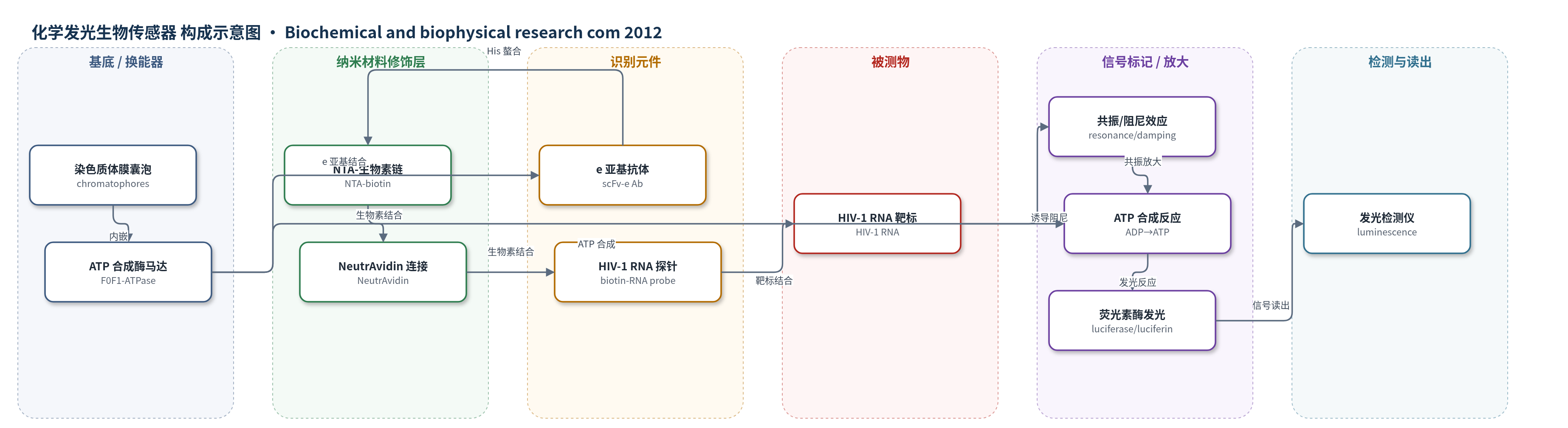
点击图片查看大图 · 依据论文自动绘制
传感器类型
化学发光生物传感器
检测对象
HIV-1 RNA(人类免疫缺陷病毒 1 型 RNA,HIV-1 RNA);样品基质:HIV-1 阳性血清(HIV-1-positive serum)及 HIV-1 阴性血清对照
检测原理
F0F1-ATPase 嵌入染色质体膜,利用 ADP 和无机磷酸合成 ATP,旋转马达转速受负载与阻尼影响。e 亚基抗体通过 NTA-biotin-NeutrAvidin-biotin 链连接 HIV-1 RNA 探针。当 HIV-1 RNA 与探针结合时,马达受到额外阻尼,转速改变;在合适 ATPase 浓度下,少量结合靶标的马达通过共振能量转移使未结合马达同步改变转速,产生集体信号。ATP 合成速率与浓度随之改变,加入荧光素/荧光素酶后产生发光信号,用发光检测仪读出。靶标浓度越高,发光强度变化率越大,可在无 PCR 放大下线性检测。
检测灵敏度
灵敏度: 35 molecules/well(0.01 pg/ml,ATPase 约 2.0 × 10^6 molecules/well);测试浓度: 0.01、0.1、1、10 pg/ml;ATPase 浓度: 1.2 × 10^8 molecules/well 与 1.05 × 10^8 molecules/well
效应效果
该传感器在液相中无需 PCR 放大即可检测 HIV-1 RNA。当 ATPase 浓度为 1.2 × 10^8 molecules/well 时可区分 100 与 1000 fg/ml HIV-1 RNA,而 1.05 × 10^8 molecules/well 时不能区分,说明共振依赖 ATPase 浓度。荧光强度变化率随 HIV-1 RNA 从 6、60、600 fg 增加而由 1.2 升至 1.3 和 1.4,提示线性检测。在约 2.0 × 10^6 ATPase molecules/well 时,0.01 pg/ml 对应灵敏度 35 molecules/well。以 HIV-1 阴性血清为阴性对照,RNA 浓度用 qRT-PCR 标准曲线定量。作者认为该共振机制可产生集体信号,避免纳米加工,具有超灵敏应用潜力。
传感器的构成
- 基底/换能器:Thermomicrobium roseum 染色质体(chromatophores)内嵌 F0F1-ATPase,作为旋转马达与 ATP 合成换能器
- 识别元件:F1 的 e 亚基结合 6×His 标签单链 e 亚基抗体(scFv-e antibody),作为靶标捕获受体
- 连接修饰层:NTA-biotin 与 6×His 标签螯合,NHS-biotin 生物素化,NeutrAvidin 连接生物素化探针,形成抗体–生物素–NeutrAvidin–生物素–RNA 探针链
- 识别探针:生物素化 HIV-1 RNA 探针(biotin-HIV-1 RNA probe,5′-GATGAATAGAATAAAAGTTGCAATA-3′),特异性结合 HIV-1 RNA
- 信号读出试剂:luciferin/luciferase ATP 检测试剂盒,通过 ATP 合成活性产生发光信号
- 反应底物:ADP、MgCl2、KH2PO4、Tricine-NaOH 和甘油,维持 F0F1-ATPase 合成 ATP 的反应环境
中文摘要
我们设计了一种旋转生物传感器作为阻尼效应器,其中 F0F1-ATPase 由三磷酸腺苷(ATP)合成驱动旋转,其旋转状态以荧光强度指示;当 RNA 分子结合到旋转生物传感器上的探针时,会诱导一种阻尼效应力。我们发现,该阻尼效应可促进液相中旋转生物传感器的共振现象和能量转移过程。这一结果表明,旋转马达在振动谐波模式下工作的能力取决于环境条件及其机制,少量旋转生物传感器分子即可诱导所有传感器分子共同发出荧光。这些发现有助于 ATPase 马达的理论研究,并为未来超灵敏生物传感器的开发提供依据。
英文摘要
We designed a rotary biosensor as a damping effector, with the rotation of the F(0)F(1)-ATPase driven by Adenosine Triphosphate (ATP) synthesis being indicated by the fluorescence intensity and a damping effect force being induced by the binding of an RNA molecule to its probe on the rotary biosensor. We found that the damping effect could contribute to the resonance phenomenon and energy transfer process of our rotary biosensor in the liquid phase. This result indicates that the ability of the rotary motor to operate in the vibration harmonic mode depends on the environmental conditions and mechanism in that a few molecules of the rotary biosensor could induce all of the sensor molecules to fluoresce together. These findings contribute to the theory study of the ATPase motor and future development of biosensors for ultrasensitive detection.