组成图示
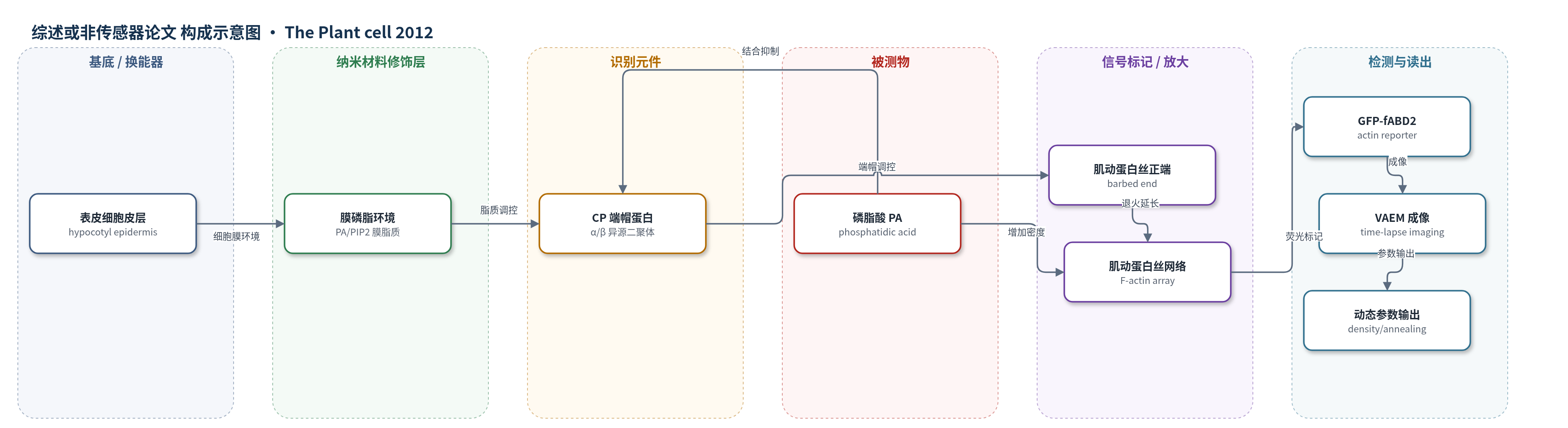
点击图片查看大图 · 依据论文自动绘制
传感器类型
综述或非传感器论文
检测对象
磷脂酸 (phosphatidic acid, PA);样品基质:拟南芥下胚轴表皮细胞(活细胞,外源 PA/PS 或 1-butanol 处理)
检测原理
本文并非人工传感器,而是以 CP 作为内源 PA 感受器。PA 水平升高时,PA 与 CP 结合并抑制其结合肌动蛋白丝正端的端帽活性,使正端去帽,增加自由正端数量;自由正端促进丝-丝退火和正端延长,导致皮层肌动蛋白丝密度与退火频率上升。GFP-fABD2 标记皮层肌动蛋白丝,VAEM 时间序列成像读出丝密度、最大长度、寿命、断裂频率、退火频率等参数。PA 处理呈剂量依赖增强,PS 无显著作用;1-butanol 抑制 PLD 降低 PA 则密度下降,cp 突变体对 PA 不响应,说明信号由 CP 介导。
检测灵敏度
原文未报告 LOD、线性范围、灵敏度斜率或相关系数。
效应效果
实验显示 cp 突变体下胚轴较野生型长 10–20%,表皮细胞长度增加,根长显著缩短;皮层肌动蛋白丝密度增加,cpb-1 根伸长区密度接近野生型两倍。野生型丝端退火频率约 2.1%,cpb-1 为 9.3%,最高增加六倍;PA 处理使野生型密度增加 10–20%,退火频率约三倍,而 cpb-1 对 PA 不敏感。PS 处理无显著影响,1-butanol 降低 PA 使密度下降,2-butanol 无影响,显示 PA 特异性。未报告稳定性、重现性、回收率或与 ELISA/HPLC/qPCR 对比。
传感器的构成
- 基底/细胞环境:拟南芥下胚轴表皮细胞皮层,提供肌动蛋白丝阵列与膜磷脂微环境
- 识别元件:capping protein (CP),α/β 异源二聚体,结合肌动蛋白丝正端并抑制组装/退火
- 信号分子:phosphatidic acid (PA),膜信号磷脂,结合并负调控 CP 端帽活性
- 荧光标记:GFP-fABD2,融合拟南芥 FIMBRIN1 第二肌动蛋白结合域,用于标记皮层肌动蛋白丝
- 成像读出:variable-angle epifluorescence microscopy (VAEM),时间序列观察单个肌动蛋白丝动态
中文摘要
肌动蛋白丝阵列在生物和非生物刺激下重塑,需要精确调控丝端生成与可用性。异源二聚体端帽蛋白(CP)是丰富的丝端帽蛋白,其活性在体外可被膜信号磷脂抑制。为解析 CP 在细胞内如何调控丝端性质及其活性是否受磷脂协调,作者直接观察拟南芥表皮细胞皮层阵列中单个丝端的动态行为,分析 CP 对肌动蛋白组织与动态的调控,以及信号磷脂磷脂酸(PA)的作用。三个 cp 敲低突变体中,CP 水平降低导致丝端动态活性增强,显著增加丝-丝退火和自由端延长,并呈现更密集的肌动蛋白丝阵列。外源 PA 处理野生型细胞可模拟 cp 突变体的肌动蛋白缺陷,表现为丝阵列密度增加和退火频率升高;这些细胞骨架反应在 cp 突变体中完全消失。数据提供遗传学证据,表明 CP 的端帽活性在真核细胞中被膜信号脂质抑制,CP 可作为 PA 生物传感器,将膜信号磷脂通量转导为肌动蛋白骨架动态变化。
英文摘要
Remodeling of actin filament arrays in response to biotic and abiotic stimuli is thought to require precise control over the generation and availability of filament ends. Heterodimeric capping protein (CP) is an abundant filament capper, and its activity is inhibited by membrane signaling phospholipids in vitro. How exactly CP modulates the properties of filament ends in cells and whether its activity is coordinated by phospholipids in vivo is not well understood. By observing directly the dynamic behavior of individual filament ends in the cortical array of living Arabidopsis thaliana epidermal cells, we dissected the contribution of CP to actin organization and dynamics in response to the signaling phospholipid, phosphatidic acid (PA). Here, we examined three cp knockdown mutants and found that reduced CP levels resulted in more dynamic activity at filament ends, and this significantly enhanced filament-filament annealing and filament elongation from free ends. The cp mutants also exhibited more dense actin filament arrays. Treatment of wild-type cells with exogenous PA phenocopied the actin-based defects in cp mutants, with an increase in the density of filament arrays and enhanced annealing frequency. These cytoskeletal responses to exogenous PA were completely abrogated in cp mutants. Our data provide compelling genetic evidence that the end-capping activity of CP is inhibited by membrane signaling lipids in eukaryotic cells. Specifically, CP acts as a PA biosensor and key transducer of fluxes in membrane signaling phospholipids into changes in actin cytoskeleton dynamics.