组成图示
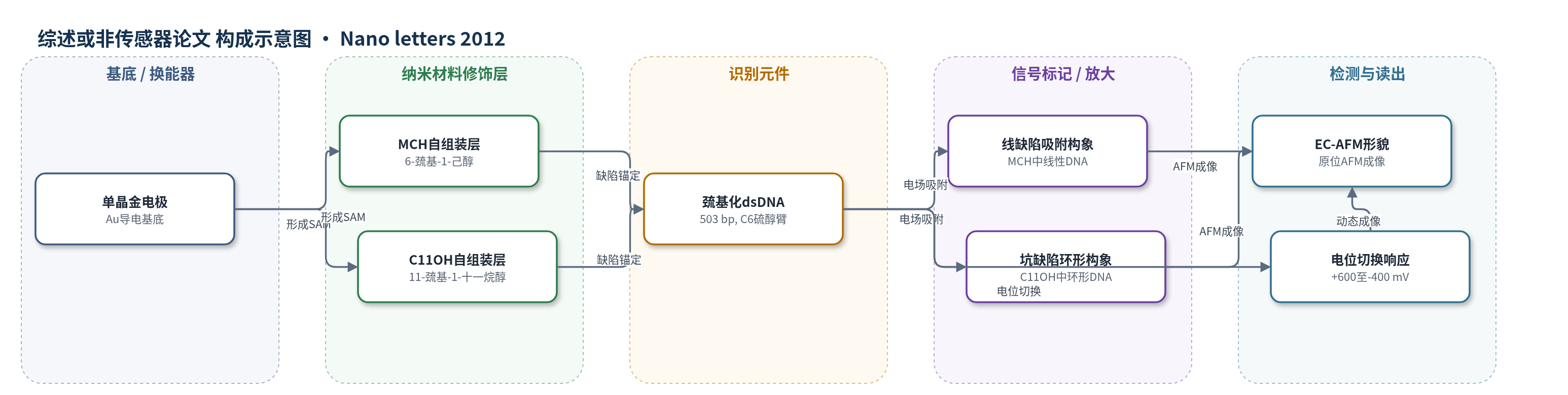
点击图片查看大图 · 依据论文自动绘制
传感器类型
综述或非传感器论文
检测对象
无明确检测对象;研究对象为模型生物传感器表面上的巯基化双链DNA(thiolated dsDNA),样品基质为0.5×TAE缓冲液。
检测原理
该文未建立针对特定分析物的传感检测,而是研究模型核酸传感器表面。巯基化双链DNA通过5′端C6硫醇臂与金表面形成Au–S键,并优先锚定于MCH或C11OH自组装单分子层的缺陷位点。施加电极电位后,界面双电层电场在缺陷处显著增强,使带负电DNA被静电吸附或抬起;在MCH线缺陷中DNA呈高度线性吸附,在C11OH坑状缺陷中因局部电场集中和弯曲能量降低而呈环形/环形凸起构象。电位从+600 mV扫至负电位时DNA可逆抬起,再回正电位时重新吸附。EC-AFM通过形貌高度、取向和电位依赖变化读出这些构象,而非浓度相关传感信号。
检测灵敏度
原文未报告LOD、线性范围、灵敏度斜率或相关系数。
效应效果
研究未报告选择性、抗干扰、RSD或回收率。AFM显示MCH表面DNA棒状特征平均高度1.43 nm(σ=0.34 nm),可分辨长度约10–50 nm,取向序参量0.43、偏移角21.2°,表明DNA沿MCH线缺陷高度取向吸附;与云母上持续长度约53 nm的蠕虫链行为不同。C11OH表面出现直径约10–20 nm的环形结构,曲率半径可小至10 nm,估算弯曲能量约33 kbT,电荷补偿后可降至约4.4 kbT。电位切换下DNA吸附/抬起可逆,双电层电容增至3.1 μF/cm2。作者认为结果有助于关联纳米尺度DNA构象与传感器性能,并提示C11OH更适合电场依赖器件。
传感器的构成
- 基底/换能器电极:单晶金电极(Au),提供导电基底、硫醇锚定界面和电场施加平台。
- 自组装单分子层(SAM):6-巯基-1-己醇(MCH)或11-巯基-1-十一烷醇(C11OH),羟基端封闭金表面,形成线缺陷或坑状缺陷并调控局部电场。
- 识别元件:503 bp双链DNA(dsDNA),5′端带C6巯基己基连接臂,通过Au–S键锚定于SAM缺陷。
- 界面缺陷:MCH或C11OH SAM中的线缺陷/坑状缺陷,增强局部电场并决定DNA吸附位置与构象。
- 读出/表征:原位电化学原子力显微镜(EC-AFM),在0.5×TAE缓冲液中施加电位并成像DNA形貌。
中文摘要
尽管已开发多种核酸传感器,但对于分子结合以及最终影响传感器灵敏度和可靠性的若干问题,我们仍缺乏明确答案。DNA探针在纳米尺度上如何分布在表面?当功能化表面高度异质时,探针分子与缺陷相互作用时构象如何受影响?DNA分子如何响应多种检测方法中施加的表面电场?利用原位电化学原子力显微镜和精细调控纳米尺度表面相互作用,我们能够在模型生物传感器表面观察单个DNA分子的纳米尺度构象:羟基终止烷硫醇自组装单分子层钝化的金表面上的巯基化DNA。我们发现,在施加电场下,构象对烷硫醇分子的选择高度敏感。取决于单分子层和缺陷性质,DNA分子可采取高度线性或高度弯曲构象。这些异常结构难以通过现有核酸传感器的“集合”表征观察到。这些发现为将目标结合亲和力、选择性和动力学与实际核酸器件中探针分子及其周围纳米尺度化学结构相关联迈出了重要一步。
英文摘要
Despite the variety of nucleic acid sensors developed, we still do not have definite answers to some questions that are important to the molecular binding and, ultimately, the sensitivity and reliability of the sensors. How do the DNA probes distribute on the surface at the nanoscale? As the functionalized surfaces are highly heterogeneous, how are the conformations affected when the probe molecules interact with defects? How do DNA molecules respond to electric fields on the surface, which are applied in a variety of detection methods? With in situ electrochemical atomic force microscopy and careful tailoring of nanoscale surface interactions, we are able to observe the nanoscale conformations of individual DNA molecules on a model biosensor surface: thiolated DNA on a gold surface passivated with a hydroxyl-terminated alkanethiol self-assembled monolayer. We find that under applied electric fields, the conformations are highly sensitive to the choice of the alkanethiol molecule. Depending on the monolayer and the nature of the defects, the DNA molecules may either adopt a highly linear or a highly curved conformation. These unusual structures are difficult to observe through existing "ensemble" characterizations of nucleic acid sensors. These findings provide a step toward correlating target-binding affinity, selectivity, and kinetics to the nanoscale chemical structure of and around the probe molecules in practical nucleic acid devices.