组成图示
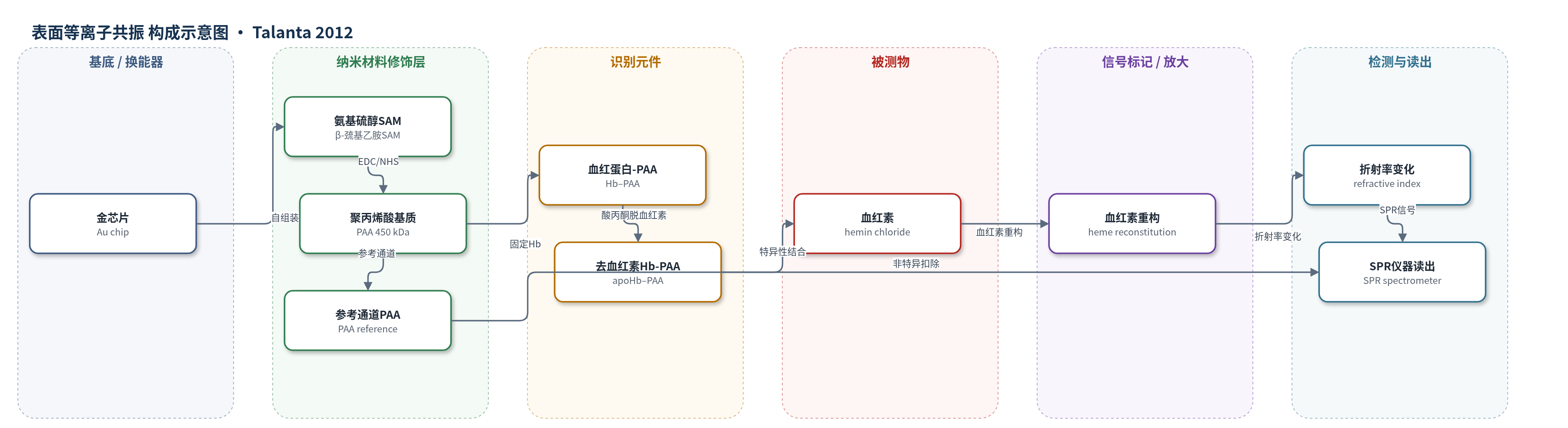
点击图片查看大图 · 依据论文自动绘制
传感器类型
表面等离子共振(SPR)生物传感器
检测对象
血红素(heme,hemin chloride);样品基质:PBS 水溶液,目标应用为血清/血浆(生物水平 1–50 mM)
检测原理
传感器以 apoHb–PAA 的血红素结合口袋为识别元件。血红素注入后进入 apoHb 口袋并发生辅因子重构,口袋快速闭合并形成铁–组氨酸配位键,结合极强且实时基本不解离。结合事件使金表面约 300 nm 倏逝场内的质量/折射率增加,导致 SPR 共振角或反射光强变化。双通道 SPR 中,样品通道信号扣除仅含 PAA 的参考通道,以消除溶剂效应和非特异结合。高 PAA 网络负载大量 Hb 提供信号放大,酸/丙酮洗脱可再生表面。
检测灵敏度
LOD: approximately 2 mM or 1.30 mg/mL;线性范围: 2.5–30 mM;R^2 = 0.966
效应效果
该传感器对血红素具有高度选择性,参考通道仅显示 PAA 的弱非特异结合;ANS 单独或与血红素共注入均无 SPR 响应,表明结合口袋特异性。表面经酸/丙酮再生至少 12 次,灵敏度与选择性无明显损失;12 个样品(4 个浓度各 3 次)在不同注入顺序下信号可重复,且再生高效。重构与再生约 5 min,可实时、无标记检测。LOD 2 mM,低于比色法约 3–30 mM,与 HPLC/MS 等临床需求相当,但 MS 和化学发光 LOD 0.4 mM 更低。作者认为其适合疟疾等溶血相关血红素升高检测,并可发展为多通道即时诊断装置。
传感器的构成
- 基底/换能器:裸金芯片(Au chip),Kretschmann 构型 SPR 换能器,提供表面等离子体激元场。
- 自组装修饰层:β-巯基乙胺盐酸盐(β-mercaptoethylamine)自组装单分子层(SAM),在金表面提供氨基锚定位点。
- 聚合物基质层:聚丙烯酸(PAA,450 kDa),经 EDC/NHS 偶联到氨基 SAM,形成亲水网络,固定蛋白并降低非特异结合。
- 识别元件前体:牛血红蛋白(Hb),经 EDC/NHS 与 PAA 羧基通过赖氨酸侧链共价固定,形成 Hb–PAA 共轭。
- 识别元件:去血红素血红蛋白–聚丙烯酸(apoHb–PAA),由酸/丙酮洗脱 Hb–PAA 中血红素形成,血红素结合口袋作为高选择性识别位点。
- 封闭剂:乙醇胺(ethanolamine,1 M,pH 8.5),封闭残余活化羧基,减少非特异结合。
- 再生/洗脱试剂:酸性丙酮(50/50 v/v,pH 2),洗脱结合血红素并再生 apoHb–PAA 表面。
- 参考通道:仅 PAA 修饰的参考通道,用于扣除溶剂效应和血红素对 PAA 的非特异结合。
中文摘要
本文报道了一种用于检测血红素(heme)的新型表面等离子共振(SPR)生物传感器,其传感机制为血红素辅因子与去血红素血红蛋白(apoHb)的再结合。该结合过程高度特异、高效,并能产生强 SPR 信号。这是首次将去血红素蛋白固定于亲水聚合物基质中并通过 SPR 检测相应辅因子,也是首次报道以 SPR 实时高灵敏检测血红素,且传感表面可多次再生而不损失灵敏度或选择性。传感表面通过原位共价固定血红蛋白于聚丙烯酸(PAA)基质中制备,使高浓度蛋白位于金芯片等离子体检测范围内;从血红蛋白–PAA 共轭中去除血红素后形成表面锚定的 apoHb–PAA。检出限约为 2 mM 或 1.30 mg/mL,与溶血病理条件下生物血红素水平(1–50 mM)相关。该体系展示了利用蛋白辅因子结合口袋进行 SPR 检测的新概念,方法可拓展至其他辅因子检测,未来有望用于生物小分子即时检测设备。
英文摘要
We have developed a novel surface plasmon resonance (SPR) biosensor for heme detection that utilizes the reconstitution of the heme cofactor with apohemoglobin (apoHb), hemoglobin from which the heme has been removed, as the sensing mechanism. The binding is highly specific, efficient and generated very strong SPR signals. This is the first report that uses immobilization of the apoprotein in a hydrophilic polymer matrix and senses the corresponding cofactor by SPR. This is also the first report of high sensitivity heme detection in real time by SPR and the sensing surface is re-generated many times without loss of sensitivity or selectivity. The sensing surface was fabricated by covalent immobilization of hemoglobin in a polyacrylic acid matrix in situ, which allowed for a high concentration of protein to be located in the plasmon detection range on the Au chip. Removal of the heme from the hemoglobin-polymer conjugate (Hb-PAA) resulted in a surface anchored apoHb-polymer conjugate. The limit of detection was approximately 2 μM or 1.30 μg/mL, which is relevant for biological heme levels (1-50 μM for hemolytic pathological conditions). This apoHb-polyacrylic acid system demonstrates a new concept in SPR detection with the use of protein cofactor binding pockets for analyte detection. The methodology that we developed here may be extended for the detection of a number of other cofactor molecules with high sensitivity, selectivity and low detection limits. In future, such sensors could be useful for the development of point-of-care devices to detect biologically important small molecules.