组成图示
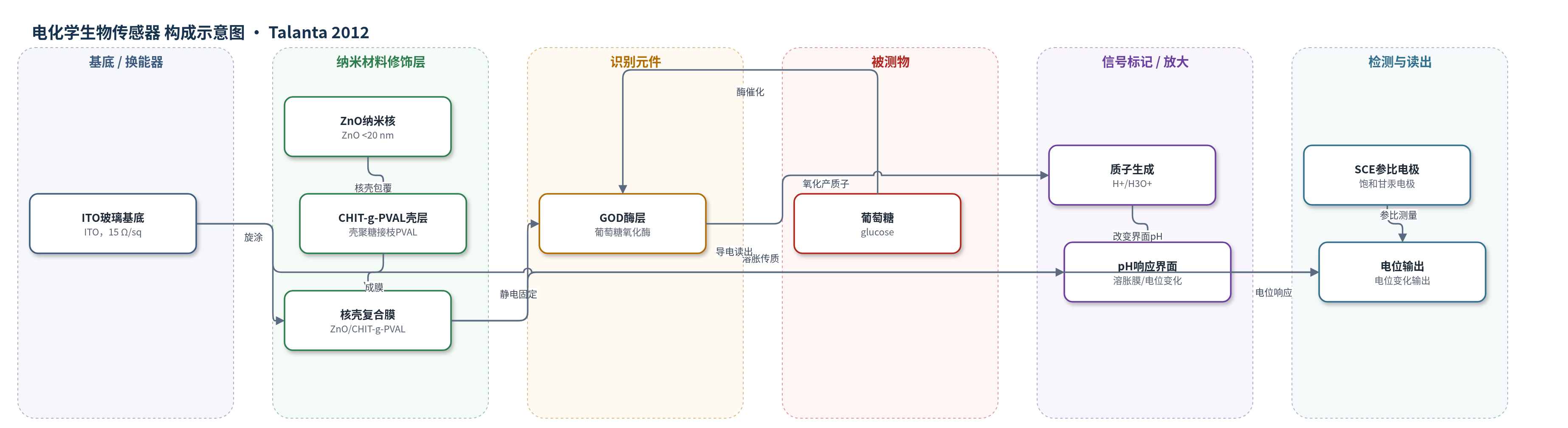
点击图片查看大图 · 依据论文自动绘制
传感器类型
电化学生物传感器
检测对象
葡萄糖(glucose);样品基质:水溶液、新鲜人血清、尿液
检测原理
该传感器采用电位法检测葡萄糖。葡萄糖氧化酶(GOD)固定于 ZnO/CHIT-g-PVAL 核壳膜上,催化葡萄糖氧化为葡萄糖酸并释放 H+/H3O+。生成的质子改变核壳膜界面 pH 和离子分布;CHIT-g-PVAL 壳层具有较高溶胀度,可促进葡萄糖扩散并放大质子响应,ZnO 核提供静电固定位点并增强电催化/电子传导。生物电极相对饱和甘汞电极(SCE)的电位随葡萄糖浓度增加而线性变化,从而实现定量检测。
检测灵敏度
LOD: 0.2 mM;线性范围: 2×10⁻⁶–1.2×10⁻³ M;灵敏度: 40.04 mV/mM;R^2 = 0.99953
效应效果
抗干扰性较好:在 250 mM 葡萄糖中加入 25 mM 的 L-丝氨酸、L-苏氨酸、α-酮戊二酸、L-丙氨酸、尿酸、L-胱氨酸、L-谷氨酸、丙酮酸钠和 L-抗坏血酸,电位相对误差约 3.6%。响应时间 3 s,恢复时间 5 s,灵敏度 40.04 mV/mM;含 ZnO 电极灵敏度约为无 ZnO 的 3 倍,%SD 为 5.08(n=5)。4 °C 储存 28 周响应稳定。在 12% v/v 乙酸或乙醇介质中斜率变化约 1–3.5%。健康人血清和尿液检测结果较标准比色法高 10–15%,总体一致性良好。作者认为该平台可拓展至胆固醇、甘油三酯等检测。
传感器的构成
- 基底/换能器电极:氧化铟锡(ITO)玻璃,电阻约15 Ω/sq,提供导电基底与电位传感界面
- 核壳纳米修饰层:氧化锌/壳聚糖接枝聚乙烯醇(ZnO/CHIT-g-PVAL)核壳纳米复合薄膜,ZnO 纳米粒子为核、CHIT-g-PVAL 为壳,旋涂成膜,提供 pH 响应、高溶胀和静电固定位点
- 识别/催化元件:葡萄糖氧化酶(GOD),通过静电作用固定于 ZnO/CHIT-g-PVAL 表面,催化葡萄糖氧化生成葡萄糖酸和 H+/H3O+
- 参比电极:饱和甘汞电极(SCE),用于电位法测量生物电极电位变化
中文摘要
本文报道了一种基于氧化锌/壳聚糖接枝聚乙烯醇(ZnO/CHIT-g-PVAL)核壳纳米复合材料的可调电位葡萄糖生物传感器。采用湿化学法合成含小于20 nm氧化锌纳米粒子的核壳纳米复合材料,并将其旋涂于氧化铟锡(ITO)玻璃基底上;随后将葡萄糖氧化酶(GOD)固定于该复合膜上,构建 GOD/ZnO/CHIT-g-PVAL/ITO 生物电极。FTIR、SEM 和 TEM 表征证实核壳结构形成及 GOD 成功固定。GOD 与 ZnO/CHIT-g-PVAL 之间的静电相互作用赋予电极较高的酶固定量和良好的寿命稳定性。电位法测试显示,该生物电极对葡萄糖在 2×10⁻⁶–1.2×10⁻³ M 范围内呈线性电位响应,检出限为 0.2 mM,灵敏度为 40.04 mV/mM,响应时间约 3 s。该核壳纳米复合材料有望用于多种酶生物传感器。
英文摘要
A potentiometrically tuned-glucose biosensor was fabricated using core-shell nanocomposite based on zinc oxide encapsulated chitosan-graft-poly(vinyl alcohol) (ZnO/CHIT-g-PVAL). In a typical experiment, ZnO/CHIT-g-PVAL core-shell nanocomposite containing <20 nm ZnO nanoparticles was synthesized using wet-chemical method. The glucose responsive bio-electrode, i.e., glucose oxidase/ZnO/chitosan-graft-poly(vinyl alcohol) (GOD/ZnO/CHIT-g-PVAL/ITO) was obtained by immobilization of glucose oxidase (GOD) onto the electrode made of resulting ZnO core-shell nanocomposite coated on the indium-tin oxide (ITO) glass substrate. The ZnO/CHIT-g-PVAL/ITO and GOD/ZnO/CHIT-g-PVAL electrodes were characterized with Fourier transform infrared spectroscopy (FTIR) and scanning electron microscopy (SEM), whereas ZnO/CHIT-g-PVAL size of core-shell nanoparticles were measured using transmission electron microscopy (TEM). The electrostatic interaction between GOD and ZnO/CHIT-g-PVAL provided the resulting tuned enzyme electrode with a high degree of enzyme immobilization and excellent lifetime stability. The response studies were carried out as a function of glucose concentration with potentiometric measurement. The GOD/ZnO/CHIT-g-PVAL/ITO bioelectrode has showed a linear potential response to the glucose concentration ranging from 2 μM to 1.2mM. The glucose biosensor exhibited a fast surface-controlled redox biochemistry with a detection limit of 0.2 μM, a sensitivity of >0.04 V/μM and a response time of three sec. ZnO/CHIT-g-PVAL core-shell nanocomposite could be a promising nanomaterials for a range of enzymic biosensors.