组成图示
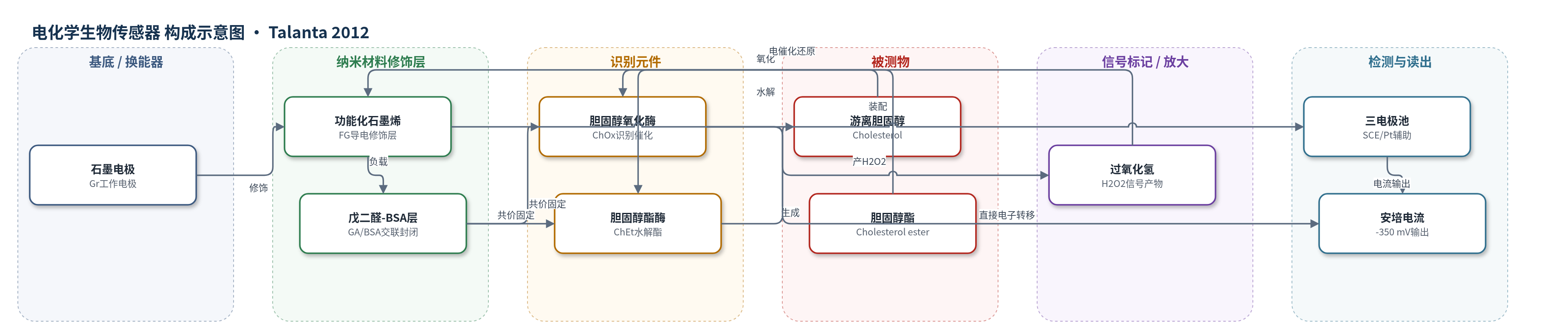
点击图片查看大图 · 依据论文自动绘制
传感器类型
电化学生物传感器
检测对象
游离胆固醇(free cholesterol, cholesterol)、总胆固醇(total cholesterol, cholesterol esters,如胆固醇棕榈酸酯 cholesterol palmitate);样品基质:PBS标准溶液和人血清(human serum)。
检测原理
该传感器采用双酶级联识别与电化学换能。对于总胆固醇,胆固醇酯酶(ChEt)先将胆固醇酯水解为游离胆固醇;随后胆固醇氧化酶(ChOx)催化游离胆固醇与氧气反应,生成胆固醇酮和过氧化氢(H2O2)。FG/Gr电极具有较高导电性和大比表面积,可在较低电位(-350 mV)下电催化还原H2O2,产生与H2O2浓度成正比的阴极电流,从而间接反映胆固醇浓度。同时,FG为ChOx的FAD/FADH2提供直接电子转移通道,增强界面电子耦合。酶通过戊二醛-BSA共价固定,保持活性并提高稳定性;低工作电位避免葡萄糖、尿酸和抗坏血酸氧化干扰。
检测灵敏度
游离胆固醇:LOD: 5 mM;线性范围: 50–350 mM;R = 0.9972。总胆固醇:LOD: 15 mM;线性范围: 50–300 mM;R = 0.9982。H2O2(CV):线性范围: 0.5–7 mM;R = 0.9967;灵敏度: 124.11 mA mM−1(443.25 mA mM−1 cm−2)。
效应效果
该传感器在-350 mV低电位下工作,葡萄糖、抗坏血酸和尿酸等常见干扰物未引起干扰。ChOx-FG/Gr电极连续10次循环伏安曲线峰电流和峰位几乎不变,表明固定稳定;游离胆固醇和总胆固醇电极的制备重现性RSD分别为4.6%和4.8%。在人血清样品(n=5)中,游离胆固醇和总胆固醇测定结果的RSD为4.2%–5.4%,与分光光度法结果一致。与文献ChOx基生物传感器相比,该电极酶负载量达1.406×10−8 mol cm−2,Ks为0.78 s−1,工作电位较低,线性范围50–350 mM,检出限5 mM,适合快速、低干扰的胆固醇检测。
传感器的构成
- 基底/换能器电极:石墨电极(Gr),经砂纸抛光,作为工作电极和电子传导基底
- 纳米材料修饰层:羧基功能化石墨烯(FG),由浓硝酸回流引入-COO-,滴涂于石墨表面,提高导电性、比表面积和H2O2电催化活性
- 交联/封闭层:戊二醛(GA)与牛血清白蛋白(BSA)混合层,用于共价固定酶并封闭非特异结合
- 识别/催化元件:胆固醇氧化酶(ChOx),催化胆固醇氧化生成H2O2,并实现FAD/FADH2直接电子转移
- 识别/催化元件:胆固醇酯酶(ChEt),水解胆固醇酯(如胆固醇棕榈酸酯)为游离胆固醇,用于总胆固醇检测
- 信号产物:过氧化氢(H2O2),酶促反应生成并在FG/Gr上电催化还原产生安培电流
- 读出系统:三电极电化学池,工作电极为FG/Gr或酶修饰电极,参比电极为饱和甘汞电极(SCE),辅助电极为铂丝(Pt),在-350 mV恒电位下安培检测
中文摘要
胆固醇氧化酶(ChOx)和胆固醇酯酶(ChEt)通过共价方式固定在羧基功能化石墨烯(FG)修饰的石墨电极上,用于游离胆固醇和总胆固醇的电化学检测。循环伏安法和电化学阻抗谱表明,FG可促进电极与固定ChOx之间的电子转移,实现ChOx中FAD/FADH2的直接电子转移,电子转移系数α为0.31,电子转移速率常数Ks为0.78 s−1。在游离胆固醇检测中,ChOx-FG/Gr电极在50–350 mM范围内呈线性响应(R=0.9972),检出限为5 mM;在总胆固醇检测中,(ChEt/ChOx)-FG/Gr电极在50–300 mM范围内线性(R=0.9982),检出限为15 mM。由于工作电位较低,葡萄糖、抗坏血酸和尿酸等常见干扰物未造成干扰。FG/Gr电极对过氧化氢(H2O2)具有良好电催化活性,在0.5–7 mM范围内线性(R=0.9967),灵敏度为443.25 mA mM−1 cm−2。
英文摘要
Cholesterol oxidase (ChOx) and cholesterol esterase (ChEt) have been covalently immobilized onto functionalized graphene (FG) modified graphite electrode. Enzymes modified electrodes were characterized using cyclic voltammetry (CV) and electrochemical impedance spectroscopy (EIS). FG accelerates the electron transfer from electrode surface to the immobilized ChOx, achieving the direct electrochemistry of ChOx. A well defined redox peak was observed, corresponding to the direct electron transfer of the FAD/FADH(2) of ChOx. The electron transfer coefficient (α) and electron transfer rate constant (K(s)) were calculated and their values are found to be 0.31 and 0.78 s(-1), respectively. For the free cholesterol determination, ChOx-FG/Gr electrode exhibits a sensitive response from 50 to 350 μM (R=-0.9972) with a detection limit of 5 μM. For total cholesterol determination, co-immobilization of ChEt and ChOx on modified electrode, i.e. (ChEt/ChOx)-FG/Gr electrode showed linear range from 50 to 300 μM (R=-0.9982) with a detection limit of 15 μM. Some common interferents like glucose, ascorbic acid and uric acid did not cause any interference, due to the use of a low operating potential. The FG/Gr electrode exhibits good electrocatalytic activity towards hydrogen peroxide (H(2)O(2)). A wide linear response to H(2)O(2) ranging from 0.5 to 7 mM (R=-0.9967) with a sensitivity of 443.25 μA mM(-1) cm(-2) has been obtained.