组成图示
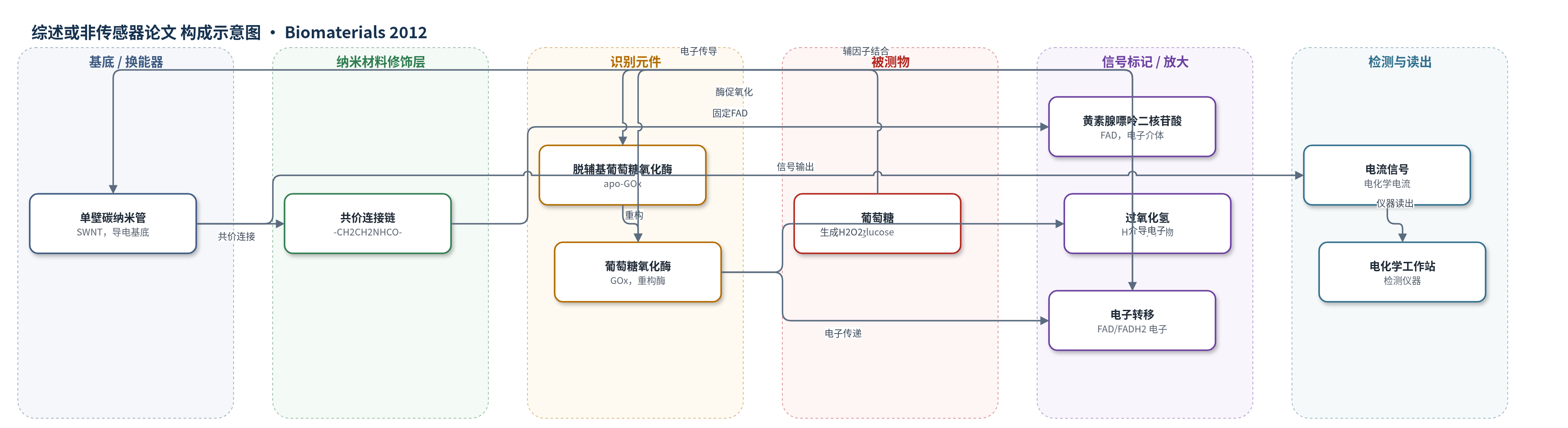
点击图片查看大图 · 依据论文自动绘制
传感器类型
综述或非传感器论文
检测对象
葡萄糖(glucose),水溶液/模拟水环境(未报告实际生物样品基质)
检测原理
该设计以葡萄糖氧化酶(GOx)为识别元件,葡萄糖(glucose)被 GOx 催化氧化为 D-葡萄糖酸-δ-内酯和过氧化氢(H2O2)。反应中 FAD 作为辅因子先接受电子被还原为 FADH2,随后 O2 将 FADH2 氧化并生成 H2O2。FAD 通过 -CH2-CH2-NH-CO- 共价连接到单壁碳纳米管(SWNT)上,SWNT 作为导电纳米连接器,将 FAD 的氧化还原中心与电极连接,使电子经 FAD/SWNT 通道传递到电极,产生可检测电流。葡萄糖浓度升高时,酶促氧化速率和电子转移通量增加,电流信号增强。模拟表明负电 SWNT 能保持 FAD 伸展构象,减少吸附和空间位阻,有利于 apo-GOx 与 FAD 重构并提高电子转移效率。
检测灵敏度
原文未报告 LOD、线性范围、灵敏度斜率或相关系数。
效应效果
本文未报道实际传感器选择性、抗干扰、稳定性、重现性、回收率或与 ELISA/HPLC/qPCR 的对比。模拟显示,未带电和正电 SWNT 体系中 FAD 最终吸附到 SWNT 表面,RMSD 约 8 nm,FAD 与 SWNT 质心归一化距离约 0.5–0.6 nm,增加空间位阻;负电 SWNT 体系中 FAD 基本保持原构象,RMSD 约 3 nm,质心距离约 0.9 nm,磷酸基团因静电排斥远离 SWNT。相互作用能分析表明正电体系总相互作用能约 -826.9 kJ/mol,静电贡献约 97.7%;负电体系总相互作用能约 30.0 kJ/mol,静电贡献约 98.4%。作者主张负电 SWNT 更适合构建 FAD 功能化 SWNT 以重构 apo-GOx,用于葡萄糖传感器设计。
传感器的构成
- 换能器/导电基底:单壁碳纳米管(SWNT),作为导电纳米连接器,模拟中设中性、正电、负电三种电荷状态。
- 连接修饰层:-CH2-CH2-NH-CO- 共价连接基团,将 FAD 通过羧基端连接到 SWNT 表面。
- 辅因子/电子介体:黄素腺嘌呤二核苷酸(FAD),作为葡萄糖氧化酶(GOx)辅因子和电子转移介体,异咯嗪环参与氧化还原。
- 识别元件:脱辅基葡萄糖氧化酶(apo-GOx),与 FAD 重构形成葡萄糖氧化酶(GOx),催化葡萄糖氧化。
- 模拟环境:TIP3 水分子与反离子(Na+、Cl-),维持体系电中性并模拟水溶液环境。
中文摘要
在单壁碳纳米管(SWNT)上重构脱辅基葡萄糖氧化酶(apo-GOx)并用黄素腺嘌呤二核苷酸(FAD)功能化,可显著提高葡萄糖传感器中氧化还原反应的电子转移周转率。本研究旨在从分子层面理解不同电荷 SWNT 对 FAD 构象和取向变化的影响,从而为选择适合 FAD 与 apo-GOx 重构的 SWNT 提供合理设计依据。作者在水溶液环境中对 FAD 共价连接到中性、正电和负电 SWNT 的体系进行了分子动力学(MD)和拉伸分子动力学(SMD)模拟,并加入反离子维持电中性。通过轨迹分析和定量计算 RMSD、质心距离及相互作用能,观察到 FAD 的构象与取向变化。结果表明,在中性和正电 SWNT 体系中,FAD 在模拟末端倾向于吸附到 SWNT 表面,增加分子间空间阻力,在一定程度上阻碍 apo-GOx 与 FAD 的重构;而 FAD 功能化负电 SWNT 体系基本保持 FAD 原有构象。因此,负电 SWNT 可能是用于电极相关中继辅因子单元上 apo-GOx 重构的电子转移介体的最佳选择。
英文摘要
The reconstitution of apo-glucose oxidase (apo-GOx) on single-walled carbon nanotubes (SWNTs) functionalized with the cofactor, flavin adenine dinucleotide (FAD), greatly improved electron transfer turnover rate of the redox reactions in glucose sensing with glucose sensors. The research reported here is aimed to better understand molecular details of affection of the charging SWNT to the conformational changes of FAD, in order to find a rational design and selection scheme of SWNT which is suitable for the FAD and apo-GOx to perform their reconstitution. In this report, molecular simulations of FAD functionalized differently charged SWNTs were carried outin an aqueous environment, with counterions to maintain total charge neutrality. The conformation and orientation changes were observed by both trajectory and quantitative analyses. The simulation results showed that in both uncharged and positively charged SWNT situations, FAD adsorbed onto SWNT at the end of the simulations, which increased the steric resistance of molecules and hindered the reconstitution of apo-GOx and FAD to some degree. By contrast, FAD functionalized negatively charged SWNT maintained its original conformation largely. In addition, negatively charged SWNT may be the best choice for electron transfer mediator for the reconstitution of apo-GOx on relay-cofactor units associated with electrodes.