组成图示
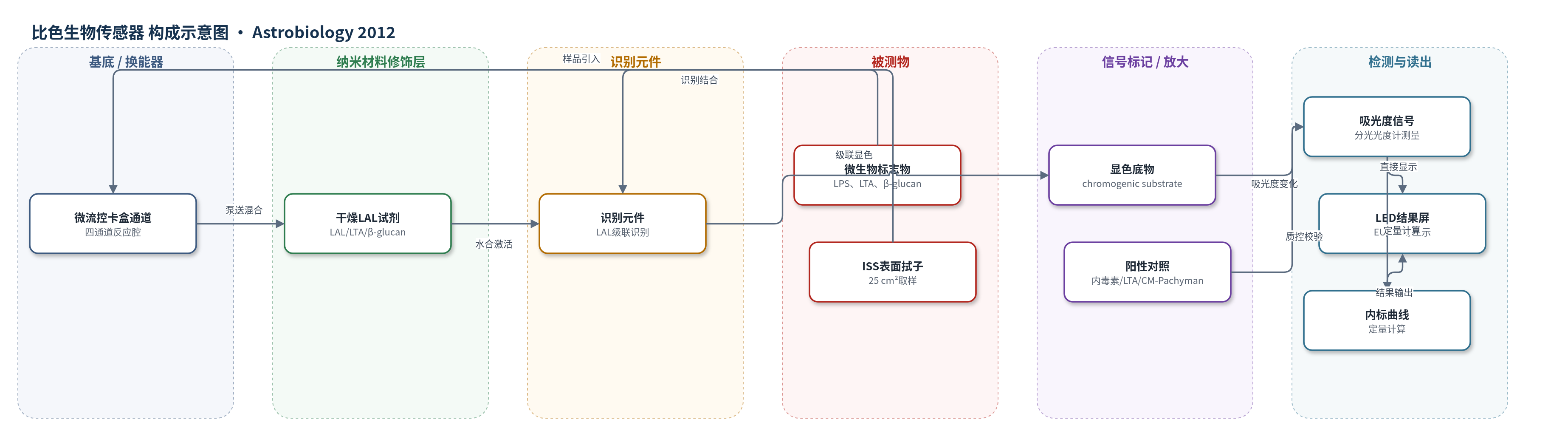
点击图片查看大图 · 依据论文自动绘制
传感器类型
比色生物传感器
检测对象
脂多糖(LPS)、脂磷壁酸(LTA)、β-葡聚糖(beta-glucan);样品基质为国际空间站(ISS)表面拭子样品(swab samples)
检测原理
LOCAD-PTS 采用一次性微流控卡盒与手持分光光度计。表面拭子样品经无菌水稀释后泵入卡盒通道,与干燥的 LAL 或特异性试剂水合并混合。样品中的 LPS、LTA 或 β-葡聚糖作为识别事件触发 LAL/特异性试剂的酶促级联反应,使显色底物转化为有色产物。有色产物浓度随被测标志物浓度升高而增加,导致反应液吸光度变化。手持分光光度计在光学读区测量吸光度,并与卡盒内置内标曲线比较,最终在 LED 屏输出 EU/mL、ng/mL 或 mg/mL。该方法不依赖培养,可检测活菌、死菌及不可培养微生物残留。
检测灵敏度
检测范围: LAL 0.05–5 EU/mL;β-葡聚糖 1–100 ng/mL;LTA 0.05–5 mg/mL;背景值: <0.05 EU/mL、1 ng/mL、0.05 mg/mL
效应效果
实验在 ISS 多舱段完成 52 个样品,六名宇航员参与 20 余次。多数表面接近背景,但频繁接触部位更高:CEVIS β-葡聚糖 >100 ng/mL,WHC 后墙 66.4 ng/mL,ATU 23.8 ng/mL;LTA 在 JEM 气闸手柄 0.185 mg/mL、WHC <0.56 mg/mL、脚部固定带 0.119 mg/mL(背景 0.05 mg/mL);WHC LAL 1.47 EU/mL。与培养法并行相关性差:CEVIS 手柄 13 CFU 但卡盒接近背景,WHC 3 CFU 伴随 LAL 和 β-葡聚糖升高。卡盒要求阳性加标回收 50%–200%、CV≤25%;在轨无效结果多于地面,多因水量不足或气泡。作者认为其可在数分钟内提供污染类型信息,支持清洁决策。
传感器的构成
- 换能器/读出单元:手持分光光度计(LOCAD-PTS reader),内置加热器、泵、电子与软件,用于泵送样品、控温并测量吸光度。
- 微流控卡盒通道:一次性四通道卡盒(cartridge),作为反应腔与流路,容纳干燥试剂并完成样品混合。
- 识别元件:LAL 试剂(Limulus Amebocyte Lysate)识别 LPS;LTA 特异性试剂识别 LTA;β-葡聚糖特异性 LAL 识别 β-glucan。
- 信号标记物:显色底物(chromogenic substrate),在 LAL/特异性试剂级联反应中产生可测吸光度变化。
- 样品采集单元:拭子单元(swab unit)与拭子套件(swab kit),含水卡盒(water cartridge)、拭子头(swab tip)、加样头(dispensing tip),用于表面取样、稀释和转移。
- 质控/标准:阳性对照(positive control)含已知内毒素、LTA 或 CM-Pachyman,用于验证卡盒有效性与内标曲线。
- 显示/输出:LED 屏幕(LED screen),显示 EU/mL、ng/mL 或 mg/mL 结果。
中文摘要
一种便携式快速微生物检测装置 LOCAD-PTS 于 2006 年 12 月作为技术演示单元发射至国际空间站(ISS)。此前研究已报道其通过定量单一微生物生物标志物脂多糖(LPS)检测 ISS 表面革兰阴性细菌。本文报告进一步在轨技术演示实验,将 LOCAD-PTS 的在轨检测能力扩展至三种微生物生物标志物:真菌细胞壁成分 β-葡聚糖(beta-glucan)、革兰阳性细菌细胞壁成分脂磷壁酸(LTA)以及革兰阴性细菌内毒素 LPS。六名宇航员在 20 余次任务中参与实验,分别并联合使用新型 β-葡聚糖卡盒、LTA 卡盒和现有鲎变形细胞裂解物(LAL)卡盒进行检测,并与 ISS 现行标准培养法同步采样。结果给出了当时 ISS 各舱段多种表面三种微生物标志物的分布数据。与前期实验一致,宇航员频繁接触的表面三种微生物分子水平均更高。
英文摘要
Abstract A portable, rapid, microbial detection unit, the Lab-On-a-Chip Application Development Portable Test System (LOCAD-PTS), was launched to the International Space Station (ISS) as a technology demonstration unit in December 2006. Results from the first series of experiments designed to detect Gram-negative bacteria on ISS surfaces by quantifying a single microbial biomarker lipopolysaccharide (LPS) were reported in a previous article. Herein, we report additional technology demonstration experiments expanding the on-orbit capabilities of the LOCAD-PTS to detecting three different microbial biomarkers on ISS surfaces. Six different astronauts on more than 20 occasions participated in these experiments, which were designed to test the new beta-glucan (fungal cell wall molecule) and lipoteichoic acid (LTA; Gram-positive bacterial cell wall component) cartridges individually and in tandem with the existing Limulus Amebocyte Lysate (LAL; Gram-negative bacterial LPS detection) cartridges. Additionally, we conducted the sampling side by side with the standard culture-based detection method currently used on the ISS. Therefore, we present data on the distribution of three microbial biomarkers collected from various surfaces in every module present on the ISS at the time of sampling. In accordance with our previous experiments, we determined that spacecraft surfaces known to be frequently in contact with crew members demonstrated higher values of all three microbial molecules. Key Words: Planetary protection-Spaceflight-Microbiology-Biosensor. Astrobiology 12, 830-840.