组成图示
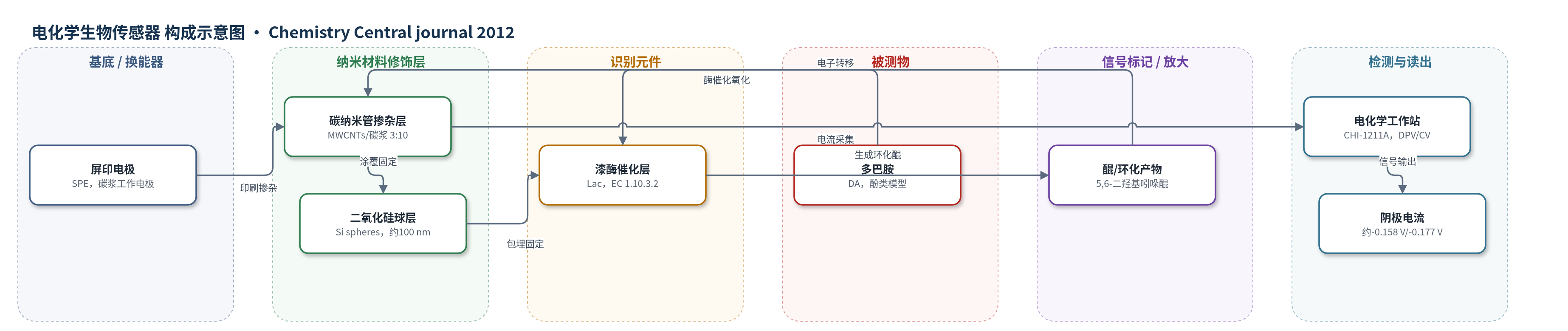
点击图片查看大图 · 依据论文自动绘制
传感器类型
电化学生物传感器
检测对象
多巴胺(dopamine, DA);样品基质:0.10 M PBS缓冲溶液(pH 5.0,酚类化合物模型)
检测原理
该传感器以漆酶(Lac)为生物识别/催化元件,固定在二氧化硅球和多壁碳纳米管(MWCNTs)修饰的屏印电极(SPE)上。检测时,多巴胺(DA)在 Lac 催化下被氧化为醌类中间体,随后发生去质子化、分子内环化及歧化/氧化,生成 5,6-二羟基吲哚醌。该产物在约 -0.158 V 的负电位下发生两电子两质子准可逆还原,产生与 DA 浓度成正比的阴极电流。MWCNTs 提供高比表面积和快速电子转移通道,二氧化硅球形成多孔保护微环境,提高 Lac 负载量并减少泄漏。由于在负电位读取还原信号,可避免 DA 正电位氧化峰附近其他电活性物质的干扰,实现非氧化机制的选择性检测。
检测灵敏度
LOD: 0.42 μM (S/N = 3);线性范围: 1.3 to 85.5 μM;线性方程: I (μA) = -0.069CDA (μM) – 2.091;R = 0.9908;灵敏度: 2.787 × 10^3 μA mM^-1 cm^-2;Km^app: 3.78 μM;R.S.D: 4.0% (n=5)
效应效果
该传感器对 DA 具有良好选择性:在 85.5 μM DA 溶液中加入 20.0、40.0 和 60.0 μM 抗坏血酸(AA)后,阴极峰电流无明显变化,表明 AA 干扰可忽略。稳定性方面,连续 20 次扫描电流响应保持同一水平;5 个独立制备电极对 60.0 μM DA 的 RSD 为 6.5%,同一电极连续 5 次检测 RSD 为 4.7%。4°C 储存 10 天和 30 天后,响应分别保持初始值的 91.0% 和 86.0%。该传感器无需交联剂,基于非氧化机制,具有快速、低成本、可一次性使用等特点,适用于酚类化合物的原位或便携式分析。
传感器的构成
- 基底/换能器电极:屏印电极(SPE),三电极系统,工作区3.1 mm²,碳浆印刷,提供导电基底与电化学换能。
- 纳米材料掺杂层:多壁碳纳米管(MWCNTs)与碳浆按质量比3:10掺杂,100°C干燥,提供高比表面积、生物相容性和快速电子转移。
- 固定基质层:二氧化硅球(Si spheres,约100 nm,Stöber法由TEOS合成),多孔、大比表面积,作为Lac固定微环境并防止泄漏。
- 识别/催化元件:漆酶(Lac,Trametes versicolor,EC 1.10.3.2,21.8 U mg^-1),催化DA氧化并参与非氧化检测机制。
- 修饰层组装:Lac与Si球按体积比3:2混合24 h后取2.5 μL涂覆于MWCNTs/SPE,溶剂蒸发并水洗去除多余Lac,形成Lac/Si/MWCNTs/SPE。
- 信号读出:便携式电化学工作站(CHI-1211A),采用DPV/CV,在约-0.158 V/-0.177 V读取阴极电流。
中文摘要
生物传感器在公共卫生和环境污染物原位监测中日益受到关注。对于酶基生物传感器,识别元件上酶活性的稳定化至关重要,而有效的固定化技术是构建高质量生物传感器的关键。本文报道了一种一次性电化学生物传感器,将漆酶(Lac)与二氧化硅球共同固定于多壁碳纳米管(MWCNTs)掺杂的屏印电极(SPE)表面,形成 Lac/Si/MWCNTs/SPE。通过扫描电镜(SEM)和循环伏安(CV)表征,结果表明二氧化硅球和 MWCNTs 的孔隙结构、大比表面积及良好生物相容性可实现高负载 Lac 并保持良好电催化活性。以多巴胺(DA)作为酚类化合物的典型模型,该传感器在 1.3–85.5 μM 范围内呈良好线性,检出限为 0.42 μM(S/N=3),表观米氏常数 Km^app 为 3.78 μM。该传感器基于非氧化机制测定 DA,具有快速、选择性和高灵敏度,且无需交联剂即可保持高酶活性和良好稳定性,为酶基生物传感器构建及酚类化合物分析提供了潜在应用。
英文摘要
BACKGROUND: Biosensors have attracted increasing attention as reliable analytical instruments in in situ monitoring of public health and environmental pollution. For enzyme-based biosensors, the stabilization of enzymatic activity on the biological recognition element is of great importance. It is generally acknowledged that an effective immobilization technique is a key step to achieve the construction quality of biosensors.
RESULTS: A novel disposable biosensor was constructed by immobilizing laccase (Lac) with silica spheres on the surface of multi-walled carbon nanotubes (MWCNTs)-doped screen-printed electrode (SPE). Then, it was characterized in morphology and electrochemical properties by scanning electron microscopy (SEM) and cyclic voltammetry (CV). The characterization results indicated that a high loading of Lac and a good electrocatalytic activity could be obtained, attributing to the porous structure, large specific area and good biocompatibility of silica spheres and MWCNTs. Furthermore, the electrochemical sensing properties of the constructed biosensor were investigated by choosing dopamine (DA) as the typical model of phenolic compounds. It was shown that the biosensor displays a good linearity in the range from 1.3 to 85.5 μM with a detection limit of 0.42 μM (S/N = 3), and the Michaelis-Menten constant (Kmapp) was calculated to be 3.78 μM.
CONCLUSION: The immobilization of Lac was successfully achieved with silica spheres to construct a disposable biosensor on the MWCNTs-doped SPE (MWCNTs/SPE). This biosensor could determine DA based on a non-oxidative mechanism in a rapid, selective and sensitive way. Besides, the developed biosensor could retain high enzymatic activity and possess good stability without cross-linking reagents. The proposed immobilization approach and the constructed biosensor offer a great potential for the fabrication of the enzyme-based biosensors and the analysis of phenolic compounds.