组成图示
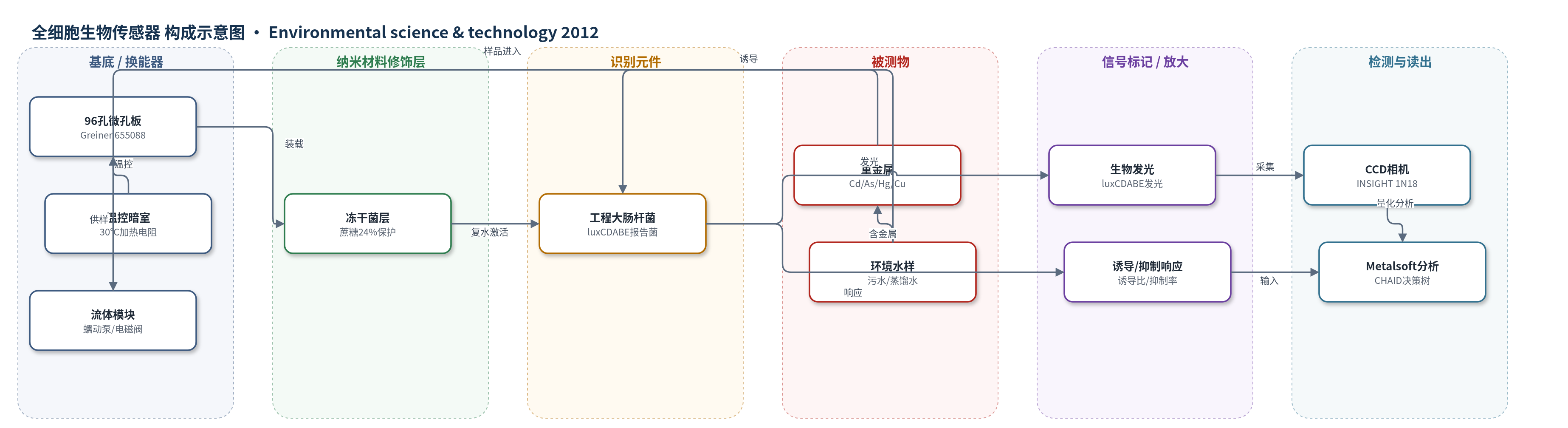
点击图片查看大图 · 依据论文自动绘制
传感器类型
全细胞生物传感器
检测对象
镉(Cd)、砷(As)、汞(Hg)、铜(Cu);样品基质为污水处理厂出水/环境水样及蒸馏水加标样品。
检测原理
传感器以工程化大肠杆菌为识别元件,菌株携带luxCDABE生物发光报告基因,分别受重金属响应启动子MerR-MerRp-MerTp、ZntAp、CopAp、ArsRp-ArsR或组成型启动子Taclux控制。样品中生物可利用金属进入细胞后,激活相应转录调控蛋白,诱导luxCDABE表达并产生生物发光;组成型菌株则因毒性作用发光被抑制。CCD相机读取发光强度,计算诱导比或抑制率。五种菌株的响应模式输入Metalsoft,利用CHAID决策树进行模式识别与半定量,从而在混合金属样品中区分Cd、As、Hg和Cu。信号随金属浓度升高而增强或抑制率增大。
检测灵敏度
未报告LOD、线性范围、灵敏度斜率或R^2。
效应效果
Lumisens III检测500 nM汞时仅7天可用,变化率约40%;原污水中2天后因微生物耗氧发光消失。Lumisens IV在蒸馏水和原污水中10天稳定,重现性约3%,分析时间由360 min缩至90 min。结合Metalsoft识别4次加标事件,与标准化学方法一致:第1天Cd 142.5 nM、Hg 109.9 nM、Cu 49.52 μM;第3天As 8.46 μM;第6天Cd 3.45 μM、Hg 107.4 nM、Cu 47.44 μM;第7天Cu 171.35 μM。作者认为其适合在线水污染监测。
传感器的构成
- 基底/样品池:96孔透明底微孔板(Greiner Bio-One 655088),承载冻干菌并允许CCD读取。
- 保存/保护层:冻干菌与蔗糖(24% w/v)保护剂,铝膜(Corning 6570)密封,维持菌体活性。
- 识别元件:工程化大肠杆菌(E. coli K12 MG1655 pBMerlux/pBZntlux/pBArslux/pBCoplux、E. coli DH1 pBTaclux),含金属响应启动子。
- 信号标记物:luxCDABE生物发光基因(来自Aliivibrio fischeri),受MerR-MerRp-MerTp、ZntAp、CopAp、ArsRp-ArsR或Taclux启动子控制。
- 温控模块:加热电阻(Radiospares 731-350)维持30±1°C,保证菌体复水与发光。
- 流体模块:8通道注射器分配器(Micro10×, Hudson Control)、蠕动泵(Medorex TL)和电磁阀(VICI Valco),注入蒸馏水复水和样品。
- 信号读出:CCD相机(Diagnostic Instruments INSIGHT 1N18)采集生物发光图像,Kodak Scientific Imaging System软件量化。
- 数据分析:Metalsoft软件(CHAID决策树)对五菌株发光响应进行金属识别与半定量。
中文摘要
本研究比较了两种用于环境金属监测的生物发光细菌生物传感器:Lumisens III和Lumisens IV。二者基于相同的诱导型或组成型工程菌,但细胞保存方式不同。Lumisens III将活菌固定在琼脂糖水凝胶中,在实验室条件下仅能稳定检测人工汞污染约7天,信号重现性约40%;在环境样品中,由于环境微生物耗氧,生物发光受到强烈抑制,使用期限缩短至2天。新一代Lumisens IV将冻干细菌置于一次性微孔板卡中,在实验室和环境样品中均可实现10天稳定检测,生物发光信号重现性约3%,单次分析仅需90分钟,而Lumisens III需360分钟。由于调控生物发光报告基因的启动子特异性不足,限制了金属检测;作者结合Lumisens IV与数据分析软件Metalsoft,实现了对镉、砷、汞和铜的可靠在线多金属检测。
英文摘要
In this study, we compared two bacterial biosensors designed for the environmental monitoring of metals: Lumisens III and Lumisens IV. These two biosensors are based on the same bacterial sensors (inducible or constitutive bacterial strains) but with a different conservation mode. The results showed that the biosensor Lumisens III using immobilized cells in agarose hydrogel, allowed to detect artificial mercury contaminations on the limited period of 7 days in laboratory conditions with a reproducibility of 40%. With environmental samples, bioluminescence of the immobilized bacteria inside the biosensor was strongly limited by the environmental microflora because of the lack of oxygen, limiting the use of the biosensor to 2 days. The biosensor of the last generation, Lumisens IV, using freeze-dried bacteria in a disposable card allowed a stable detection during 10 days with 3% of reproducibility of the bioluminescence signal both in laboratory conditions and environmental samples. One analysis was performed in only 90 min against 360 min for Lumisens III. Nevertheless, the lack of specificity of the promoter, which regulates the bioluminescent reporter genes, limits the metal detection. We addressed the problem by using Lumisens IV and a data analysis software namely Metalsoft, developed in previous works. Thanks to this analytical software, Lumisens IV was a reliable online biosensor for the multidetection of Cd, As, Hg, and Cu.