组成图示
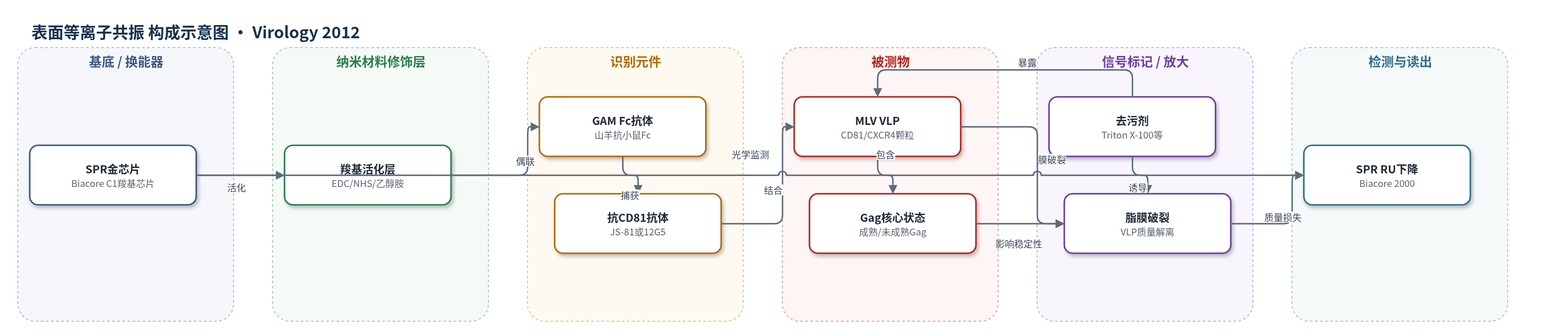
点击图片查看大图 · 依据论文自动绘制
传感器类型
表面等离子共振(SPR)生物传感器
检测对象
小鼠白血病病毒病毒样颗粒(MLV VLPs,含成熟 Gag-Pol 或未成熟 Gag-His/Gag-GFP 核心);样品基质:纯化 VLP 悬液(PBS/HEPES 缓冲液)
检测原理
该检测基于 SPR 质量传感。首先,芯片表面羧基经 EDC/NHS 活化,共价固定山羊抗小鼠 GAM Fc 抗体,再捕获抗 CD81 或抗 CXCR4 单克隆抗体,从而将 MLV VLPs 特异性固定于换能表面。随后以连续流动方式引入不同浓度去污剂。当去污剂达到或超过其 CMC 时,胶束形成并插入/剥离 VLP 脂双层,导致颗粒膜破裂、Gag 核心及膜质量从芯片解离。SPR 共振单位(RU)与芯片表面 200 nm 内质量成正比,因此 VLP 质量损失表现为 RU 实时下降。成熟 Gag 核心使脂膜更易完全裂解,未成熟未切割 Gag 核心则增强脂膜稳定性,使 RU 下降幅度减小。该方法无酶或核酸放大,直接以质量变化反映膜完整性。
检测灵敏度
—
效应效果
该 SPR 破裂检测可区分裂解性与非裂解性去污剂。Triton X-100(CMC 0.2–0.3 mM)在 0.02% v/v 引起成熟 VLP 质量损失;BOG 在 20 mM、CHAPS 在 8 mM、NP-40 在 0.02% v/v、Empigen 在 0.05–0.5% v/v 引起破裂。Tween 20(CMC 0.06 mM)、Tween 80(CMC 0.012 mM)和 Lubrol(CMC 0.1 mM)未引起完全破裂。未成熟 VLPs 在 5% Triton X-100 下仍保留质量,成熟 VLPs 经 Triton X-100 后残留 20–40% 信号,Empigen 可降至 0%。5% Tween 20(4700 倍 CMC)连续 15 min 仅使成熟 VLPs 缓慢部分解离。两种捕获抗体结果一致,无 VLP 对照无基线漂移,n=3。
传感器的构成
- 基底/换能器:Biacore C1 金基 SPR 芯片(表面羧基):提供表面等离子共振换能表面
- 化学活化/封闭层:EDC/NHS 活化羧基并用乙醇胺封闭:形成偶联位点并减少非特异结合
- 固定捕获抗体:山羊抗小鼠 GAM Fc 多克隆抗体:共价固定于芯片并捕获小鼠单克隆抗体
- 识别/捕获抗体:抗 CD81 单克隆抗体 JS-81 或抗 CXCR4 单克隆抗体 12G5:特异性捕获 VLP 表面蛋白
- 目标颗粒:MLV VLPs(含 CD81 或 CXCR4,成熟 Gag-Pol 或未成熟 Gag-His/Gag-GFP):被捕获后暴露去污剂
- 扰动/信号触发物:去污剂(Triton X-100、Tween 20、Tween 80、Lubrol、Saponin、BOG、CHAPS、NP-40、Empigen):诱导脂膜破裂
- 读出系统:Biacore 2000 光学生物传感器:实时监测 SPR 共振单位(RU)质量变化
中文摘要
为阐明去污剂如何破坏包膜病毒,作者利用实时表面等离子共振(SPR)生物传感器监测小鼠白血病病毒(MLV)病毒样颗粒(VLPs)对多种常用去污剂的生物物理稳定性。实验将纯化 VLPs 通过抗 CD81 或抗 CXCR4 抗体捕获到 Biacore 芯片上,在连续流动去污剂时实时监测表面共振单位(RU)变化。结果显示,Triton X-100、β-辛基葡萄糖苷、CHAPS、NP-40 和 Empigen 等去污剂在接近其临界胶束浓度(CMC)时即可引起 VLP 膜破裂和颗粒质量损失;而 Tween 20、Tween 80、Lubrol 和皂苷对 VLP 完全裂解的破坏作用很弱,VLPs 在 Tween 20 高达 CMC 500 倍浓度下仍保持结构完整。含未切割 Gag 多聚蛋白的未成熟核心 VLPs 比成熟核心 VLPs 显著更耐去污剂裂解,提示逆转录病毒 Gag 核心成熟不仅影响蛋白核心稳定性,也降低周围脂双层的稳定性。
英文摘要
To better understand how detergents disrupt enveloped viruses, we monitored the biophysical stability of murine leukemia virus (MLV) virus-like particles (VLPs) against a panel of commonly used detergents using real-time biosensor measurements. Although exposure to many detergents, such as Triton X-100 and Empigen, results in lysis of VLP membranes, VLPs appeared resistant to complete membrane lysis by a significant number of detergents, including Tween 20, Tween 80, Lubrol, and Saponin. VLPs maintained their structural integrity after exposure to Tween 20 at concentrations up to 500-fold above its CMC. Remarkably, VLPs containing immature cores composed of unprocessed (uncleaved) Gag polyprotein were significantly more resistant to detergent lysis than VLPs with mature cores. Although the maturity of retroviral Gag is known to influence the stability of the protein core structure itself, our studies suggest that the maturity of the Gag core also influences the stability of the lipid bilayer surrounding the core.