组成图示
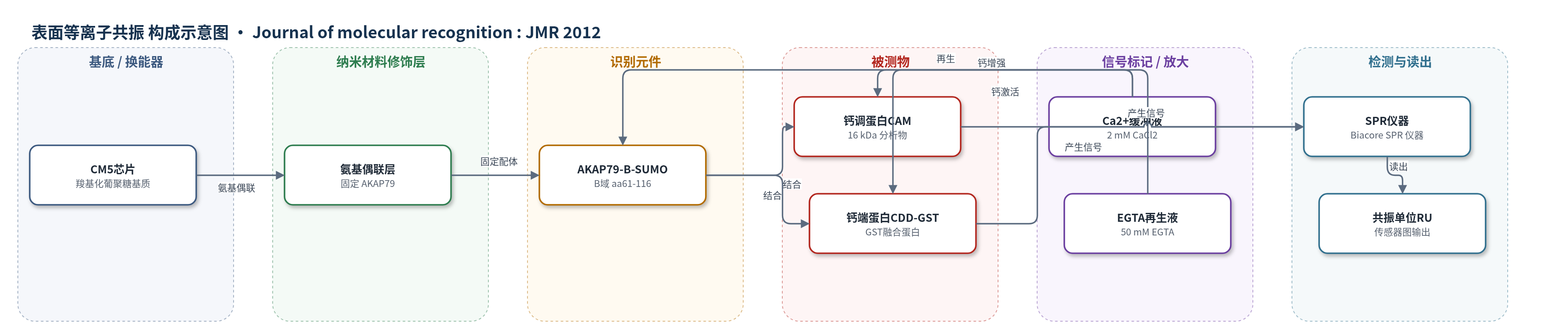
点击图片查看大图 · 依据论文自动绘制
传感器类型
表面等离子共振(SPR)生物传感器
检测对象
钙调蛋白(calmodulin, CAM)、钙端蛋白(caldendrin, CDD;以 CDD-GST 融合蛋白形式);样品基质:SPR 运行缓冲液(Buffer A 含 2 mM Ca2+,Buffer B 含 50 mM EGTA 无钙)
检测原理
AKAP79-B-SUMO 通过氨基偶联固定于 CM5 芯片表面,作为识别元件。CAM 或 CDD-GST 在流动缓冲液中流过芯片,与表面 AKAP79 结合后,界面质量增加,改变表面等离子体共振条件,SPR 仪器以共振单位(RU)实时记录结合/解离传感器图。CAM 与 AKAP79 的结合为可逆单步过程,且依赖 Ca2+;无 Ca2+ 时不结合。CDD-GST 的结合呈双相动力学,符合两步诱导契合模型:先形成初始遭遇复合物,再经构象重排形成稳定复合物;无 Ca2+ 时仍可弱结合,但结合水平降低。竞争实验表明 CAM 与 CDD 结合位点重叠,CAM 可阻断 CDD 结合。信号强度随分析物浓度升高而增加,并通过多浓度动力学拟合获得速率常数和 KD。
检测灵敏度
—
效应效果
AKAP79 表面密度 5000–8000 RU,表观功能约 20%,基线漂移 ≤0.5 RU/min,表面稳定。CAM 结合可被无钙缓冲液完全再生;CDD-GST 难以再生,故用单周期动力学。GST 单独无结合,反转固定实验结果一致,排除标签干扰。CAM k1=2×10^6 s^-1 M^-1,比 CDD k1=9×10^3 s^-1 M^-1 快约 200 倍;KD 分别为 30 nM 和 20 nM。CAM 无钙不结合,CDD 无钙结合低 10 倍。竞争实验中,125 nM CAM 与 250 nM CDD-GST 混合信号增加不足非竞争模拟的 50%,支持位点竞争。作者认为该 SPR 方法可揭示同源蛋白机制差异,有助于理解突触功能。
传感器的构成
- 基底/换能器:CM5 传感器芯片(carboxylated dextran matrix,羧基化葡聚糖基质),提供 SPR 信号换能表面
- 识别元件:AKAP79-B-SUMO(AKAP79 B 域 aa61–116 His-SUMO 融合蛋白),通过氨基偶联固定,作为捕获蛋白
- 分析物:calmodulin(CAM,钙调蛋白)或 caldendrin-GST(CDD-GST,钙端蛋白-GST 融合蛋白),以溶液形式注入
- 离子调节层:Buffer A(25 mM Tris-HCl、150 mM NaCl、2 mM CaCl2、1 mM MgCl2、0.05% Tween-20,pH 7.4)与 Buffer B(无 Ca2+,50 mM EGTA),控制钙依赖结合与再生
- 信号读出:Biacore T200/S51/X100 SPR 仪器,以共振单位(RU)记录传感器图
中文摘要
本研究采用基于生物传感器的方法,测定钙端蛋白(caldendrin, CDD)、钙调蛋白(calmodulin, CAM)与 A 蛋白激酶锚定蛋白 79(AKAP79)B 域之间的相互作用动力学和机制。表面等离子共振(SPR)结果显示,CDD 与 CAM 在 AKAP79 上存在竞争性结合,提示二者结合位点重叠。尽管两者对 AKAP79 的亲和力相近(CDD KD=20 nM,CAM KD=30 nM),但相互作用特征不同。CAM 的结合可用可逆单步模型描述,且仅在 Ca2+ 存在时检测到;CDD 的结合更复杂,推断为诱导契合机制,初始遭遇复合物缓慢松弛并形成稳定复合物。CDD 在无 Ca2+ 条件下也能结合 AKAP79,但速率常数不同。数据支持两种蛋白具有相似的初始 Ca2+ 依赖结合步骤;对 CDD 而言,随后发生 Ca2+ 非依赖的重排步骤,形成稳定复合物。研究强调建立蛋白-蛋白相互作用机制和动力学的重要性,并表明两个同源蛋白相互作用的细微差异可能对其功能特性产生重大影响,为阐明 CDD 和 CAM 在突触功能中的作用提供依据。
英文摘要
The kinetic and mechanistic details of the interaction between caldendrin, calmodulin and the B-domain of AKAP79 were determined using a biosensor-based approach. Caldendrin was found to compete with calmodulin for binding at AKAP79, indicating overlapping binding sites. Although the AKAP79 affinities were similar for caldendrin (K(D) = 20 nM) and calmodulin (K(D) = 30 nM), their interaction characteristics were different. The calmodulin interaction was well described by a reversible one-step model, but was only detected in the presence of Ca(2+). Caldendrin interacted with a higher level of complexity, deduced to be an induced fit mechanism with a slow relaxation back to the initial encounter complex. It interacted with AKAP79 also in the absence of Ca(2+), but with different kinetic rate constants. The data are consistent with a similar initial Ca(2+)-dependent binding step for the two proteins. For caldendrin, a second Ca(2+)-independent rearrangement step follows, resulting in a stable complex. The study shows the importance of establishing the mechanism and kinetics of protein-protein interactions and that minor differences in the interaction of two homologous proteins can have major implications in their functional characteristics. These results are important for the further elucidation of the roles of caldendrin and calmodulin in synaptic function.