组成图示
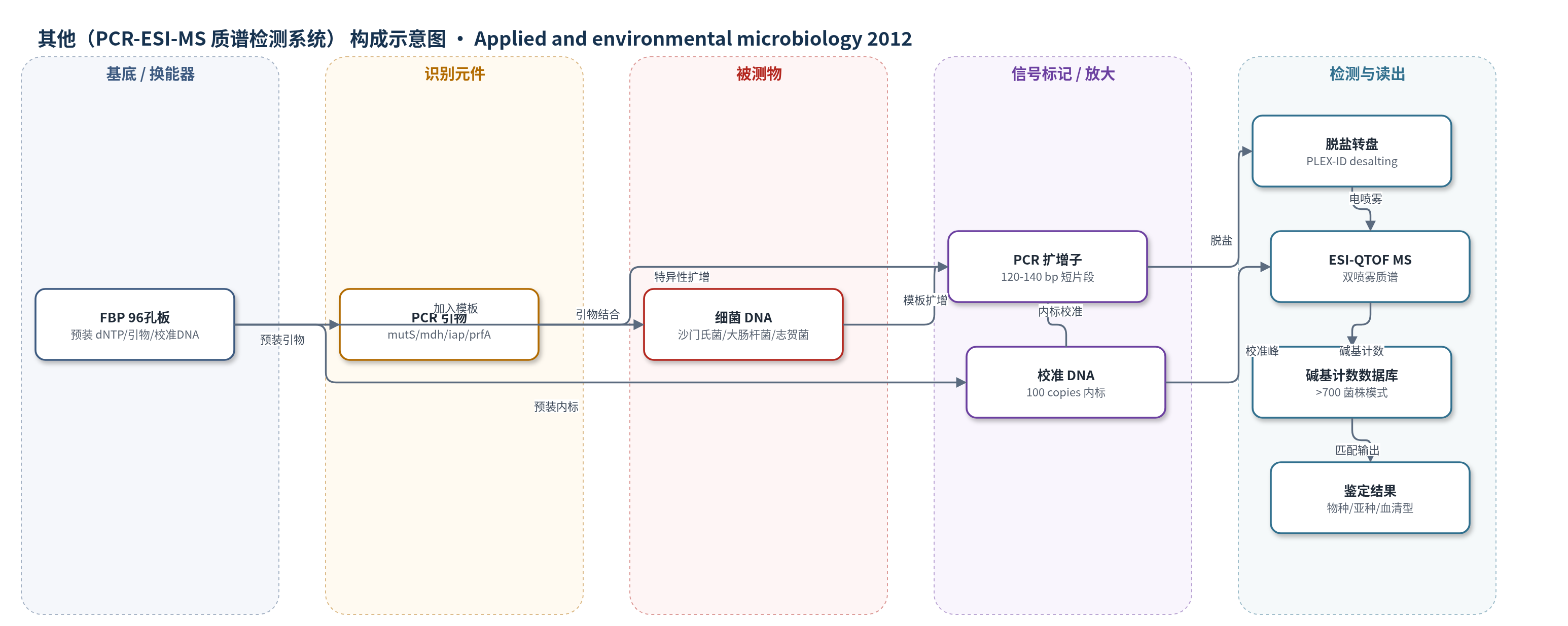
点击图片查看大图 · 依据论文自动绘制
传感器类型
其他(PCR-ESI-MS 质谱检测系统)
检测对象
沙门氏菌(Salmonella enterica)、大肠杆菌(Escherichia coli)、志贺菌(Shigella spp.);方法亦设计用于单核细胞增生李斯特菌(Listeria monocytogenes),但本文未测试;样品基质:纯培养物、食品加标样品、预增菌液(mBPW/TSB/LB)、选择性增菌液(RV/TT)
检测原理
该方法以 PCR 引物作为识别元件,靶向细菌基因组中 mutS、mdh、iap 和 prfA 等可变区,从混合样品中扩增 120–140 bp 短片段。不同菌株因碱基组成不同,扩增子精确质量不同。PCR 实现指数信号放大,孔内预置校准 DNA 用于质量校准。扩增产物经 PLEX-ID 脱盐转盘脱盐后,由双喷雾 ESI-QTOF 质谱离子化并测定质量。软件根据双链互补峰计算 A、G、C、T 碱基计数,并与含 >700 个验证菌株的 FBP 数据库匹配,从而给出物种、亚种和部分血清型鉴定。目标菌扩增子匹配数据库,非目标菌不扩增或匹配为非目标。
检测灵敏度
引物对灵敏度:20 copies 校准 DNA;部分引物 5 copies。
效应效果
纯培养物中,S. enterica 检测率 100%,30% 血清型与血清学一致(95% CI 23–37%);E. coli 检测率 99%,72% 血清群一致(95% CI 65–77%),O157:H7 66/66 一致;Shigella 81% 识别为志贺菌,73% 种水平一致(95% CI 66–78%),S. sonnei 52/52 一致。食品加标预增菌液不稳定:辣椒粉 4/12、番茄 6/12 高置信,奶酪 12/12 正确血清型,鱼 12/12 检出但血清型难分。监管样品预增菌液 16 例多无高质量结果,选择性增菌液 10 例中 9 例高置信,8/10 达血清型水平。非目标革兰阳性菌不扩增,C. freundii 误判为 E. coli。作者认为可缩短鉴定时间,适用于临床和监管实验室。
传感器的构成
- 反应容器:96孔 FBP 检测板(FBP plate),每孔预装 0.2 mM dNTPs、0.5 μM PCR 引物和 100 copies 校准 DNA,用于分室 PCR 扩增
- 识别元件:8 对 PCR 引物,靶向 mutS、mdh、iap 和 prfA 基因片段,用于扩增沙门氏菌、大肠杆菌、志贺菌和李斯特菌靶序列
- 酶与缓冲体系:Immolase DNA 聚合酶和 PCR buffer,用于扩增并降低商业聚合酶中残留 E. coli DNA 的干扰
- 模板样品:细菌 DNA,由煮沸法或 PrepSEQ/MagMax 系统从纯培养物、预增菌液或选择性增菌液中提取
- 样品处理模块:PLEX-ID 脱盐转盘(desalting carousel),用于 PCR 扩增子脱盐
- 换能检测模块:双喷雾 ESI 四极杆飞行时间质谱仪(dual-sprayer ESI-QTOF MS),用于测定扩增子质量并计算碱基计数
- 数据识别模块:PLEX-ID FBP 数据库,包含 >700 个验证菌株的碱基计数模式,用于匹配物种、亚种和血清型
中文摘要
本研究与 Ibis Biosciences 合作,为 PLEX-ID 生物传感器系统开发了一种用于鉴定常见食源性病原菌沙门氏菌、大肠杆菌、志贺菌和单核细胞增生李斯特菌的检测方法。该平台利用电喷雾电离质谱(ESI-MS)检测短 PCR 扩增子的碱基组成。新设计的食源性病原菌(FBP)检测板使用 4 个基因片段,共设置 8 个扩增子靶标。前期工作建立了 DNA 碱基计数数据库,包含 140 多种沙门氏菌、139 种大肠杆菌、11 种志贺菌、36 种李斯特菌模式以及 18 种其他肠杆菌科菌。研究分析了 800 多株沙门氏菌、大肠杆菌和志贺菌分离株,总体检测率分别为 100%、99% 和 73%,并能将 30% 的沙门氏菌鉴定到血清型水平。加标食品基质和监管现场样品测试显示,预增菌液分析不稳定,而选择性增菌液可使 10 个监管样品中的 8 个达到血清型水平鉴定。结果表明,该高通量方法可用于临床和监管实验室检测这些病原菌。
英文摘要
An assay to identify the common food-borne pathogens Salmonella, Escherichia coli, Shigella, and Listeria monocytogenes was developed in collaboration with Ibis Biosciences (a division of Abbott Molecular) for the Plex-ID biosensor system, a platform that uses electrospray ionization mass spectroscopy (ESI-MS) to detect the base composition of short PCR amplicons. The new food-borne pathogen (FBP) plate has been experimentally designed using four gene segments for a total of eight amplicon targets. Initial work built a DNA base count database that contains more than 140 Salmonella enterica, 139 E. coli, 11 Shigella, and 36 Listeria patterns and 18 other Enterobacteriaceae organisms. This assay was tested to determine the scope of the assay's ability to detect and differentiate the enteric pathogens and to improve the reference database associated with the assay. More than 800 bacterial isolates of S. enterica, E. coli, and Shigella species were analyzed. Overall, 100% of S. enterica, 99% of E. coli, and 73% of Shigella spp. were detected using this assay. The assay was also able to identify 30% of the S. enterica serovars to the serovar level. To further characterize the assay, spiked food matrices and food samples collected during regulatory field work were also studied. While analysis of preenrichment media was inconsistent, identification of S. enterica from selective enrichment media resulted in serovar-level identifications for 8 of 10 regulatory samples. The results of this study suggest that this high-throughput method may be useful in clinical and regulatory laboratories testing for these pathogens.