组成图示
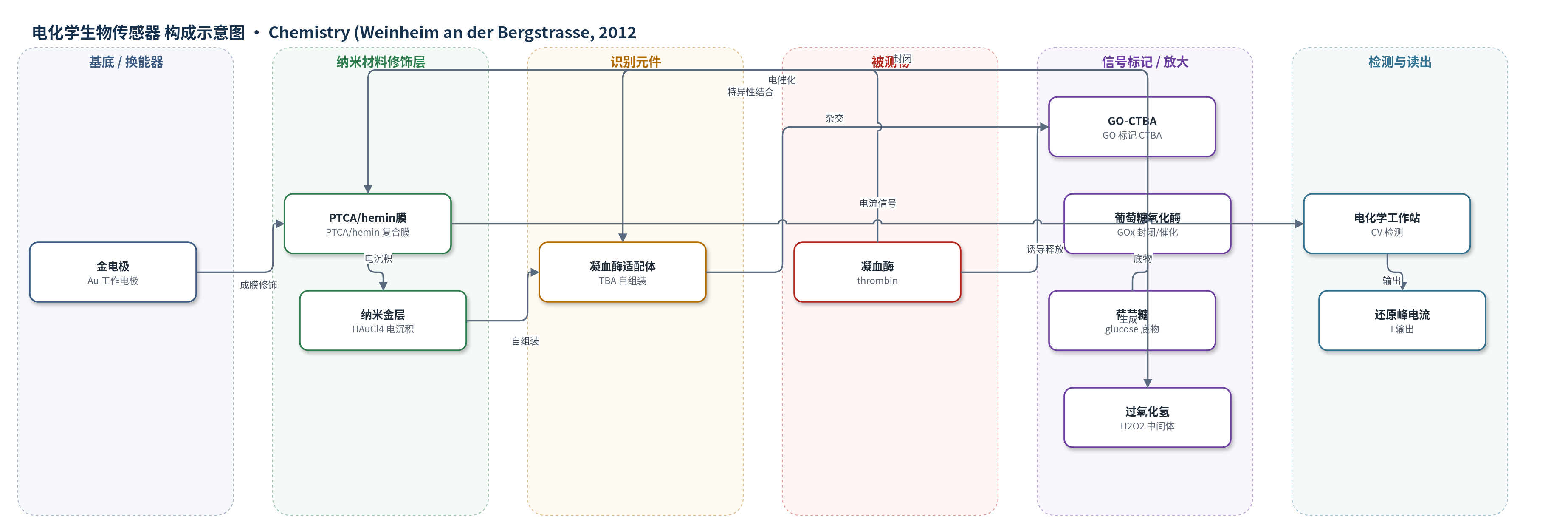
点击图片查看大图 · 依据论文自动绘制
传感器类型
电化学生物传感器
检测对象
凝血酶(thrombin);样品基质:人血清(human blood serum)加标样品
检测原理
传感器表面 TBA 与 GO-CTBA 杂交,GO 形成空间位阻,抑制电子传递。凝血酶与 TBA 特异性结合后,GO-CTBA 释放,界面位阻降低,有利于假双酶通道放大。检测液中葡萄糖被表面 GOx 生物电催化氧化生成 H2O2,H2O2 再被 PTCA/hemin 纳米复合膜的类过氧化物酶活性电催化还原,产生阴极电流。凝血酶浓度越高,释放的 GO-CTBA 越多,通道开放程度越大,还原峰电流越大。该级联酶促与电催化耦合实现信号放大。
检测灵敏度
LOD: 0.001 nm;线性范围: 0.005–20 nm;灵敏度斜率: -40.2578(I/mA 对 log c/nm);R^2 = 0.9906
效应效果
该传感器对凝血酶具有良好选择性,BSA、BHB 及三者混合液均无明显电流变化,而目标凝血酶引起显著电流增加。加入葡萄糖的假双酶通道策略显著增强灵敏度,线性范围由无葡萄糖时的 0.05–20 nm 扩展至 0.005–20 nm,且信号变化更明显。人血清加标回收率为 90.3%–109%,相对标准偏差为 4.7%–8.1%,表明其适用于真实生物样品分析。作者认为葡萄糖化学惰性有助于提高传感器稳定性并延长使用寿命,该策略较传统酶基适配体传感器更简单,具有临床诊断应用潜力。
传感器的构成
- 基底电极:金电极(Au)作为工作电极与电子转导基底
- 纳米复合材料修饰层:PTCA/hemin 纳米复合材料(PTCA/hemin)成膜,提供明确氧化还原峰并电催化 H2O2
- 纳米金修饰层:HAuCl4 电沉积形成纳米金(nano-Au),用于固定巯基适配体
- 识别元件:巯基末端凝血酶适配体(TBA)自组装单层,特异性识别凝血酶
- 信号标记/空间位阻元件:氧化石墨烯标记互补凝血酶适配体(GO-CTBA)与 TBA 杂交,GO 增加空间位阻,凝血酶结合后释放
- 封闭与酶催化层:葡萄糖氧化酶(GOx)封闭非特异位点并催化葡萄糖生成 H2O2
- 底物/电子供体:葡萄糖(glucose)作为 GOx 底物,经生物电催化产生 H2O2 供 PTCA/hemin 电催化
中文摘要
本文报道了一种通过π–π相互作用合成3,4,9,10-菲四羧酸(PTCA)/血卟啉(hemin)纳米复合物的简单湿化学策略。hemin 成功将 PTCA 的氧化还原活性协调为一对定义明确的氧化还原峰,并赋予其固有的类过氧化物酶活性,使 PTCA 自身衍生的氧化还原活性可作为氧化还原探针使用。此外,PTCA/hemin 纳米复合物具有良好的成膜性能,既避免了传统氧化还原探针固定化中繁琐的包埋、共价连接或自组装过程,又减少了作为电子传递屏障的成膜材料参与。基于这些特性,作者构建了与葡萄糖氧化酶(GOx)耦合的假双酶通道放大电化学适配体传感器,用于凝血酶检测。检测时向电解池中加入葡萄糖,传感器表面的 GOx 生物电催化葡萄糖氧化生成 H2O2,H2O2 再被 PTCA/hemin 纳米复合物电催化。这种酶促级联方案可产生信号放大,从而提高传感器灵敏度。最终获得凝血酶 0.005–20 nm 的线性关系和 0.001 nm 的检出限。
英文摘要
A simple wet-chemical strategy for the synthesis of 3,4,9,10-perylenetetracarboxylic acid (PTCA)/hemin nanocomposites through π-π interactions is demonstrated. Significantly, the hemin successfully conciliates PTCA redox activity with a pair of well-defined redox peaks and intrinsic peroxidase-like activity, which provides potential application of the PTCA self-derived redox activity as redox probes. Additionally, PTCA/hemin nanocomposites exhibit a good membrane-forming property, which not only avoids the conventional fussy process for redox probe immobilization, but also reduces the participation of the membrane materials that act as a barrier of electron transfer. On the basis of these unique properties, a pseudobienzyme-channeling amplified electrochemical aptasensor is developed that is coupled with glucose oxidase (GOx) for thrombin detection by using PTCA/hemin nanocomposites as redox probes and electrocatalysts. With the addition of glucose to the electrolytic cell, the GOx on the aptasensor surface bioelectrocatalyzed the reduction of glucose to produce H(2)O(2), which in turn was electrocatalyzed by the PTCA/hemin nanocomposites. Cascade schemes, in which an enzyme is catalytically linked to another enzyme, can produce signal amplification and therefore increase the biosensor sensitivity. As a result, a linear relationship for thrombin from 0.005 to 20 nM and a detection limit of 0.001 nM were obtained.