组成图示
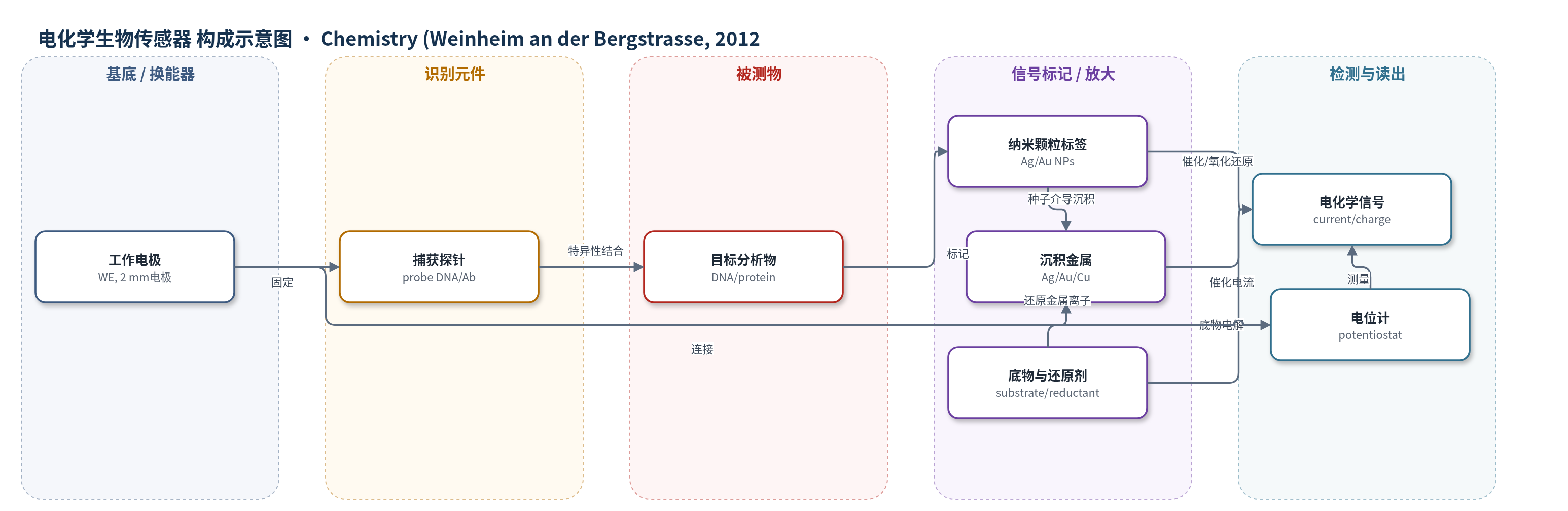
点击图片查看大图 · 依据论文自动绘制
传感器类型
电化学生物传感器
检测对象
DNA(DNA)、蛋白质(protein,如 hIgG);样品基质:溶液相,原文未指定具体实际基质
检测原理
传感器先以捕获探针(probe DNA 或抗体)固定于工作电极表面,目标 DNA/蛋白结合后,再与分析物特异性生物分子偶联的纳米颗粒标签结合。纳米颗粒通过四种机制放大信号:增加电活性物质负载、作为超微电极阵列催化高浓度底物电解、作为种子介导金属沉积、介导电催化剂沉积。换能机制为电极/纳米颗粒界面的氧化还原、剥离或催化电流,信号随结合分析物数量增加而增大。由于纳米颗粒扩散层重叠,质量传输限制会使校准曲线在结合未饱和时提前平台化。
检测灵敏度
未报告
效应效果
该文为理论模拟研究,未提供实验选择性、稳定性、重现性、回收率或与 ELISA/HPLC/qPCR 的对比数据。模拟表明,四种纳米颗粒放大策略均可提高灵敏度,并将动态范围向低浓度移动;但案例 2–4 中校准曲线平台早于结合等温线平台,非特异性吸附影响更显著。文中指出,案例 4 中仅约 40000 个 10 nm 纳米颗粒(表面覆盖度 1e-6)即可引发平台响应。作者建议采用无标签检测、高亲和识别分子、抗污表面、流动系统、较弱还原剂及空白对照来改善。
传感器的构成
- 工作电极:理论模型中的工作电极(working electrode, WE),文中以 2 mm 直径电极为例;示例中提及 Pt 电极
- 识别元件:捕获探针(capture probe),可为探针 DNA(probe DNA)或捕获抗体(capture antibody),共价固定于电极表面
- 被测物结合层:目标 DNA/蛋白(target DNA/protein analyte),与捕获探针特异性结合
- 信号标记层:纳米颗粒标签(nanoparticle labels, NPLs),如 Ag/Au 纳米颗粒,偶联分析物特异性生物分子
- 催化/沉积试剂:显色/沉积液(developer solution),含金属离子(metal ions, Mn+)与强还原剂(strong reductant)
- 底物/电子供体:高浓度底物(substrate, Ox/Red)或抗坏血酸(ascorbic acid),用于催化电解或金属沉积
中文摘要
本文对用于检测 DNA 和蛋白质的电化学生物传感器进行了理论研究,重点考察采用纳米颗粒标签进行信号放大时,分析物表面结合与质量传输对传感器性能的影响。作者通过数值模拟分析了四种纳米颗粒放大策略:1)纳米颗粒用于增加电活性物质负载,或在拟一级条件下作为催化剂;2)纳米颗粒作为超微电极阵列,用于电解高浓度底物;3)纳米颗粒作为种子,介导可电化学检测物质的沉积;4)纳米颗粒介导电催化剂的沉积。结果表明,在上述所有条件下,纳米颗粒标签均可实现高灵敏度检测。但理论分析指出,在案例 2–4 中,由于表面结合化学与基于质量传输的信号放大原理之间存在不匹配,非特异性吸附可能更为突出;此时信号会在远低于分析物结合达到平台时的浓度处提前进入平台。文章还讨论了可能解决上述局限性的策略。
英文摘要
This paper presents a theoretical study of electrochemical affinity biosensors for the detection of DNA/protein that utilize nanoparticle labels for signal amplification. This study analyzes the effects of binding and mass transport of the analytes on biosensor performance by using numerical simulations. Four cases were considered: 1) nanoparticles used to increase the loading of an electroactive species, or used as catalysts under pseudo-first-order conditions; 2) nanoparticles used as ultramicroelectrode arrays for the electrolysis of large concentrations of substrate; 3) nanoparticles used as seeds to deposit electrochemically detectable species; and 4) nanoparticles used to mediate the deposition of electrocatalysts. By using nanoparticle labels, high sensitivity is possible under all conditions considered. However, theoretical findings suggested that nonspecific adsorption could be more problematic in cases 2-4 due to the mismatch between the chemistry of surface binding and the principle of signal amplification that originates from the effect of mass transport. Under these conditions, any given signal would plateau at a much lower analyte concentration, well before the analyte binding had actually reached a plateau. Views on possible solutions to the above limitations are also presented.