组成图示
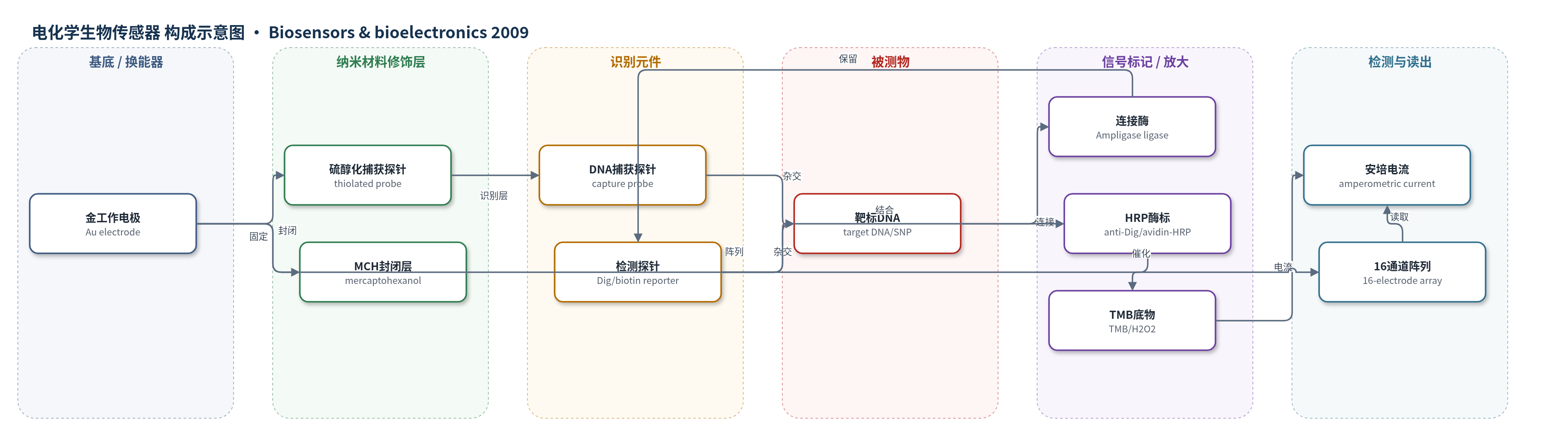
点击图片查看大图 · 依据论文自动绘制
传感器类型
电化学生物传感器
检测对象
DNA靶标(target DNA)、单核苷酸多态性DNA(SNP DNA);样品基质:PBS缓冲液溶液(体外混合靶标)。
检测原理
硫醇化DNA捕获探针通过Au-S键固定于金电极,与靶标DNA杂交;带Dig或biotin标记的检测探针与靶标另一端杂交形成夹心结构。多靶标检测中,anti-Dig-HRP结合Dig标记;SNP检测中,Ampligase连接酶仅在捕获探针与检测探针完全互补时连接二者,使检测探针在严格洗涤后保留,若存在1碱基错配则不连接并被洗去。随后avidin-HRP或anti-Dig-HRP结合标记,HRP催化TMB与H2O2反应生成可电化学还原产物,TMB作为电子穿梭体在电极上产生还原电流,安培电流随靶标浓度和结合量增加而增大,实现酶促放大和SNP区分。
检测灵敏度
原文未报告 LOD、线性范围、灵敏度斜率或相关系数。
效应效果
该传感器在16通道阵列上实现4种DNA靶标同时检测,15个捕获探针中仅4个与靶标互补,对应通道信号显著高于背景(>3 S.D.)。10 nM靶标的安培电流约650 nA,无靶标背景低于50 nA。阵列重现性较好,电极间变异约7.5%,阵列间变异约12%(5次独立实验)。SNP检测中,完全互补靶标信号显著高于1碱基错配序列,表明连接酶策略可有效区分单碱基差异。论文未报告实际生物样品加标回收率或与ELISA/HPLC/qPCR的定量对比,但作者认为该平台可用于多重DNA分析和SNP分型,具有简单、准确、低成本和可自动化潜力。
传感器的构成
- 基底/换能器电极:金工作电极(Au working electrode),16通道微加工传感器阵列,提供电化学信号转换与读取。
- 自组装修饰层:硫醇化DNA捕获探针(thiolated capture probe)通过Au-S键固定于金电极;MCH(mercaptohexanol)处理形成有序DNA单分子层。
- 识别元件:DNA捕获探针(capture probe)与靶标DNA杂交;检测/报告探针(reporter probe)带Dig或biotin标记,与靶标另一端杂交形成夹心结构。
- 连接酶识别元件:Ampligase连接酶,在无错配时连接捕获探针与生物素标记检测探针,提高SNP区分。
- 信号标记物:抗地高辛-辣根过氧化物酶(anti-Dig-HRP)或亲和素-辣根过氧化物酶(avidin-HRP),结合Dig/biotin标记并催化底物。
- 酶促放大元件:辣根过氧化物酶(HRP)催化TMB(3,3′,5,5′-tetramethylbenzidine)/H2O2产生可电化学还原产物,放大电流信号。
- 封闭剂:BSA(bovine serum albumin)和PEG 3350,减少非特异性结合。
中文摘要
本文报道一种用于序列特异性DNA检测的电化学生物传感器,对单核苷酸多态性(SNP)具有高区分能力。该DNA传感器由一对侧翼探针“夹心”靶标构建。采用16电极电化学传感器阵列,每个金电极通过金-硫化学固定一个DNA捕获探针;结合生物素标记检测探针,可在单一阵列上检测多个DNA靶标。为实现SNP检测,采用连接酶策略:当捕获探针和检测探针与靶标杂交后形成串联序列,连接酶仅在没有错配时连接两者,使复合物在严格洗涤后保留在表面;若存在1碱基错配,连接酶可识别错配,检测探针不被连接并被洗去。随后通过生物素-亲和素桥接亲和素-辣根过氧化物酶(avidin-HRP),电化学检测HRP催化过氧化氢还原产生的电流。结果表明,野生型DNA的电化学信号显著高于含SNP的序列。
英文摘要
We herein report an electrochemical biosensor for the sequence-specific detection of DNA with high discrimination ability for single-nucleotide polymorphisms (SNPs). This DNA sensor was constructed by a pair of flanking probes that "sandwiched" the target. A 16-electrode electrochemical sensor array was employed, each having one individual DNA capture probe immobilized at gold electrodes via gold-thiol chemistry. By coupling with a biotin-tagged detection probe, we were able to detect multiple DNA targets with a single array. In order to realize SNP detection, a ligase-based approach was employed. In this method, both the capture probe and the detection probe were in tandem upon being hybridized with the target. Importantly, we employed a ligase that specifically could ligate tandem sequences only in the absence of mismatches. As a result, when both probes were complementary to the target, they were ligated in the presence of the ligase, thus being retained at the surface during the subsequent stringent washing steps. In contrast, if there existed 1-base mismatch, which could be efficiently recognized by the ligase, the detection probe was not ligated and subsequently washed away. A conjugate of avidin-horseradish peroxidase was then attached to the biotin label at the end of the detection probe via the biotin-avidin bridge. We then electrochemically interrogated the electrical current for the peroxidase-catalyzed reduction of hydrogen peroxide. We demonstrated that the electrochemical signal for the wild-type DNA was significantly larger than that for the sequence harboring the SNP.