组成图示
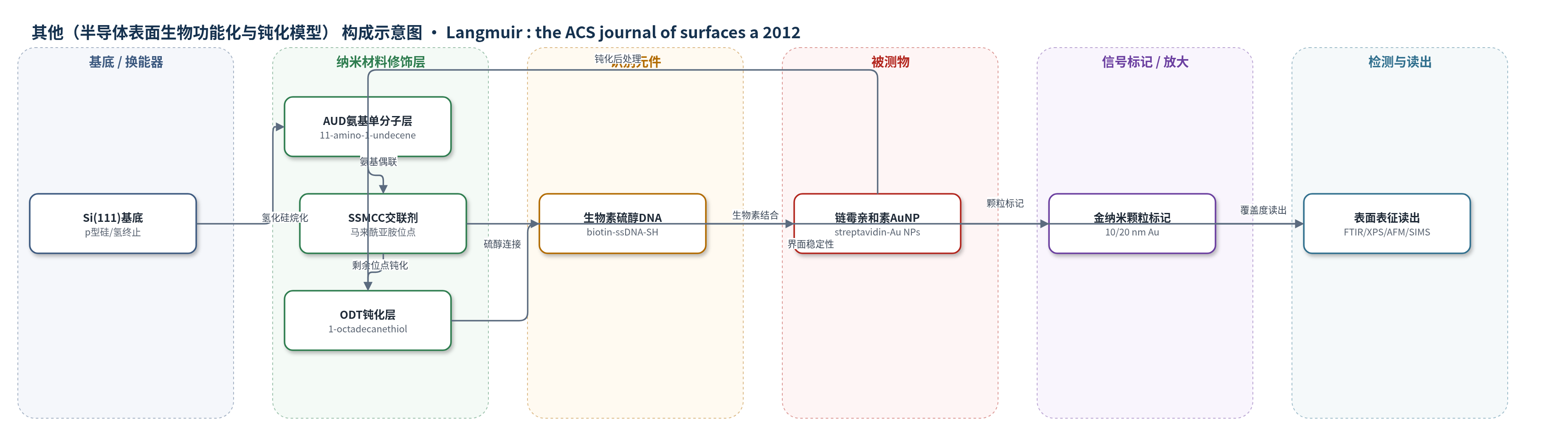
点击图片查看大图 · 依据论文自动绘制
传感器类型
其他(半导体表面生物功能化与钝化模型)
检测对象
无实际分析物;模型结合对象为链霉亲和素包被金纳米颗粒(streptavidin-coated Au NPs);样品基质:缓冲液中的表面模型(非血清、尿液等实际生物样品)
检测原理
该模型以Si(111)为基底,先形成AUD氨基自组装单分子层,再用SSMCC交联剂将5′-生物素-3′-硫醇ssDNA共价固定。ssDNA的3′硫醇与SSMCC的马来酰亚胺位点反应,5′生物素暴露于表面。当加入链霉亲和素包被金纳米颗粒时,生物素-链霉亲和素高亲和结合使AuNP附着在表面;DNA浓度越高,表面生物素位点越多,AuNP覆盖度越高。剩余未反应SSMCC位点用ODT钝化,形成有序烷基层,阻止非特异吸附并抑制硅氧化。信号并非电学输出,而是通过FTIR的CH2伸缩峰、XPS的C/N峰、AFM颗粒高度与密度、ToF-SIMS硫/磷离子信号读出表面覆盖度、界面完整性和钝化效果。
检测灵敏度
—
效应效果
AFM显示低浓度DNA表面AuNP平均高度为8.5±0.8 nm,ODT钝化后降至7.5±0.9 nm;高浓度DNA表面AuNP平均高度约7.5 nm,颗粒密度约为低浓度5倍,与DNA浓度5倍差异一致。FTIR估算低浓度DNA约34%表面SSMCC位点被DNA/AuNP占据,高浓度约73%。XPS中C 1s和N 1s峰增强,Si 2p仅出现轻微SiOx峰,表明SAM/硅界面在多次修饰后仍稳定。ODT钝化后生物素仍可与链霉亲和素-AuNP结合,未观察到非特异结合;延长数天饱和覆盖不变。作者认为该化学钝化策略可用于实际生物传感器表面制备,不降低目标生化反应活性。
传感器的构成
- 基底:p型Si(111)单晶,氢终止表面,作为半导体平台与换能器基底
- 自组装单分子层:11-氨基-1-十一烷(11-amino-1-undecene, AUD)经t-BOC保护后氢化硅烷化形成氨基终止SAM,提供有机界面与氨基反应位点
- 交联剂层:SSMCC(sulfosuccinimidyl-4-(N-maleimidomethyl)-cyclohexane-1-carboxylate)与AUD氨基反应,提供马来酰亚胺位点连接硫醇-DNA
- 识别/探针层:5′-生物素-ssDNA-3′-硫醇(biotin-modified thiol-DNA,10 nt),3′硫醇经DTT还原后与SSMCC连接,5′生物素用于结合链霉亲和素
- 信号/探针颗粒:链霉亲和素包被金纳米颗粒(streptavidin-coated Au NPs,约10或20 nm),通过生物素-链霉亲和素结合作为表面反应性探针
- 钝化/封闭层:1-十八烷硫醇(1-octadecanethiol, ODT)与剩余SSMCC/反应位点反应,形成有序烷基单分子层,阻断非特异结合并保护界面
中文摘要
在开发基于半导体的新型生物传感器及一般半导体生物功能化方案时,关键在于生物修饰后能够阻断表面剩余反应位点,防止其继续发生化学反应。该步骤既用于保护硅基底免受氧化,也用于在分子水平控制最外层生物分子相互作用。本文设计了一种基于单链生物素修饰硫醇-DNA连接在硅基底上的生物传感器模型系统。硫醇-DNA通过连接在Si(111)表面11-氨基-1-十一烷单分子层上的SSMCC交联剂固定到表面。链霉亲和素包被金纳米颗粒用于测试表面反应性并考察钝化在整个方案中的作用。剩余表面反应位点通过与1-十八烷硫醇(ODT)反应实现钝化。该方法同时检验硅/有机层界面稳定性和生物功能化表面的钝化效果。显微与光谱研究结合,对钝化前后的模型系统进行表征。
英文摘要
In developing novel designs for semiconductor-based biosensors and for biofunctionalization of semiconductors in general, it is extremely important to be able to block the reaction sites present on a surface following the biomodification from further chemical transformations. This procedure is required both to protect the surface from oxidation and to allow for molecular-level control of the biomolecular interactions at the topmost layer. In this work, the biosensor model system is designed based on a single-strand biotin-modified thiol-DNA attached to the silicon substrate. The binding of this thiol-DNA to the surface is performed through the cross-linker sulfosuccinimidyl-4-(N-maleimidomethyl)-cyclohexane-1-carboxylate (SSMCC) attached to the 11-amino-1-undecene monolayer on Si(111) surface. Streptavidin-coated gold nanoparticles are used to test the reactivity of the surface and to examine the role of passivation in the entire scheme. The passivation of the remaining surface reactive sites is achieved via a reaction with 1-octadecanethiol (ODT). This approach tests both the stability of the silicon/organic layer interface and the passivation of the biofunctionalized surface on top of the organic layer. Microscopy and spectroscopy studies are combined to interrogate this model system before and after surface passivation.