组成图示
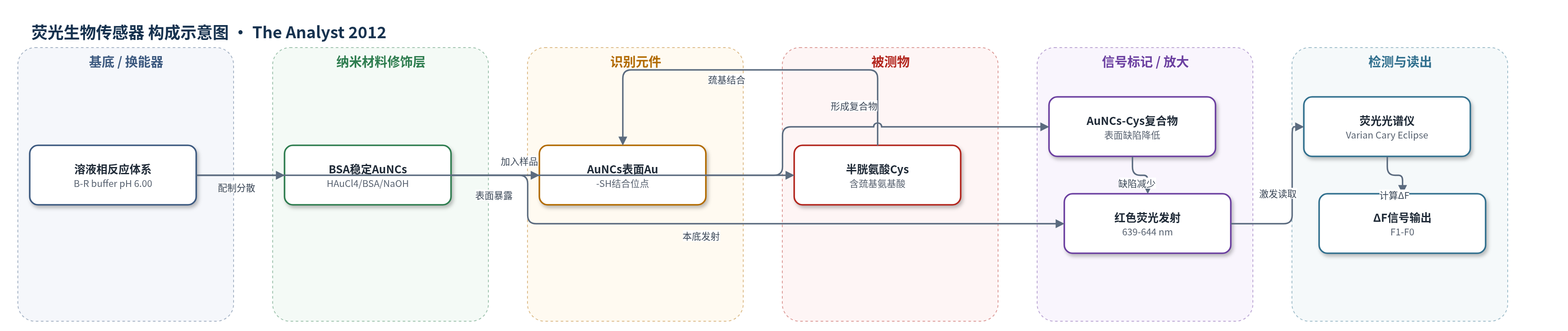
点击图片查看大图 · 依据论文自动绘制
传感器类型
荧光生物传感器
检测对象
半胱氨酸(Cysteine, Cys);样品基质:人血清/血浆(human serum/plasma)
检测原理
BSA作为大分子模板和稳定剂,与HAuCl4在NaOH作用下形成AuNCs,紫外激发后产生红色荧光。检测时,Cys分子中的-SH与AuNCs表面Au原子结合,形成AuNCs–Cys复合物。该结合使团簇表面缺陷和非辐射复合中心减少,荧光强度增强,发射峰由639 nm红移至644 nm。在pH 6.00 B-R缓冲液、40 °C反应40 min条件下,ΔF随Cys浓度增加而增大,并在2.0–800 nmol mL-1范围内呈线性。方法未使用酶、HCR或RCA等外源放大,而是依靠Cys对AuNCs表面缺陷的钝化实现荧光增强。
检测灵敏度
LOD: 1.2 nmol mL-1;线性范围: 2.0–800.0 nmol mL-1;斜率: 0.1284 ΔF/(nmol mL-1);r = 0.9948;LOQ: 4.0 nmol mL-1
效应效果
该方法选择性较好:在200 nmol Cys存在下,多数氨基酸耐受比超过40,甲硫氨酸和谷胱甘肽耐受比超过50,相对误差基本低于5%。体系稳定性良好,冷却后30 min内ΔF基本恒定。重现性RSD为0.62–0.13%。10份人血清加标回收率为96.7–102.0%,与电化学生物传感器结果相对误差小于5%。与比色法、荧光法和电化学生物传感器相比,其线性范围更宽、检出限更低、操作更简单且不使用乙醛等污染试剂,适用于人血清半胱氨酸检测及疾病辅助诊断。
传感器的构成
- 基底/换能器:无独立电极或固体基底,采用溶液相荧光检测,AuNCs作为荧光换能材料
- 纳米材料修饰层:BSA稳定金纳米团簇(AuNCs),由HAuCl4、BSA和NaOH在37 °C下制备,提供红色光致发光
- 识别/结合位点:AuNCs表面Au原子与半胱氨酸(Cys)巯基(-SH)结合,形成AuNCs–Cys
- 反应介质:Britton–Robinson缓冲液(B-R buffer,pH 6.00),维持酸度并增强ΔF
- 信号读出:荧光光谱仪(Varian Cary Eclipse)读取639–644 nm发射强度变化
中文摘要
本研究以牛血清白蛋白(BSA)为稳定剂,采用大分子模板法合成金纳米团簇(AuNCs)。在紫外光激发下,AuNCs可发射稳定的红色光致发光。当半胱氨酸(Cys)与AuNCs作用时,其巯基与团簇表面金原子结合,使AuNCs表面缺陷减少,荧光强度增强,并伴随发射峰红移。基于该荧光增强效应,作者建立了一种测定痕量半胱氨酸的新型荧光法。该方法线性范围为2.0–800 nmol mL-1,检出限为1.2 nmol mL-1,具有较宽线性范围、较高灵敏度和较好选择性,可用于实际样品中半胱氨酸含量测定,结果与电化学生物传感器测定结果一致。同时,采用傅里叶变换红外光谱(FTIR)和高分辨透射电子显微镜(HRTEM)对AuNCs及AuNCs–Cys结构进行表征,并讨论了检测机制。
英文摘要
Gold nanoclusters (AuNCs) were synthesized by a macromolecules template using bovine serum albumin (BSA) as stabilizer which can emit red photoluminescence under illumination of ultraviolet light. The fluorescence intensity of AuNCs enhanced through decreasing the surface defects of AuNCs modified with cysteine, herein we present a novel fluorometry for determination of trace cysteine. This method with a wider linear range from 2.0 to 800 nmol mL(-1), higher sensitivity (detection limit was 1.2 nmol mL(-1)) and better selectivity has been utilized to determine cysteine content in real samples, and the results were in a good agreement with those determined by electrochemical biosensor. At the same time, the structures of AuNCs and AuNCs-cysteine were characterized by Fourier-transform infrared spectroscopy (FTIR) and high resolution transmission electron microscopy (HRTEM) and the mechanism of the proposed assay for the detection of cysteine has been discussed.