组成图示
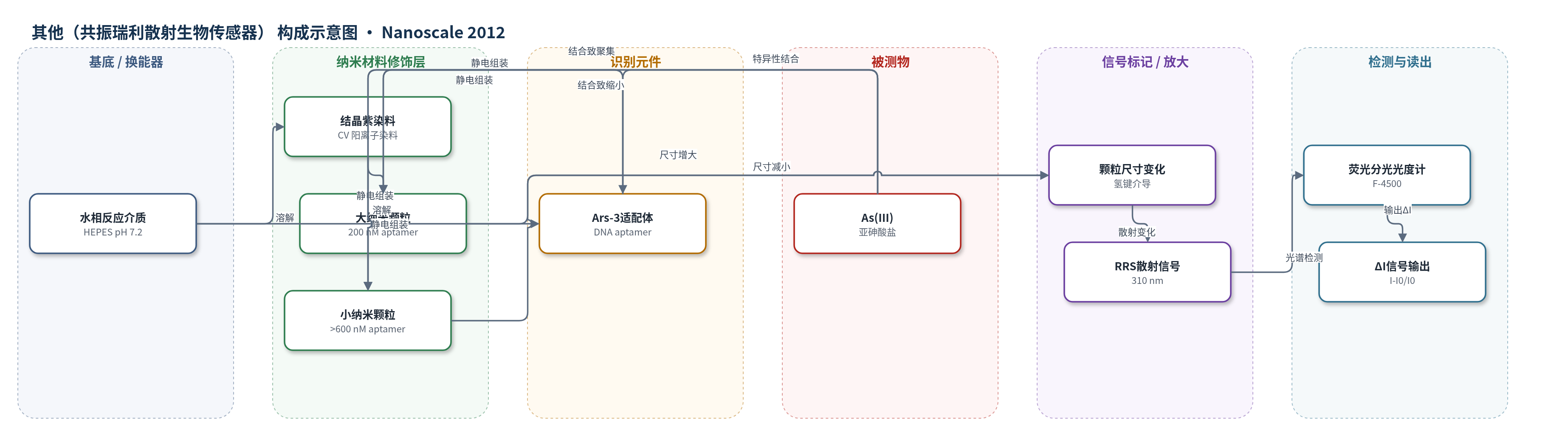
点击图片查看大图 · 依据论文自动绘制
传感器类型
其他(共振瑞利散射生物传感器)
检测对象
三价砷(As(III),arsenite);样品基质:水样/饮用水/环境水样
检测原理
CV 阳离子三苯甲烷染料与带负电磷酸骨架的 Ars-3 适配体通过静电作用及疏水三苯环聚集,组装成 CV-aptamer 纳米颗粒。适配体浓度控制颗粒尺寸:低浓度(约200 nM)形成疏松大颗粒,高浓度(≥600 nM)因适配体竞争结合和静电排斥形成紧密小颗粒。As(III) 与适配体高亲和结合(Kd 7.05 nM),其羟基与 DNA 碱基氨基形成氢键:在大颗粒中形成分子内氢键使颗粒致密化、尺寸减小;在小颗粒中形成分子间氢键使颗粒聚集、尺寸增大。根据 Rayleigh 散射方程,310 nm RRS 强度随颗粒尺寸变化而下降或增强,经荧光分光光度计同步扫描读出 ΔI,实现定量。
检测灵敏度
LOD: 0.2 ppb(biosensor-600);LOD: 0.3 ppb(biosensor-200);动态范围: 0.1 ppb–200 ppb;灵敏度斜率: 0.037(biosensor-200低浓度线性方程 y = 0.037 x + 1.086)、0.051(biosensor-600低浓度线性方程 y = 0.051 x + 1.453);R^2 = 0.998(biosensor-200低浓度线性)、R^2 = 0.997(biosensor-600低浓度线性)、R^2 = 0.973(biosensor-200 Hill拟合)、R^2 = 0.989(biosensor-600 Hill拟合)
效应效果
该传感器对 As(III) 选择性良好:在 10 ppb 的 MMA、DMA、As(V)、Sb(III)、Bi(III)、Pb(II)、Cd(II)、Hg(II)、Ag(I)、Mg(II)、Zn(II)、Mn(II)、Ni(II)、Cu(II)、Fe(II)、Fe(III) 和 Ca(II) 存在下,RRS 信号变化轻微且可忽略。实际水样加标检测中,biosensor-200 与 biosensor-600 的平均回收率为 96.7%–104%,RSD 为 5.2%–10.8%。检测限 0.2 ppb,低于美国 EPA 和 WHO 饮用水砷限值 10 ppb,作者认为其可用于环境水样中痕量 As(III) 的可靠、高灵敏、高选择性监测。原文未报告长期稳定性或批次重现性数据。
传感器的构成
- 识别元件:Ars-3 适配体(DNA aptamer),特异性结合 As(III) 并介导纳米颗粒尺寸变化
- 纳米颗粒组装层:结晶紫(CV)阳离子三苯甲烷染料与适配体静电组装形成 CV-aptamer 纳米颗粒,作为 RRS 散射信号载体
- 信号标记/放大元件:CV 三苯甲基疏水结构聚集形成纳米颗粒,在 310 nm 产生共振瑞利散射(RRS)信号
- 被测物:As(III)(亚砷酸盐,NaAsO2),与适配体结合后通过氢键改变颗粒尺寸
- 反应介质:50 mM HEPES 缓冲液(pH 7.2),维持适配体构象与反应环境
- 读出装置:F-4500 荧光分光光度计(RRS 模式,310 nm),检测散射强度变化并输出 ΔI
中文摘要
近年来,适配体组装纳米材料在分析化学中受到关注,但用于砷检测的适配体生物传感器报道较少。本文开发了一种基于共振瑞利散射(RRS)光谱法的高灵敏、高选择性适配体生物传感器,用于水溶液中三价砷(As(III))检测。检测前,通过控制砷结合适配体(Ars-3 aptamer)在结晶紫(CV)溶液中的浓度,组装出不同尺寸的纳米颗粒。光子相关光谱(PCS)和扫描探针显微镜(SPM)证实,As(III) 的引入确实改变了纳米颗粒尺寸,并导致 310 nm 处 RRS 强度显著变化。在 100 ppb As(III) 存在下,由 200 nM 适配体和 CV 组装的大纳米颗粒 RRS 强度下降最大,平均粒径由 273 nm 降至 168 nm;当适配体浓度超过 600 nM 时,小纳米颗粒 RRS 强度增加最大。结合 RRS 光谱法,利用上述大、小纳米颗粒作为靶标识别元件,构建了有效生物传感器。该传感器检测限低至 0.2 ppb,动态范围为 0.1–200 ppb,并对其他金属离子具有较高选择性,将在环境检测中发挥重要作用。
英文摘要
Aptamer-assembled nanomaterials have captured much attention from the field of analytical chemistry in recent years. Although they have been regarded as a promising tool for heavy metal monitoring, report involving aptamer-based biosensors for arsenic detection are rare. Herein we developed a highly sensitive and selective aptamer biosensor for As(iii) detection based on a Resonance Rayleigh Scattering (RRS) spectral assay. Prior to As(iii) detection, we firstly assembled a variety of nanoparticles with different sizes via controlling the concentration of arsenic-binding aptamers in crystal violet (CV) solutions. The results of photon correlation spectroscopy (PCS) and scanning probe microscope (SPM) testified that the introduction of As(iii) had indeed changed the size of nanoparticles, which caused a great variation in the RRS intensity at 310 nm. In the presence of 100 ppb As(iii), a maximum decline in the ratio of RRS intensity was achieved for large nanoparticles assembled from 200 nM of aptamers and CV molecules, where the average size of nanoparticles had decreased from 273 nm to 168 nm. In the case of small nanoparticles, the maximum increase ratio of the RRS intensity was obtained when the concentration of aptamer was over 600 nM. Combined with an RRS spectral assay, an effective biosensor has been developed for As(iii) detection, using the above large and small nanoparticles as the target recognition element. The present biosensor has a detection limit as low as 0.2 ppb, a dynamic range from 0.1 ppb to 200 ppb, and high selectivity over other metal ions. Such an efficient biosensor will play an important role in environmental detection.