组成图示
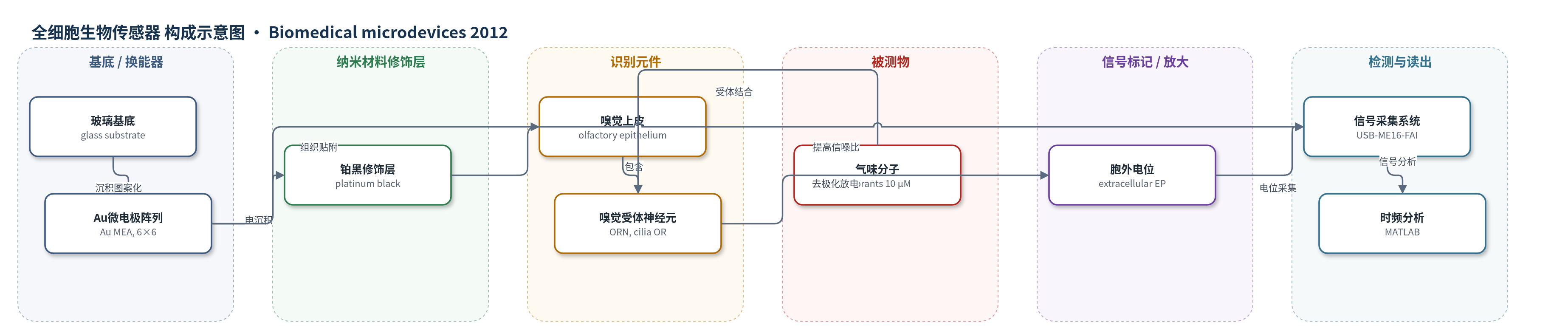
点击图片查看大图 · 依据论文自动绘制
传感器类型
全细胞生物传感器
检测对象
乙醚(ethyl ether)、乙酸(acetic acid)、丁二酮(butanedione)、丙酮(acetone);样品基质为标准灌流液(standard perfusate,10 μM气味分子)
检测原理
该传感器以完整嗅觉上皮中的嗅觉受体神经元(ORN)为识别与换能单元。气味分子(乙醚、乙酸、丁二酮、丙酮)扩散至上皮表面,与ORN纤毛膜上的嗅觉受体(OR)特异性结合,触发嗅觉信号转导级联,引起膜去极化并产生动作电位。由于MEA位于上皮下方,可记录多个ORN的胞外电位。不同气味分子引起不同的振幅、持续时间、放电频率和时频分布,形成特征性响应模式。系统通过USB-ME16-FAI采集电位,经MATLAB进行时域、频域、声谱图和三维模式分析,实现气味识别与区分。该过程依赖生物受体-配体结合和神经电生理转导,无外源化学放大;信号强度主要反映刺激类型与神经元群体放电模式。
检测灵敏度
原文未报告LOD、线性范围、灵敏度斜率或相关系数。
效应效果
可区分乙醚、乙酸、丁二酮、丙酮,并识别丙酮+丁二酮混合;三种以上混合无法有效识别。振幅:乙酸36.18±0.383、丁二酮49.68±0.3899、乙醚78.94±0.6165、丙酮82.93±1.233 μV;持续时间:乙酸687.5±12.5、乙醚582.4±3.784、丙酮674.2±9.967、丁二酮661.2±5.044 ms;频率峰:乙醚0.5、乙酸0.2、丙酮0.3、丁二酮0.15 Hz。作者认为选择性优于传统电子鼻,适用于食品安全、环保和医疗,但细胞毒性影响稳定性与重复性。
传感器的构成
- 基底/换能器电极:玻璃基底上沉积Ti(30 nm)粘附层和Au(300 nm)微电极,形成6×6阵列,电极直径30 μm、间距200 μm,用于记录胞外电位。
- 绝缘层:PECVD沉积Si3N4绝缘层,湿法刻蚀形成电极图案与外部焊盘,实现互连电隔离。
- 电极修饰层:微电极表面电沉积铂黑(platinum black,0.1 V、25 s),提高信噪比。
- 识别元件:完整大鼠嗅觉上皮(olfactory epithelium)纤毛侧朝上贴附于MEA,其中嗅觉受体神经元(ORN)及纤毛膜嗅觉受体(OR)识别气味分子。
- 信号标记物:无外源标记,嗅觉受体神经元(ORN)去极化/动作电位产生的胞外电位作为电生理信号。
- 信号读出:USB-ME16-FAI采集系统(增益1200、噪声20 μV、采样20 kHz)记录电位,MATLAB进行时频分析。
中文摘要
生物混合系统为整合活体生物活性单元与合适生物传感系统提供了机会,以利用生物活性单元的独特性质。生物嗅觉系统能够感知和识别数千种痕量气味。本研究旨在将嗅觉上皮与微电极阵列(MEA)结合,建立嗅觉上皮-MEA混合系统,以记录组织的气味诱导电生理活动。实验中,在乙醚、乙酸、丁二酮和丙酮分别存在下,测量完整上皮中嗅觉受体神经元的胞外电位。对气味诱导响应信号进行时域和频域分析后,提取了响应信号的时间特征。研究发现,嗅觉上皮-MEA混合系统能够反映不同信号特征和放电模式下的体外气味信息。该生物混合传感系统可作为具有良好识别模式、用于感知和检测气味分子的有用仪器。随着传感技术的发展,生物混合系统将成为从医疗保健到环境监测等广泛应用的新兴且前景广阔的平台。
英文摘要
Bio-hybrid systems provide an opportunity for integrating a living bio-active unit and a proper biosensing system, to employ the unique properties of the bio-active unit. The biological olfactory system can sense and identify thousands of trace odors. The purpose of this study is to combine olfactory epithelium with microelectrode array (MEA) to establish an olfactory epithelium-MEA hybrid system to record the odor-induced electrophysiological activities of the tissue. In our experiments, extracellular potential of olfactory receptor neurons in intact epithelium were measured in the presence of ethyl ether, acetic acid, butanedione, and acetone, respectively. After the odor-induced response signals were analyzed in the time and frequency domain, the temporal characteristics of response signals were extracted. We found that olfactory epithelium-MEA hybrid system can reflect the in vitro odor information of different signal characteristics and firing modes in vitro. The bio-hybrid sensing system can represent a useful instrument to sense and detect the odorant molecules with well recognizing patterns. With the development of sensor technology, bio-hybrid systems will represent emerging and promising platforms for wide applications, ranging from health care to environmental monitoring.