组成图示
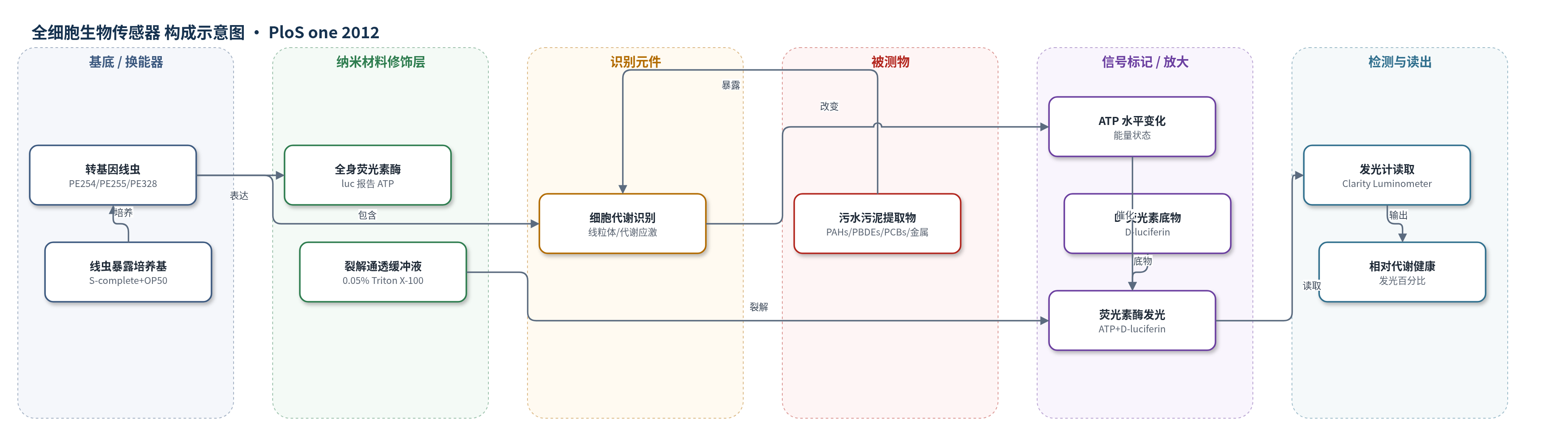
点击图片查看大图 · 依据论文自动绘制
传感器类型
全细胞生物传感器
检测对象
污水污泥提取物(sewage sludge extract, SSE;含 PAHs、PBDEs、PCBs、Cr/Cu/Zn 等),样品基质为 DMSO 溶解的污泥提取物/线虫暴露液。
检测原理
该传感器以转基因线虫为整体换能器。SSE 中的 PAHs、PBDEs、PCBs 和金属等污染物进入线虫后,干扰线粒体呼吸与细胞能量代谢,使 ATP 水平下降;这一代谢应激即识别事件。线虫全身表达荧光素酶(luc),其活性依赖 ATP。检测时加入含 D-荧光素(D-luciferin)和 Triton X-100 的发光缓冲液,裂解/通透细胞并供给底物;荧光素酶催化 D-luciferin 与 ATP、O2 反应生成氧化荧光素并释放光子。发光强度正比于细胞内 ATP 水平,因此 SSE 浓度越高、代谢抑制越强,短暴露下生物发光越低;长暴露后线虫启动解毒/代偿机制,ATP 和发光可恢复。无 HCR/RCA 等核酸放大,信号放大来自酶催化发光和全组织 ATP 池。
检测灵敏度
原文未报告 LOD、线性范围、灵敏度斜率或 R^2。
效应效果
该传感器对真实污水污泥提取物呈浓度依赖响应:L4 幼虫短暴露(≤8 h)发光降至 1% DMSO 对照的 50–60%,22–24 h 恢复;L1 暴露致生长减慢、产卵延迟,94–98 h 后代数较培养基对照下降 73%(SSE)和 53%(DMSO),SSE 较 DMSO 额外下降 20%。400 mM FUdR 下 SSE 中位寿命 16.3 d,短于 DMSO 19.6 d 和培养基 21.1 d;600 mM 下为 18.1 d、22.3 d、24.6 d。GFP 监测显示 L4 暴露 24 h 内 luc 表达无显著变化,体外酶实验示 1% SSE 仅降低荧光素酶活性 10%,提示信号主要反映 ATP 代谢。作者认为其快速、定量、全组织,适合复杂污染物混合物高通量风险评估。
传感器的构成
- 整体换能器/识别单元:转基因秀丽隐杆线虫(C. elegans)品系 PE254/PE255/PE328,全身表达荧光素酶(luc),将细胞内 ATP 水平转化为生物发光。
- 识别元件:线虫细胞与组织直接暴露于污染物,无特异性抗体/适配体,通过线粒体呼吸和代谢应激响应实现毒性识别。
- 信号底物:D-荧光素(D-luciferin),在荧光素酶催化下与 ATP 和 O2 反应生成发光产物。
- 信号读出介质:含 S-complete、1% DMSO、0.05% Triton X-100 和 100 mM D-luciferin 的发光缓冲液,用于裂解/通透线虫并供给底物。
- 培养/暴露基质:S-complete 液体培养基加 OP50 大肠杆菌,置于 96 孔板中,维持线虫存活并暴露于 SSE。
- 溶剂/对照:1% DMSO,用于溶解污水污泥提取物(SSE)并作为溶剂对照。
- 读出仪器:Clarity Luminometer(BioTek),测量生物发光强度并换算为相对 ATP/代谢健康。
中文摘要
本研究利用一种转基因秀丽隐杆线虫(Caenorhabditis elegans)品系,其全身表达荧光素酶,生物发光可反映整体 ATP 水平,作为新型全细胞生物传感器,检测经二氯甲烷提取并以 DMSO 溶解的污水污泥提取物(SSE)中环境污染物混合物的亚致死效应。L4 幼虫短暴露(≤8 h)后,生物发光随 SSE 浓度升高而下降至溶剂对照(1% DMSO)的 50–60%,提示能量状态受损;延长暴露至 22–24 h 后发光恢复。自 L4 阶段持续暴露并加入 400–600 mM 5-氟-2'-脱氧尿苷(FUdR)抑制繁殖时,SSE 组中位寿命短于 DMSO 和培养基对照,表明 FUdR 延长寿命的作用被 SSE 抵消。自 L1 阶段暴露导致生长减慢和产卵延迟,但达到生殖期后产卵率和子宫内卵数无显著变化。1% DMSO 本身对 L1 生长和 L4 繁殖有显著抑制。结果表明,该生物发光 ATP 传感器是一种新颖、敏感、快速、定量的全组织检测系统,适用于复杂环境污染物混合物的高通量风险评估。
英文摘要
A transgenic strain of the model nematode Caenorhabditis elegans in which bioluminescence reports on relative, whole-organism ATP levels was used to test an environmentally-relevant mixture of pollutants extracted from processed sewage sludge. Changes in bioluminescence, following exposure to sewage sludge extract, were used to assess relative ATP levels and overall metabolic health. Reproductive function and longevity were also monitored. A short (up to 8 h) sublethal exposure of L4 larval stage worms to sewage sludge extract had a concentration-dependent, detrimental effect on energy status, with bioluminescence decreasing to 50-60% of the solvent control (1% DMSO). Following longer exposure (22-24 h), the energy status of the nematodes showed recovery as assessed by bioluminescence. Continuous exposure to sewage sludge extract from the L4 stage resulted in a shorter median lifespan relative to that of solvent or medium control animals, but only in the presence of 400-600 µM 5-fluoro-2'-deoxyuridine (FUdR), which was incorporated to inhibit reproduction. This indicated that FUdR increased lifespan, and that the effect was counteracted by SSE. Exposure to sewage sludge extract from the L1 stage led to slower growth and a delayed onset of egg laying. When L1 exposed nematodes reached the reproductive stage, no effect on egg laying rate or egg number in the uterus was observed. DMSO itself (1%) had a significant inhibitory effect on growth and development of C. elegans exposed from the L1 stage and on reproduction when exposed from the L4 stage. Results demonstrate subtle adverse effects on C. elegans of a complex mixture of environmental pollutants that are present, individually, in very low concentrations and indicate that our biosensor of energy status is a novel, sensitive, rapid, quantitative, whole-organism test system which is suitable for high throughput risk assessment of complex pollutant mixtures.