组成图示
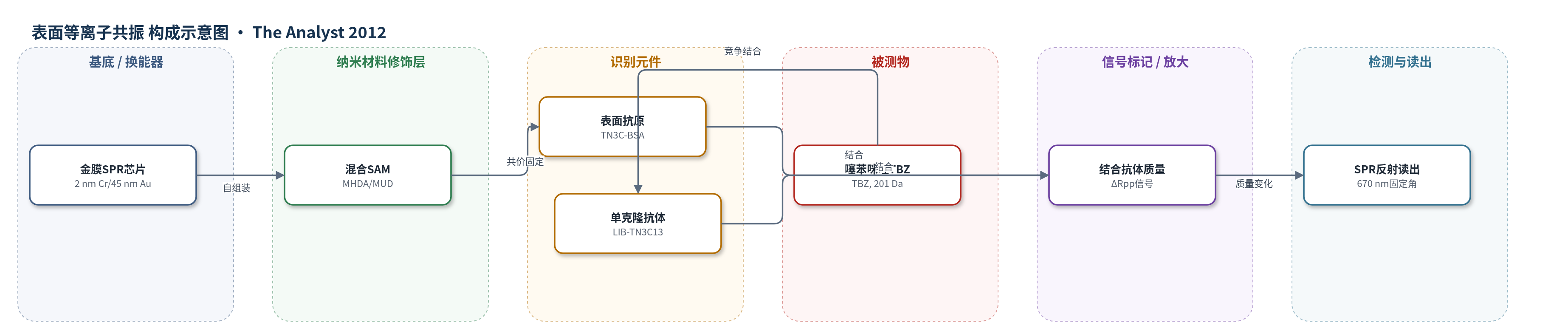
点击图片查看大图 · 依据论文自动绘制
传感器类型
表面等离子共振(SPR)生物传感器
检测对象
噻苯咪唑(Thiabendazole, TBZ);样品基质:完整橙子(whole oranges)甲醇提取液及PBST(0.05)稀释液
检测原理
该传感器采用无标记间接竞争SPR免疫分析。金表面经MHDA/MUD混合SAM修饰后,用EDC/NHS将TN3C-BSA表面抗原共价固定。固定浓度单克隆抗体LIB-TN3C13先与样品中TBZ孵育,TBZ与表面TN3C-BSA竞争结合抗体。TBZ浓度越低,剩余游离抗体越多,结合到表面的抗体质量越大,导致670 nm偏振光在固定入射角下的反射强度变化ΔRpp越大。信号随TBZ浓度呈S形抑制曲线,经四参数方程拟合定量。表面可用100 mM NaOH再生,无需酶标或荧光标记。
检测灵敏度
LOD: 0.67 nM (0.13 mg L-1)(PBST 0.05%;结论中另报0.16 mg L-1);IC50: 3.2 nM (0.64 mg L-1);工作范围: 1.21-8.5 nM (0.24-1.7 mg L-1)(PBST 0.05%);另一缓冲液工作范围: 1.13-9.35 nM (0.23-1.88 mg L-1);拟合斜率: 1.46(SPR,ELISA为1.09)
效应效果
方法选择性良好:500 nM carbaryl无抑制,非特异性抗体或错误抗原均无信号。表面可再生100次以上,最大信号CV小于14%,单周期约25 min。基质效应显示PBST(0.05)可消除非特异吸附,2.5%橙子基质不改变IC50/LOD,样品需至少40倍稀释。与HPLC-MS/MS比较,三个完整橙子样品SPR结果为391.2±52.7、288.6±49.1、354.1±68.8 mg L-1,对应HPLC 371、261、337 mg L-1,回收率105.2%、110.9%、105.1%。灵敏度低于欧盟MRL,适合快速筛查。
传感器的构成
- 基底/换能器:金膜SPR芯片(2 nm Cr/45 nm Au),Kretschmann配置,提供等离激元换能
- 自组装单分子层:MHDA与MUD(11-巯基十一醇)混合SAM,提供羧基并降低非特异吸附
- 表面抗原层:TN3C-BSA偶联物(TBZ半抗原TN3C偶联BSA),经EDC/NHS酰胺键共价固定,作为竞争识别位点
- 封闭剂:1 M乙醇胺,封闭未反应活化羧基
- 识别元件:单克隆抗体LIB-TN3C13(MAb),与TBZ竞争结合TN3C-BSA
- 被测物:噻苯咪唑(TBZ),与抗体预孵育后竞争结合表面抗原
- 再生/检测介质:100 mM NaOH再生表面;PBST(0.05)缓冲液抑制基质非特异吸附
中文摘要
本文报道了一种高灵敏、高特异的表面等离子共振(SPR)竞争免疫分析方法,用于检测杀菌剂噻苯咪唑(TBZ)。采用间接竞争格式,将TBZ-蛋白偶联物固定于金表面,使溶液中的单克隆抗体与样品中TBZ竞争结合表面抗原。在优化条件下,方法检出限为0.67 nM(0.13 mg L-1),IC50为3.2 nM(0.64 mg L-1),与常规ELISA结果相当。作者首先评估完整橙子复杂基质对SPR信号的影响,随后检测经色谱法预先测定的含TBZ样品。结果表明,甲醇提取后仅需在检测缓冲液中简单稀释即可测定橙子样品,回收率优良。该SPR生物传感器灵敏、稳健,可用于食品中低于欧盟最大残留限量(MRLs)的TBZ检测。
英文摘要
A highly sensitive and specific SPR-based competitive immunoassay for the detection of Thiabendazole (TBZ) has been developed. An indirect format where a TBZ-protein conjugate is immobilized onto gold surfaces has been selected. Under the optimal conditions, a LOD of 0.67 nM (0.13 μg L(-1)) and an IC(50) of 3.2 nM (0.64 μg L(-1)) have been achieved which are comparable to the values obtained by conventional ELISA. Analysis of real samples has been attempted by first evaluating the influence of complex matrix samples coming from whole oranges and secondly measuring samples containing TBZ previously evaluated by chromatographic methods. A methanolic extraction procedure followed by a simple dilution in assay buffer has proven to be sufficient to measure orange samples using the developed immunoassay with an excellent recovery percentage. The sensitivity and the feasibility of measuring whole orange samples demonstrate the effectiveness and robustness of the SPR biosensor, which can be useful for the determination of TBZ in food at concentrations below the Maximum Residue Levels (MRLs) established by the European legislation.