组成图示
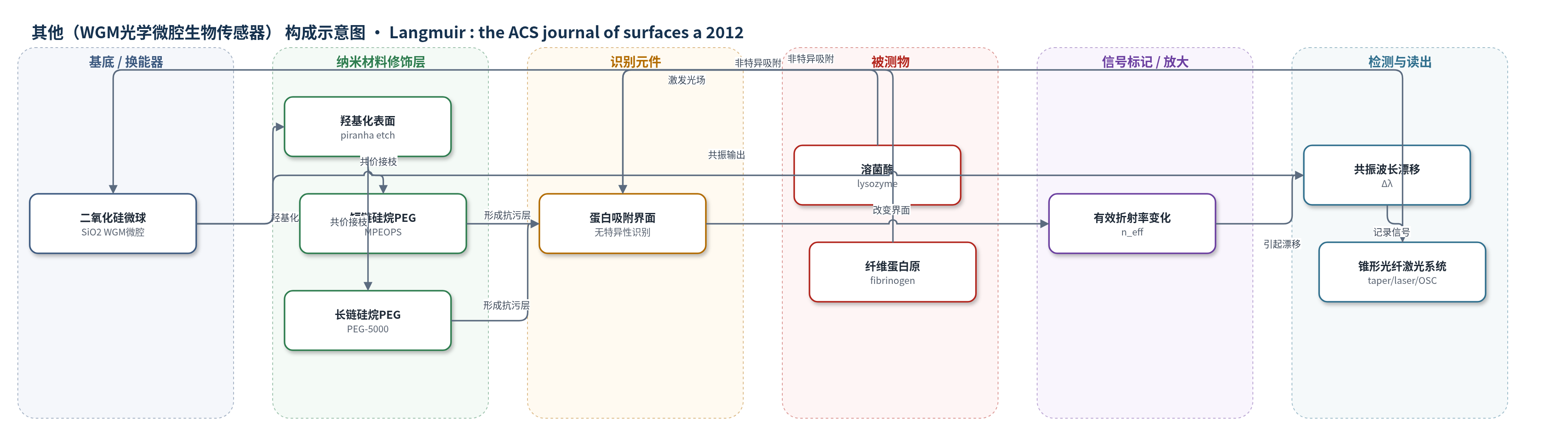
点击图片查看大图 · 依据论文自动绘制
传感器类型
其他(WGM光学微腔生物传感器)
检测对象
溶菌酶(lysozyme)、纤维蛋白原(fibrinogen),样品基质为磷酸盐缓冲液(PBS)
检测原理
该传感器以二氧化硅微球作为回音壁模式(WGM)微腔,激光经锥形光纤耦合后在球面附近形成驻波光场,其倏逝场延伸至周围介质。当溶菌酶或纤维蛋白原吸附到微球表面时,界面局部折射率及光场有效折射率发生变化,导致共振波长发生漂移;吸附量越大,漂移越明显。PEG涂层通过强水化层和空间位阻效应抑制非特异蛋白吸附,其中短链MPEOPS因接枝密度更高,抗污效果优于长链PEG-5000。系统通过记录共振峰位置随时间的变化实现无标记检测,未使用酶或核酸放大策略。
检测灵敏度
未报告LOD、线性范围、灵敏度斜率或相关系数。
效应效果
PEG功能化可将WGM微球表面非特异性蛋白吸附最多降低至初始羟基化对照的1/4。短链MPEOPS对溶菌酶和纤维蛋白原的抑制均优于长链PEG-5000;MPEOPS表面吸附量约为0.5%单层溶菌酶和11.7%–16.7%单层纤维蛋白原,而羟基化表面文献值通常为<1%单层溶菌酶和35%–50%单层纤维蛋白原。椭光法测得MPEOPS与PEG-5000厚度分别为11.03 nm±2.17和3.33 nm±0.395,荧光显微镜显示PEG覆盖均匀。涂层后Q factor仍高于10^6,说明灵敏度未明显受损。作者认为该策略可提升复杂真实样品中的特异性和应用潜力。
传感器的构成
- 基底/换能器:二氧化硅微球(SiO2 microsphere),形成回音壁模式(WGM)微腔,光场沿球面传播并产生共振波长。
- 表面初始层:羟基化二氧化硅表面(hydroxylated SiO2),经piranha etch提供硅羟基,用于共价接枝PEG。
- 修饰层:短链硅烷-PEG(MPEOPS,Mw 460–590),共价接枝形成抗蛋白非特异吸附层。
- 修饰层:长链硅烷-PEG(PEG-5000,Mw 5000),共价接枝形成抗蛋白非特异吸附层。
- 识别元件:未引入特异性识别元件,直接以溶菌酶(lysozyme)或纤维蛋白原(fibrinogen)的非特异吸附作为传感事件。
- 读出系统:锥形光纤(tapered fiber)耦合980 nm可调谐二极管激光,示波器与LabVIEW记录共振波长漂移。
中文摘要
无标记生物传感器技术因兼具高灵敏度换能器与高特异性识别元件,有望革新环境监测、医学诊断和食品安全评价,实现极低浓度有害化合物的实时检测。然而,在废水、血液和尿液等复杂环境中,非特异性结合会降低特异性并增加假阳性。本文展示将高灵敏度回音壁模式(WGM)微腔与不同厚度的共价结合聚乙二醇(PEG)涂层相结合,用于抑制生物传感器表面的非特异性蛋白吸附。作者监测了涂层后传感器的灵敏度,并通过蛋白吸附实验研究PEG链长对降低非特异吸附的影响。结果表明,PEG功能化可将传感器表面的非特异性蛋白吸附最多降低至初始对照表面的四分之一,且链长显著影响微腔表面的抗污性能。出乎意料的是,短链PEG表面特异性改善最好,不同于许多偏好长链PEG的体系。将WGM微腔与针对器件优化的PEG涂层结合,可显著提升无标记光学生物传感器平台整体性能,并推动其在复杂真实监测场景中的应用。
英文摘要
Label-free biosensor technologies have the potential to revolutionize environmental monitoring, medical diagnostics, and food safety evaluation processes due to their unique combinations of high-sensitivity signal transducers and high-specificity recognition elements. This enables their ability to perform real-time detection of deleterious compounds at extremely low concentrations. However, to further improve the biosensors' performance in complex environments, such as wastewater, blood, and urine, it is necessary to minimize nonspecific binding, which in turn will increase their specificity, and decrease the rate of false positives. In the present work, we illustrate the potential of combining emerging high-sensitivity optical signal transducers, such as whispering gallery mode (WGM) microcavities, with covalently bound poly(ethylene glycol) (PEG) coatings of varying thickness, as an effective treatment for the prevention of nonspecific protein adsorption onto the biosensor surface. We monitor the sensitivity of the coated biosensor, and investigate the effect of PEG chain length on minimizing nonspecific adsorption via protein adsorption studies. Experimental results confirm not only that PEG-functionalization reduces nonspecific protein adsorption to the surface of the sensor by as much as a factor of 4 compared to an initialized control surface, but also that chain length significantly impacts the nonfouling character of the microcavity surface. Surprisingly, it is the short chain PEG surfaces that experience the best improvement in specificity, unlike many other systems where longer PEG chains are preferred. The combination of WGM microcavities with PEG coatings tuned specifically to the device will significantly improve the overall performance of biosensor platforms, and enable their wider application in complex, real-world monitoring scenarios.