组成图示
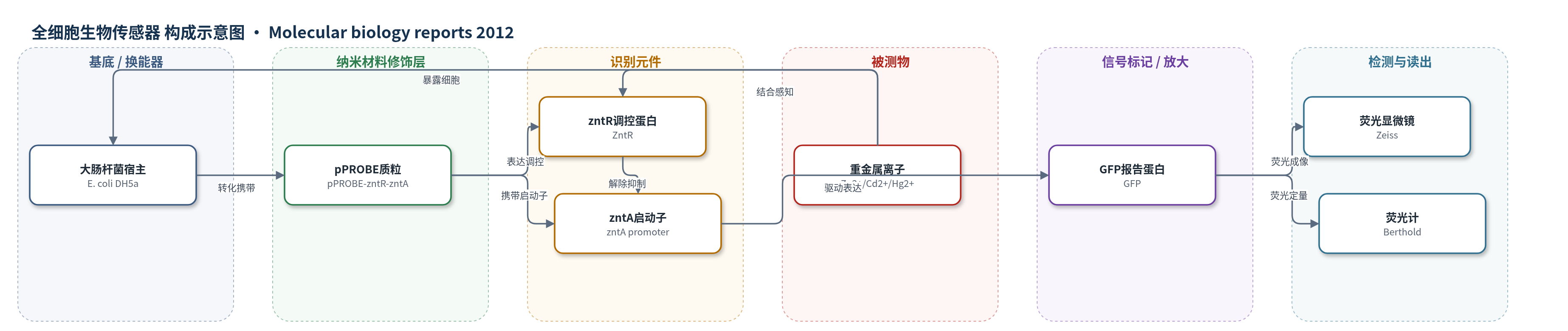
点击图片查看大图 · 依据论文自动绘制
传感器类型
全细胞生物传感器
检测对象
锌离子(Zn2+)、镉离子(Cd2+)、汞离子(Hg2+);样品基质为 LB 琼脂/肉汤培养基及环境水样(aquatic water samples)
检测原理
该传感器以大肠杆菌 DH5a 为活细胞换能器,质粒 pPROBE-zntR-zntA 携带 zntR 调控基因和 zntA 启动子-GFP 报告盒。无金属时,ZntR 蛋白结合 zntA 启动子并抑制转录;当 Zn2+、Cd2+ 或 Hg2+ 进入细胞并与 ZntR 结合后,ZntR 构象改变,解除对启动子的抑制,RNA 聚合酶启动下游 GFP 转录。GFP 蛋白在细胞内积累并产生荧光,荧光强度随诱导金属离子浓度变化,16 h 培养时信号最强且稳定。该全细胞系统通过基因表达实现信号放大,无需外加底物,可直接反映重金属的生物可利用性和毒性。
检测灵敏度
测试范围: 3–800 ppm Zn2+、0.005–4 ppm Cd2+、0.001–0.12 ppm Hg2+;最大诱导: 20 ppm Zn2+、0.005 ppm Cd2+、0.002 ppm Hg2+
效应效果
在 LB-卡那霉素平板和液体培养基中,Zn2+、Cd2+、Hg2+ 诱导均产生 GFP 荧光,对照无表达。16 h 培养荧光增强且一致,20 和 24 h 因 GFP 半衰期及细胞衰老降低;Zn2+ 24 h 超过 200 ppm 时荧光突降。最大荧光为 20 ppm Zn2+、0.005 ppm Cd2+、0.002 ppm Hg2+。Ivask 荧光素酶系统最大诱导为 650 ppm Zn2+、0.1 ppm Cd2+、0.2 ppm Hg2+,本系统更低。细胞密度在超过 200 ppm Zn2+、0.5 ppm Cd2+、0.016 ppm Hg2+ 时下降。诱导浓度与 Daphnia magna 24 h LC50 毒性趋势一致,可用于水体重金属污染初筛。
传感器的构成
- 宿主细胞:大肠杆菌 DH5a(E. coli DH5a),作为活细胞表达与换能平台
- 质粒载体:pPROBE-zntR-zntA(基于 pPROBE-KT),携带 zntR、zntA 启动子和 GFP 报告盒
- 识别调控元件:zntR 基因编码 ZntR 蛋白,感知 Zn2+、Cd2+、Hg2+ 并调控转录
- 启动子元件:zntA 启动子(zntA promoter),受金属诱导驱动下游 GFP 表达
- 信号报告元件:GFP 基因,表达绿色荧光蛋白(GFP),产生可测荧光信号
- 培养介质:LB 琼脂或 LB 肉汤(含 50 μg/mL 卡那霉素),用于细胞培养与金属诱导
中文摘要
细菌生物传感器可按其对生物体的实际毒性来衡量污染。本研究构建了一种重组细菌生物传感器,可响应锌离子(Zn2+)、镉离子(Cd2+)和汞离子(Hg2+)的毒性水平。该传感器利用大肠杆菌 znt 操纵子中的锌调控基因 zntR 和 zntA 启动子,在上述离子达到毒性浓度时触发绿色荧光蛋白(GFP)报告蛋白的表达。实验以 3–800 ppm Zn2+、0.005–4 ppm Cd2+ 和 0.001–0.12 ppm Hg2+ 诱导传感器,并在液体培养基中通过荧光计定量 GFP 荧光。为确定最佳培养条件,分别设置 16、20 和 24 h 培养时间。结果显示,培养 16 h 的细胞荧光增强且稳定。Zn2+、Cd2+ 和 Hg2+ 的最大诱导分别出现在 20、0.005 和 0.002 ppm。所报道的 pPROBE-zntR-zntA 生物传感器可作为水体重金属污染初筛技术。
英文摘要
Bacterial biosensors can measure pollution in terms of their actual toxicity to living organisms. A recombinant bacterial biosensor has been constructed that is known to respond to toxic levels of Zn(2+), Cd(2+) and Hg(2+). The zinc regulatory gene zntR and zntA promoter from znt operon of E. coli have been used to trigger the expression of GFP reporter protein at toxic levels of these ions. The sensor was induced with 3-800 ppm of Zn(2+), 0.005-4 ppm of Cd(2+) and 0.001-0.12 ppm of Hg(2+) ions. Induction studies were also performed in liquid media to quantify GFP fluorescence using fluorimeter. To determine the optimum culture conditions three different incubation periods (16, 20 and 24 h) were followed. Results showed an increased and consistent fluorescence in cells incubated for 16 h. Maximum induction for Zn(2+), Cd(2+) and Hg(2+) was observed at 20, 0.005 and 0.002 ppm, respectively. The pPROBE-zntR-zntA biosensor reported here can be employed as a primary screening technique for aquatic heavy metal pollution.