组成图示
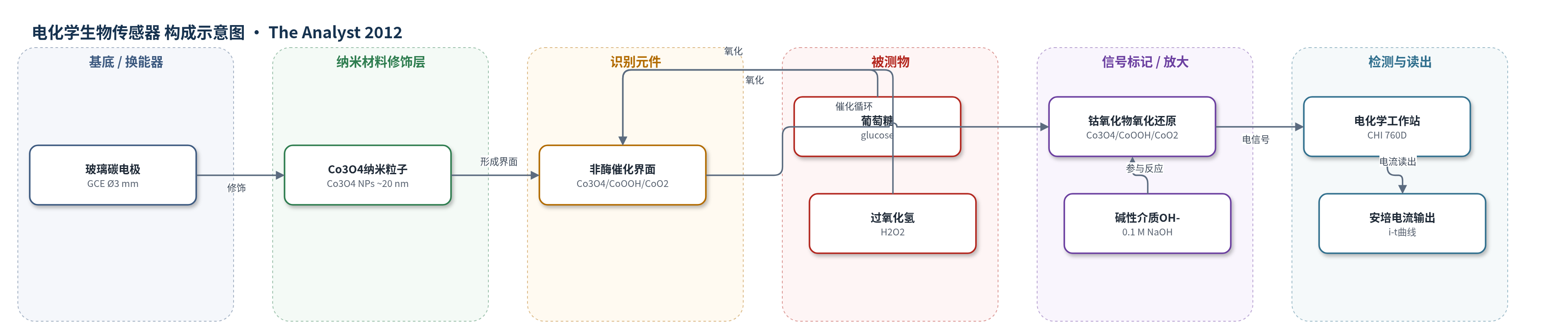
点击图片查看大图 · 依据论文自动绘制
传感器类型
电化学生物传感器
检测对象
葡萄糖(glucose):0.1 M NaOH溶液、人血清(human blood serum);过氧化氢(H2O2):0.1 M NaOH溶液、消毒剂样品(disinfectant sample)
检测原理
该传感器为非酶直接电化学检测。Co3O4 NPs修饰在GCE表面,在0.1 M NaOH中存在Co3O4/CoOOH和CoOOH/CoO2两对可逆氧化还原。检测葡萄糖时,在+0.59 V下,葡萄糖主要被CoOOH/CoO2介导氧化为葡萄糖内酯,反应可表示为2CoO2 + C6H12O6 → 2CoOOH + C6H10O6;CoO2被还原为CoOOH后又被电极再氧化,形成催化循环,使阳极电流随葡萄糖浓度增加而增大。检测H2O2时,在+0.42 V下,H2O2被Co3O4/CoOOH催化氧化,反应为6CoOOH + H2O2 → 2Co3O4 + O2 + 4H2O,同样产生与浓度相关的电流。传感器依靠Co3O4纳米粒子的高比表面积和丰富活性位点实现信号放大,无需酶或外源标记。
检测灵敏度
葡萄糖:LOD: 0.13 mM (S/N = 3);线性范围: 5 × 10^-6 M–8 × 10^-4 M;灵敏度: 520.7 mA mM^-1 cm^-2;R^2 = 0.9939。H2O2:LOD: 0.81 mM;线性范围: 0–200 mM;灵敏度: 107.4 mA mM^-1 cm^-2;R^2 = 0.9964。
效应效果
葡萄糖检测响应时间小于6 s。选择性方面,0.02 mM尿酸(UA)和对乙酰氨基酚(AP)几乎无电流响应,0.02 mM抗坏血酸(AA)仅引起相当于0.2 mM葡萄糖响应16%的电流增加;0.1 M NaCl存在下对0.2 mM葡萄糖响应几乎无变化。人血清样品检测结果与医院血糖仪结果一致,各血清样品RSD小于5%,两种方法六次测量相关系数为0.77。H2O2检测用于消毒剂样品,与高锰酸钾滴定法结果一致,加标回收率为99–104%。作者认为该传感器具有高灵敏度、低检出限、快速响应和良好选择性,适用于无酶直接检测葡萄糖和H2O2。
传感器的构成
- 基底/换能器电极:玻璃碳电极(GCE),作为工作电极与电子传导基底
- 纳米材料修饰层:Co3O4纳米粒子(Co3O4 NPs),由ZIF-8模板合成,提供电催化活性位点
- 识别元件:无(非酶直接电催化氧化,不依赖抗体、酶或适配体)
- 信号标记物:无外源标记物,Co3O4自身Co3O4/CoOOH/CoO2氧化还原循环产生电流
- 电子供体:葡萄糖(glucose)或过氧化氢(H2O2),在电极表面被氧化并贡献安培电流
中文摘要
本文以金属有机框架(MOF)为模板合成了平均直径约20 nm的Co3O4纳米粒子(NPs),并采用扫描电子显微镜(SEM)、透射电子显微镜(TEM)、傅里叶变换红外光谱(FT-IR)和X射线衍射(XRD)对其形貌与结构进行表征。将Co3O4 NPs修饰于玻碳电极(GCE)表面,构建了非酶葡萄糖和过氧化氢(H2O2)电化学传感器。该传感器在碱性介质中对葡萄糖和H2O2的氧化表现出良好电催化活性。葡萄糖检测中,传感器响应时间小于6 s,灵敏度为520.7 mA mM−1 cm−2,检出限为0.13 mM(S/N=3),选择性良好,且高浓度NaCl不会毒化电极;人血清样品检测结果与医院结果一致。H2O2检测中,检出限和灵敏度分别为0.81 mM和107.4 mA mM−1 cm−2,消毒剂样品检测也获得满意结果。作者认为,Co3O4 NPs优异的电催化性能赋予传感器高灵敏度和低检出限,表明其在无酶检测葡萄糖和H2O2方面具有应用潜力。
英文摘要
Co(3)O(4) nanoparticles (NPs) with an average diameter of about 20 nm were synthesized by using MOFs as a template. Scanning electron microscopy (SEM) and transmission electron microscopy (TEM) were employed to characterize the as-prepared Co(3)O(4) NPs. Fourier transform infrared spectroscopy (FT-IR) and X-ray diffraction (XRD) were used to confirm the structure of the Co(3)O(4) NPs. Then the Co(3)O(4) NPs were modified on a glassy carbon electrode (GCE) to obtain a non-enzymatic glucose and H(2)O(2) sensor. The NPs show electrocatalytic activity toward oxidation of glucose and H(2)O(2) in alkaline medium. For glucose detection, the developed sensor shows a short response time (less than 6 s), a high sensitivity of 520.7 μA mM(-1) cm(-2), a detection limit of 0.13 μM (S/N = 3), and good selectivity. The high concentration of NaCl does not poison the electrode. Its application for the detection of glucose in a human blood serum sample shows good agreement with the results obtained from the hospital. Furthermore, the proposed sensor was used for the detection of H(2)O(2). The results indicate that the detection limit and sensitivity for H(2)O(2) are 0.81 μM and 107.4 μA mM(-1) cm(-2), respectively. Determination of H(2)O(2) concentration in a disinfectant sample by the proposed biosensor also showed satisfactory result. The high sensitivity and low detection limit can be attributed to the excellent electrocatalytic performance of the as-prepared Co(3)O(4) NPs. These results demonstrate that the as-prepared Co(3)O(4) NPs have great potential applications in the development of sensors for enzyme-free detection of glucose and H(2)O(2).