组成图示
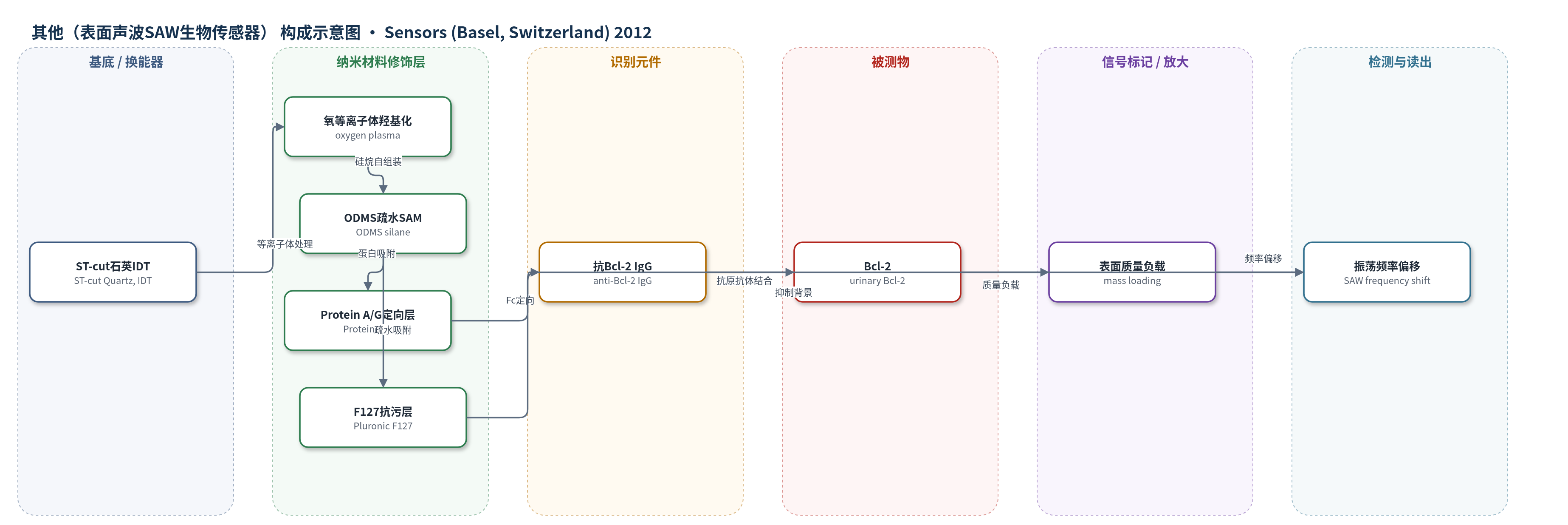
点击图片查看大图 · 依据论文自动绘制
传感器类型
其他(表面声波SAW生物传感器)
检测对象
Bcl-2蛋白(B-cell lymphoma 2 protein, Bcl-2),样品基质:PBS缓冲液及含BSA的PBS模拟尿液蛋白混合物(目标应用为尿液)
检测原理
SH-SAW器件在ST-cut石英上以IDT激发剪切水平表面声波,延迟路径表面经ODMS疏水SAM、Protein A/G定向、抗Bcl-2 IgG捕获抗体和Pluronic F127抗污层修饰。当样品中的Bcl-2与固定抗体特异性结合时,延迟路径表面质量密度增加。根据声学质量负载效应,表面质量负载降低SAW传播速度,使振荡回路中反馈元件的振荡频率下降。频率偏移量随Bcl-2浓度增加而单调增大;Pluronic F127的PEG链减少非特异蛋白吸附,提高信噪比。该传感器无酶或标记放大,直接以质量换能实现检测。
检测灵敏度
原文未报告LOD、线性范围、灵敏度斜率或R^2。表1稳态频率偏移:PBS 6 Hz(标准差2 Hz);Bcl-2 0.5 ng/mL 369 Hz(标准差37 Hz);Bcl-2 4 ng/mL 693 Hz(标准差29 Hz);Bcl-2 8 ng/mL 907 Hz(标准差40 Hz);Bcl-2 12 ng/mL 1392 Hz(标准差27 Hz)。
效应效果
改良夹心ELISA筛选五种表面,ODMS/Protein A/G/anti-Bcl-2 IgG/Pluronic F127组合信噪比最高(#5 S/N=1.83,#1=1.03、#2=1.00、#3=1.23、#4=0.77)。SAW原型中,PBS对照偏移6±2 Hz,BSA 5 μg/mL为108±80 Hz;Bcl-2 0.5、4、8、12 ng/mL分别为369±37、693±29、907±40、1392±27 Hz。Bcl-2 4 ng/mL与BSA 5 μg/mL混合(BSA过量1000倍)时偏移538±142 Hz,接近Bcl-2单独4 ng/mL,显示强抗干扰和特异性。未报告实际尿液回收率与长期稳定性;作者认为可支持即时检测卵巢癌早期诊断,并替换抗体用于其他标志物。
传感器的构成
- 基底/换能器:ST-cut石英晶圆(ST-cut Quartz)与互指换能器(IDT),激发和接收剪切水平表面声波(SH-SAW)
- 表面预处理:氧等离子体(oxygen plasma)清洗并生成羟基,用于硅烷自组装
- 疏水自组装单层:氯二甲基辛基硅烷(ODMS, chlorodimethyloctylsilane)形成疏水表面,促进蛋白吸附
- 抗体定向层:重组Protein A/G吸附,结合IgG Fc区,使Fab区朝向溶液
- 识别元件:多克隆兔抗Bcl-2 IgG(anti-Bcl-2 IgG)特异性捕获Bcl-2
- 抗污封闭层:Pluronic F127(聚氧乙烯-聚氧丙烯-聚氧乙烯嵌段共聚物)吸附,提供PEG链减少非特异蛋白吸附
中文摘要
声学生物传感器表面质量负载变化会引起输出频率偏移,从而实现对分析物的精确测量。因此,为检测特定生物标志物,传感器延迟路径必须经过精心设计,以最大化灵敏度与特异性。B细胞淋巴瘤2蛋白(Bcl-2)在尿液中被研究作为卵巢癌无创早期检测的生物标志物。本研究评估了表面化学与生物功能化策略在展示抗体以捕获Bcl-2、同时降低非特异性蛋白吸附方面的有效性。在疏水表面上依次吸附Protein A/G、抗Bcl-2 IgG和Pluronic F127的组合提供了最高信噪比,并能够可靠检测低于既往用于早期卵巢癌识别水平的Bcl-2浓度,该性能通过改良ELISA方法表征。最后,将最优表面修饰应用于原型声学器件,并量化不同Bcl-2浓度下的频率偏移,以证明其在表面声波(SAW)检测应用中的有效性。本文展示的表面功能化方法可在工作的超声MEMS生物传感器原型中特异、灵敏地检测Bcl-2,并可方便地修改用于检测其他生物标志物,增强其他声学生物传感器。
英文摘要
Changes in mass loading on the surface of acoustic biosensors result in output frequency shifts which provide precise measurements of analytes. Therefore, to detect a particular biomarker, the sensor delay path must be judiciously designed to maximize sensitivity and specificity. B-cell lymphoma 2 protein (Bcl-2) found in urine is under investigation as a biomarker for non-invasive early detection of ovarian cancer. In this study, surface chemistry and biofunctionalization approaches were evaluated for their effectiveness in presenting antibodies for Bcl-2 capture while minimizing non-specific protein adsorption. The optimal combination of sequentially adsorbing protein A/G, anti-Bcl-2 IgG and Pluronic F127 onto a hydrophobic surface provided the greatest signal-to-noise ratio and enabled the reliable detection of Bcl-2 concentrations below that previously identified for early stage ovarian cancer as characterized by a modified ELISA method. Finally, the optimal surface modification was applied to a prototype acoustic device and the frequency shift for a range of Bcl-2 concentration was quantified to demonstrate the effectiveness in surface acoustic wave (SAW)-based detection applications. The surface functionalization approaches demonstrated here to specifically and sensitively detect Bcl-2 in a working ultrasonic MEMS biosensor prototype can easily be modified to detect additional biomarkers and enhance other acoustic biosensors.