组成图示
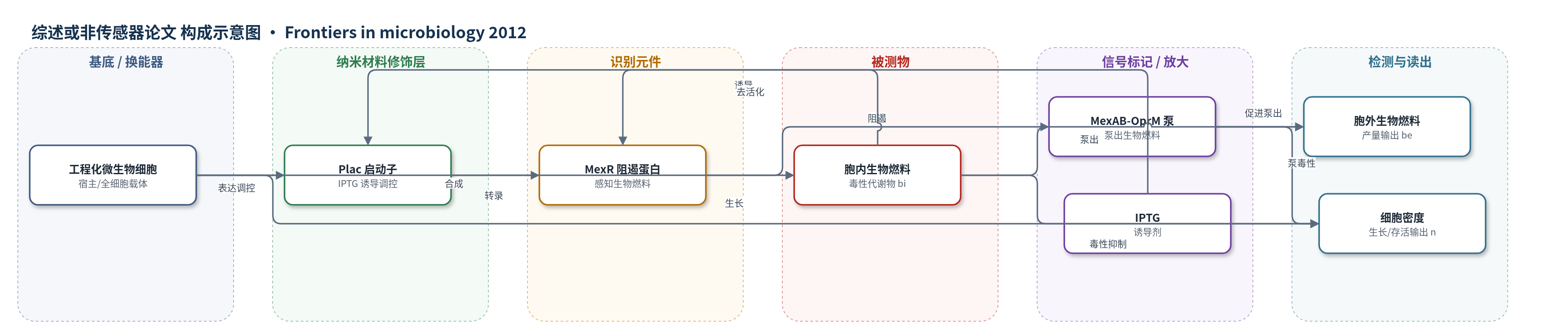
点击图片查看大图 · 依据论文自动绘制
传感器类型
综述或非传感器论文
检测对象
生物燃料(biofuel,如烷烃/芳烃类);样品基质:工程化微生物胞内及发酵培养物
检测原理
该模型以转录生物传感器 MexR 作为识别元件。MexR 由 Plac 启动子表达,在 IPTG 诱导下达到设定浓度,并结合外排泵操纵子启动子,阻遏 MexAB-OprM 泵表达。当胞内生物燃料浓度升高时,生物燃料使 MexR 去活化,使其不能结合启动子,泵表达随之增加。泵利用质子动力势将胞内生物燃料泵出,降低胞内毒性,从而减轻对细胞生长的抑制。系统形成负反馈:燃料越高,泵越多;泵越多,胞内燃料越低。由于低燃料阶段不表达泵,细胞可优先生长,达到更高密度;当燃料达到毒性水平后再启动泵,平衡燃料毒性与泵表达毒性,提高胞外生物燃料产量。
检测灵敏度
原文未报告 LOD、线性范围、灵敏度斜率或相关系数。
效应效果
本文为计算模型研究,未报告选择性、抗干扰、稳定性、重现性 RSD 或实际样品回收率。敏感性分析将各参数在标称值上下 20% 变化,发现系统对多数参数稳健,但生物燃料导出率 δb、毒性系数 δn、产量 αb、生长率 αn、泵毒性阈值 γp 和最大细胞密度 nmax 对 40 h 细胞密度影响超过 5%。与恒定泵模型相比,反馈传感器在 αb 为 0.01、0.1、1 h-1 时均产生更高胞外生物燃料;在参数按均值标称、标准差 25% 的 1000 次随机模拟中,反馈模型平均产量更高。作者认为反馈回路可适应噪声与参数变异,适合实际生物燃料生产。
传感器的构成
- 宿主细胞:工程化微生物(如大肠杆菌 E. coli 等)作为全细胞载体,承载生物燃料合成、MexR 表达与外排泵功能。
- 识别元件:MexR 转录阻遏蛋白(R),结合外排泵启动子,被胞内生物燃料去活化后解除阻遏。
- 调控元件:Plac 诱导型启动子,受 IPTG 诱导控制 MexR 表达水平。
- 效应元件:MexAB-OprM 外排泵操纵子,利用质子动力势将胞内生物燃料泵出。
- 代谢通路:生物燃料合成途径,按速率 αb 产生胞内生物燃料。
- 诱导剂:IPTG,调节 MexR 表达强度,用于系统调谐。
- 模型输出:胞外生物燃料浓度 be 与细胞密度 n,作为产量与生长读出。
中文摘要
当前微生物生物燃料生产利用工程菌降解纤维素并转化为燃料,但产物对产菌的毒性常限制产量。外排泵可提高耐受性,但过度表达会加重细胞负担、抑制生长并降低产量,因此需平衡燃料毒性与泵表达毒性。本文建立了一个包含合成反馈回路的数学模型,利用转录生物传感器 MexR 调控外排泵表达:MexR 在 Plac 启动子控制下表达并阻遏外排泵操纵子;当胞内生物燃料积累时,MexR 被去活化,泵表达增加,将燃料泵出细胞,从而维持生长与生产。模型还比较了恒定泵表达策略,并进行单参数与双参数敏感性分析。结果表明,反馈传感器对多数参数稳健,但生物燃料产量、毒性系数、泵导出率、生长率、泵毒性阈值和最大细胞密度等关键参数影响显著;与恒定泵系统相比,反馈回路通过延迟泵表达至需要时提高总生物燃料产量,且在参数存在变异时优势更明显。
英文摘要
Current biofuel production methods use engineered bacteria to break down cellulose and convert it to biofuel. A major challenge in microbial fuel production is that increasing biofuel yields can be limited by the toxicity of the biofuel to the organism that is producing it. Previous research has demonstrated that efflux pumps are effective at increasing tolerance to various biofuels. However, when overexpressed, efflux pumps burden cells, which hinders growth and slows biofuel production. Therefore, the toxicity of the biofuel must be balanced with the toxicity of pump overexpression. We have developed a mathematical model for cell growth and biofuel production that implements a synthetic feedback loop using a biosensor to control efflux pump expression. In this way, the production rate will be maximal when the concentration of biofuel is low because the cell does not expend energy expressing efflux pumps when they are not needed. Additionally, the microbe is able to adapt to toxic conditions by triggering the expression of efflux pumps, which allow it to continue biofuel production. Sensitivity analysis indicates that the feedback sensor model is insensitive to many system parameters, but a few key parameters can influence growth and production. In comparison to systems that express efflux pumps at a constant level, the feedback sensor increases overall biofuel production by delaying pump expression until it is needed. This result is more pronounced when model parameters are variable because the system can use feedback to adjust to the actual rate of biofuel production.