组成图示
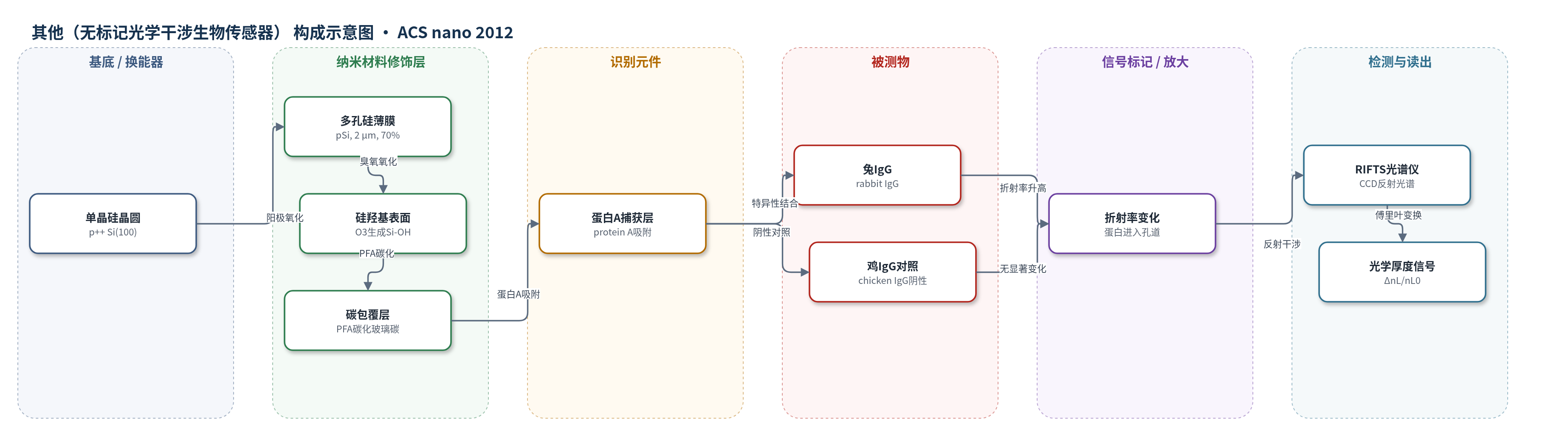
点击图片查看大图 · 依据论文自动绘制
传感器类型
其他(无标记光学干涉生物传感器)
检测对象
兔免疫球蛋白G(rabbit IgG)、鸡免疫球蛋白G(chicken IgG,阴性对照);样品基质为PBS缓冲液(磷酸盐缓冲液,pH 7.4)
检测原理
pSi-C薄膜上下界面反射光形成Fabry-Perot干涉,反射光谱经傅里叶变换得到光学厚度nL。蛋白A物理吸附于多孔pSi-C表面和孔道,作为捕获探针;当兔IgG进入孔道并与蛋白A的Fc结合位点结合时,孔内蛋白质量增加,使多孔膜平均折射率n升高,nL随之增加,表现为反射干涉峰位移或RIFTS信号变化。鸡IgG与蛋白A亲和性弱,不产生明显nL变化,用于排除非特异吸附。该传感器无外源标记,信号近似与结合蛋白质量成正比;多孔高比表面积和蛋白A物理吸附提供捕获量,但没有HCR、RCA或酶催化沉积等放大步骤。碳包覆层抑制pSi水解,提高长期光学稳定性。
检测灵敏度
原文未报告LOD、线性范围、灵敏度斜率或相关系数。
效应效果
pSi-C在pH 7.4 PBS中约75 min内光学厚度无显著下降;在pH 12缓冲液中稳定性低于中性条件,但仍优于热氧化pSiO2、乙炔碳氢化pSi和十一碳烯酸氢硅化pSi,水稳定性与多孔TiO2相当或优于多孔Al2O3。蛋白A吸附使ΔnL/nL0为1.62±0.07%,高于多孔Al2O3(0.03%)、多孔TiO2(0.3%)和多孔SiO2(1%)。兔IgG结合响应为0.41±0.06%(表1)或约0.3%(图5),鸡IgG无显著响应,选择性良好;无蛋白A时IgG非特异结合约0.2%。作者认为pSi-C在稳定性与灵敏度间提供最佳折中,适合无标记光学生物传感。
传感器的构成
- 基底/换能器:高硼掺杂p++单晶硅(100)晶圆,电阻率0.9 mΩ cm,提供多孔硅模板与光学薄膜基底
- 多孔硅层:电化学阳极氧化形成的多孔硅(pSi)薄膜,厚度约2 μm,孔径14–42 nm、平均37 nm,孔隙率约70%,构成Fabry-Perot干涉光腔
- 表面氧化层:臭氧处理生成的硅羟基(Si-OH)表面,用于后续PFA渗入与表面化学
- 聚合物前驱体层:呋喃甲醇(furfuryl alcohol)在草酸催化下聚合生成的聚呋喃甲醇(PFA),渗入pSi孔道
- 碳包覆层:PFA在N2中700 °C碳化形成的玻璃碳/无序sp2碳,包覆孔壁并提高水稳定性
- 识别元件:物理吸附的蛋白A(protein A),作为IgG捕获探针,结合IgG的Fc段
- 被测物结合层:兔IgG(rabbit IgG)与蛋白A特异性结合,鸡IgG(chicken IgG)作为阴性对照
- 读出层:反射干涉傅里叶变换光谱(RIFTS)系统,卤素灯与CCD光谱仪监测光学厚度nL变化
中文摘要
本文报道了一种基于多孔硅-碳(pSi-C)复合材料的稳定、无标记光学生物传感器。该材料首先通过电化学阳极氧化晶态硅(在含HF的电解质中)制备多孔硅模板,随后将聚呋喃甲醇(PFA)渗入孔道并碳化,形成光学平滑的pSi-C薄膜。与热氧化、十一碳烯酸氢硅化或乙炔碳氢化处理的多孔硅相比,pSi-C在pH 7.4和pH 12水缓冲液中表现出显著更高的稳定性,其水稳定性与多孔TiO2或Al2O3光学生物传感器相当。作者利用蛋白A修饰的pSi-C芯片检测兔IgG,并以鸡IgG作为无亲和性阴性对照,证实了检测的特异性。pSi-C比多孔TiO2或Al2O3能结合更多蛋白A捕获探针,蛋白A修饰的pSi-C传感器对兔IgG的灵敏度约为上述两种材料无标记光学生物传感器的2倍。
英文摘要
A stable, label-free optical biosensor based on a porous silicon-carbon (pSi-C) composite is demonstrated. The material is prepared by electrochemical anodization of crystalline Si in an HF-containing electrolyte to generate a porous Si template, followed by infiltration of poly(furfuryl) alcohol (PFA) and subsequent carbonization to generate the pSi-C composite as an optically smooth thin film. The pSi-C sensor is significantly more stable toward aqueous buffer solutions (pH 7.4 or 12) compared to thermally oxidized (in air, 800 °C), hydrosilylated (with undecylenic acid), or hydrocarbonized (with acetylene, 700 °C) porous Si samples prepared and tested under similar conditions. Aqueous stability of the pSi-C sensor is comparable to related optical biosensors based on porous TiO(2) or porous Al(2)O(3). Label-free optical interferometric biosensing with the pSi-C composite is demonstrated by detection of rabbit IgG on a protein-A-modified chip and confirmed with control experiments using chicken IgG (which shows no affinity for protein A). The pSi-C sensor binds significantly more of the protein A capture probe than porous TiO(2) or porous Al(2)O(3), and the sensitivity of the protein-A-modified pSi-C sensor to rabbit IgG is found to be ~2× greater than label-free optical biosensors constructed from these other two materials.