组成图示
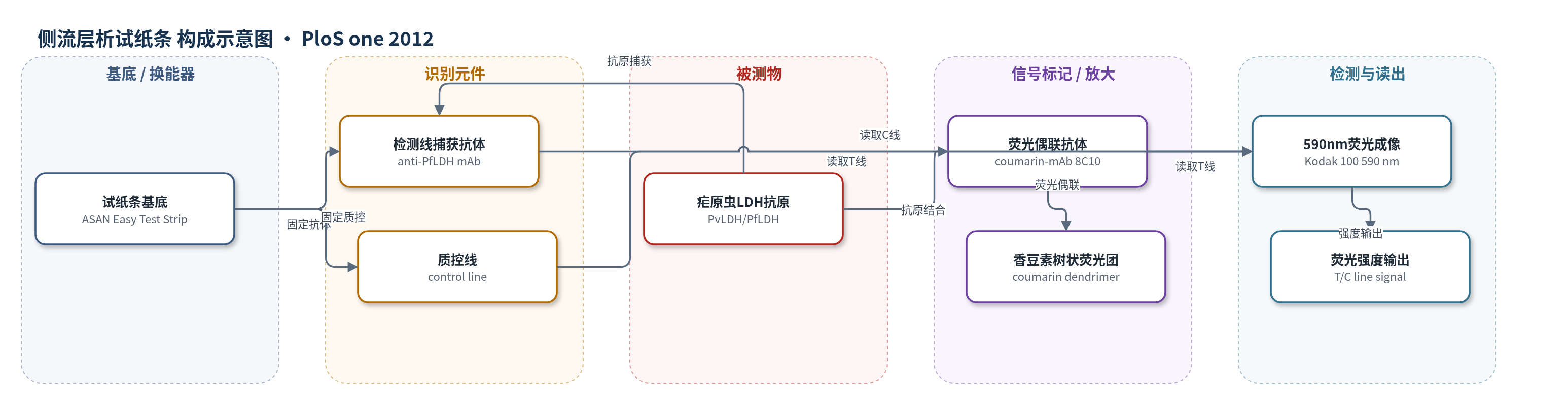
点击图片查看大图 · 依据论文自动绘制
传感器类型
侧流层析试纸条
检测对象
疟原虫LDH抗原(Plasmodium LDH, PvLDH/PfLDH);样品基质:患者全血、重组PvLDH蛋白溶液
检测原理
本方法基于抗原-抗体特异性识别与荧光换能。FICT中,患者全血或重组PvLDH样品沿试纸条层析,LDH抗原被检测线固定的抗PfLDH单克隆抗体捕获;结合垫中的香豆素树状荧光团-抗PfLDH mAb偶联物与同一抗原结合,形成夹心复合物。香豆素树状分子具有宽吸收带(中心455 nm)和高光稳定性,偶联抗体后发射峰由512 nm红移至590 nm,使激发与发射分离,降低背景。T线荧光强度随LDH抗原量增加而增强,C线荧光用于质控。FLISA中,96孔板包被捕获抗体,样品LDH结合后加入荧光偶联检测抗体,微孔板在460 nm激发/560 nm发射读取荧光,相对荧光值高于正常均值+6SD判阳。
检测灵敏度
LOD: 0.1 ng
效应效果
FLISA在两组独立临床样本中对P. vivax和P. falciparum感染均达100%敏感性和100%特异性(p<0.0001),而商用ELISA敏感性约90%;HCV和HIV样本未出现假阳性,显示高选择性。FICT中,胶体金偶联物在1000 ng和100 ng抗原时信号清晰、10 ng时减弱,而香豆素树状荧光偶联物在0.1 ng时仍可检测,较胶体金低100倍。P. vivax感染患者全血FICT中各条带T线荧光明显,可区分阴阳性,但存在背景噪声;HCV/HIV样本亦无交叉反应。生物偶联物10 min内荧光强度下降<20%,优于Alexa染料(降至60%)。作者认为其可支持低成本、低能耗LED基便携定量POC生物传感器和实时疾病监测。
传感器的构成
- 层析基底:商用 ASAN Easy Test Malaria Pf/Pv Strip(含样品垫、结合垫、检测膜、吸收垫):提供层析通道与固定线。
- 检测线识别元件:抗疟原虫LDH单克隆抗体(anti-PfLDH mAb):固定于T线,特异性捕获LDH抗原。
- 结合垫信号标记物:coumarin-derived dendrimer–anti-PfLDH mAb (8C10) 生物偶联物:与LDH结合后形成荧光夹心复合物。
- 荧光标记物:coumarin-derived dendrimer(香豆素衍生树状分子,NHS酯偶联):455 nm激发、590 nm发射,提供高亮度稳定荧光。
- 质控线:试纸条C线(control line):验证层析过程与试纸条有效性。
- 光学读出:Kodak Gel Logic 100 成像系统(590 nm带通滤光片):读取T线/C线荧光强度。
中文摘要
快速现场诊断对预防传染病暴发至关重要。基于特异性抗原-抗体结合和优质荧光团的荧光免疫化学检测可实现疾病的高灵敏、定量检测,并有望发展为小型、便携、可传输诊断结果的定量生物传感器,用于疾病控制中心的系统化防控。本研究开发了一种新型香豆素衍生树状分子荧光团(coumarin-derived dendrimer),具有高发射强度、强信号亮度和高光稳定性。该荧光团易于与生物分子偶联,在455 nm激发下于590 nm发射强而稳定的荧光。将其应用于荧光免疫层析试纸条(FICT)显示,新型香豆素树状分子生物偶联物可检测低至0.1 ng的抗原。临床结果和光谱特性首次表明,可开发低成本、低能耗的LED基便携定量生物传感器用于即时医疗(POC)疾病诊断,并支持疾病控制中心的实时监测(U-healthcare系统)。
英文摘要
Rapid in-field diagnosis is very important to prevent the outbreak of various infectious and contagious diseases. Highly sensitive and quantitative detection of diseases can be performed using fluorescent immunochemical assay with specific antigen-antibody binding and a good quality fluorophore. This can lead to the development of a small, portable, quantitative biosensor to transmit diagnostic results to a control center in order to systematically prevent disease outbreaks. In this study, we developed a novel fluorophore, coumarin-derived dendrimer, with high emission intensity, strong signal brightness, and high photostability. It is easily coupled with biomolecules and emits strong and stable fluorescence at 590 nm with excitation at 455 nm. Application to fluorescent immunochromatographic test (FICT) showed that the novel coumarin-derived dendrimer bioconjugate could detect antigens at amount as low as 0.1 ng. The clinical results and the spectral characteristics of the novel coumarin-derived dendrimer open, for the first time, the possibility of developing a cost/energy efficient LED-based portable quantitative biosensor for point-of-care (POC) disease diagnosis, which can permit real time monitoring (U-healthcare system) by a disease control center.