组成图示
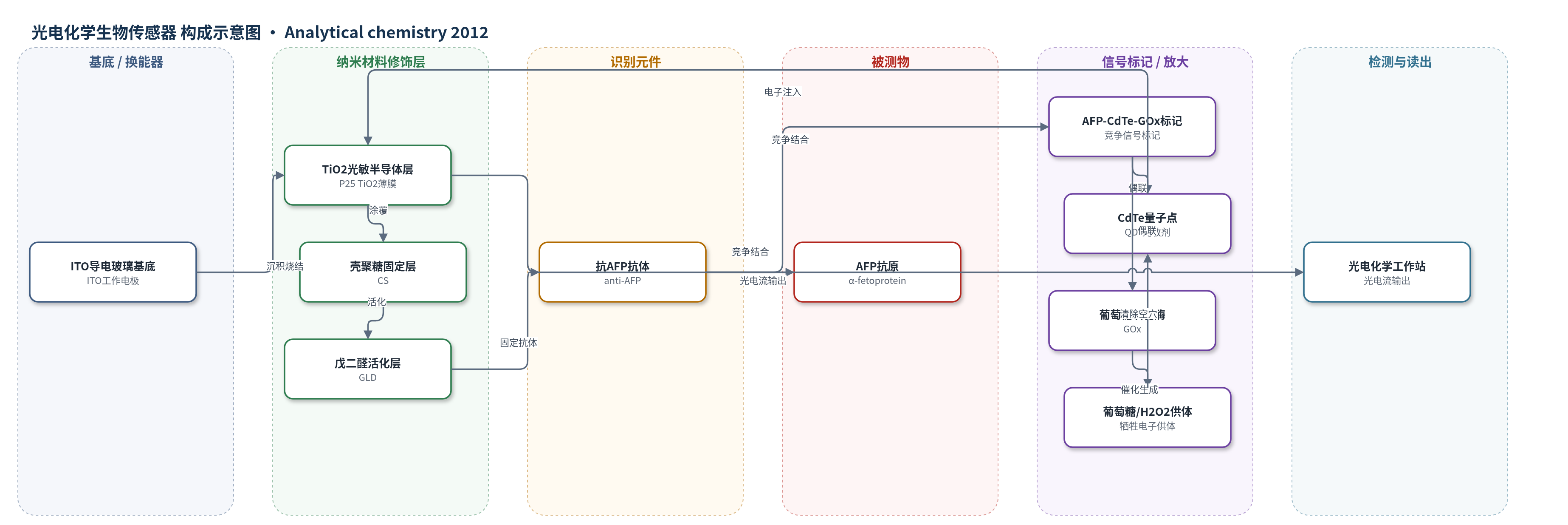
点击图片查看大图 · 依据论文自动绘制
传感器类型
光电化学生物传感器
检测对象
α-甲胎蛋白(α-fetoprotein, AFP);样品基质:人血清(健康人与肝癌患者血清)及磷酸盐缓冲液加标样品
检测原理
该传感器采用竞争免疫模式:抗AFP抗体固定于ITO/TiO2/CS/GLD电极表面,样品中游离AFP与AFP–CdTe–GOx生物偶联物竞争结合抗体。游离AFP浓度越高,结合到电极上的AFP–CdTe–GOx越少,光电流越低。信号放大来自两方面:光照下,CdTe量子点吸收可见光,其导带与TiO2导带能级匹配,激发电子快速注入TiO2,抑制电子–空穴复合,产生第一重放大;GOx催化葡萄糖生成H2O2,H2O2作为牺牲电子供体清除CdTe价带光生空穴,促进电荷分离,产生第二重放大。在恒定电位−0.4 V下,光电流随AFP浓度对数下降,实现定量检测。
检测灵敏度
LOD: 0.13 pg/mL;线性范围: 0.5 pg/mL–10 μg/mL;相关系数: 0.9997;回归方程: I = −4.60 log C_AFP + 19.2
效应效果
重现性良好:0.1、10、100 ng/mL AFP下批内RSD为1.4%、1.6%、2.0%,批间RSD为1.0%、0.8%、1.5%。10倍CEA、PSA、IL-6、HIgG单独或混合均无明显干扰。4 °C避光保湿保存2周后响应无明显变化。人血清结果与ELISA比较,6个样品相对偏差为1.5%、−1.0%、3.0%、−3.6%、−0.2%、−0.6%。LOD 0.13 pg/mL低于ELISA 12.8 ng/mL、电化学0.8 ng/mL、ECL 3.3 pg/mL、质谱0.2 ng/mL和光电化学40 pg/mL,作者认为可拓展至其他蛋白检测。
传感器的构成
- 基底/换能器电极:ITO 导电玻璃片(indium tin oxide, ITO),作为工作电极和电子传输基底
- 光敏半导体层:TiO2 纳米颗粒(P25)薄膜,滴涂后 450 °C 烧结,作为光吸收与电子传输层
- 生物固定层:壳聚糖(chitosan, CS),涂覆于 TiO2 表面,提供生物相容性并固定抗体
- 交联活化层:戊二醛(glutaraldehyde, GLD),活化 CS 表面,用于共价固定抗体
- 识别元件:抗人 AFP 单克隆抗体(anti-AFP antibody, anti-AFP),特异性结合 AFP 抗原
- 封闭剂:牛血清白蛋白(BSA),封闭非特异性结合位点
- 信号标记/放大元件:AFP–CdTe–GOx 生物偶联物,其中 CdTe 量子点(QDs)作光敏剂、AFP 作竞争抗原、葡萄糖氧化酶(GOx)作酶标记
- 电子供体/反应底物:葡萄糖(glucose)及 GOx 催化生成的 H2O2,作为牺牲电子供体清除光生空穴
中文摘要
本文提出一种用于癌症生物标志物α-甲胎蛋白(AFP)的超灵敏光电化学免疫检测方法。该方法以二氧化钛(TiO2)电极为基础,结合 AFP–CdTe–葡萄糖氧化酶(GOx)生物偶联物;其中 AFP 抗原和 GOx 标记物连接在 CdTe 量子点(QDs)上,用于信号放大。所合成的 CdTe QDs 粒径均一、分布窄,可实现 AFP 和 GOx 在 QDs 表面的结合。AFP 检测灵敏度的显著提高来自双信号放大策略:首先,CdTe QDs 与 TiO2 导带能级有效匹配,使光照下激发态 CdTe QDs 的电子快速注入 TiO2,减少电子–空穴复合,提升光电化学性能;其次,GOx 可催化葡萄糖生成 H2O2,H2O2 作为牺牲电子供体清除 CdTe QDs 价带中的光生空穴,进一步增大光电流。基于该策略,利用抗 AFP 抗体与 AFP 及 AFP–CdTe–GOx 生物偶联物的特异性竞争结合,构建了竞争型免疫传感器。该传感器对 AFP 的线性检测范围为 0.5 pg/mL 至 10 μg/mL,检出限为 0.13 pg/mL。该放大策略具有高灵敏度、良好稳定性和重现性,可成为其他蛋白检测的潜在平台。
英文摘要
An ultrasensitive photoelectrochemical immunoassay of cancer biomarker α-fetoprotein (AFP) is proposed that uses titanium dioxide (TiO(2)) coupled with AFP-CdTe-GOx bioconjugate, which featured AFP antigen and glucose oxidase (GOx) labels linked to CdTe quantum dots (QDs) for signal amplification. The synthesized CdTe QDs yielded a homogeneous and narrow size distribution, which allowed the binding of AFP and GOx on CdTe QDs. Greatly enhanced sensitivity for AFP came from a dual signal amplification strategy. First, an effective matching of energy levels between the conduction bands of CdTe QDs and TiO(2) allowed for fast electron injection from excited CdTe QDs to TiO(2) upon irradiation, which reduced the recombination process of electron-hole pairs and prompted photoelectrochemical performance. Second, GOx enzyme could catalyze glucose to produce H(2)O(2), which acted as a sacrificial electron donor to scavenge the photogenerated holes in the valence band of CdTe QDs, further causing an enhanced photocurrent. Thus, on the basis of the dual signal amplification strategy, the competitive immunosensor based on the specific binding of anti-AFP antibodies to AFP and AFP-CdTe-GOx bioconjugates was achieved. This proposed biosensor for AFP possessed largely increased linear detection range from 0.5 pg/mL to 10 μg/mL with a detection limit of 0.13 pg/mL. The proposed amplification strategy shows high sensitivity, stability, and reproducibility and can become a promising platform for other protein detection.