组成图示
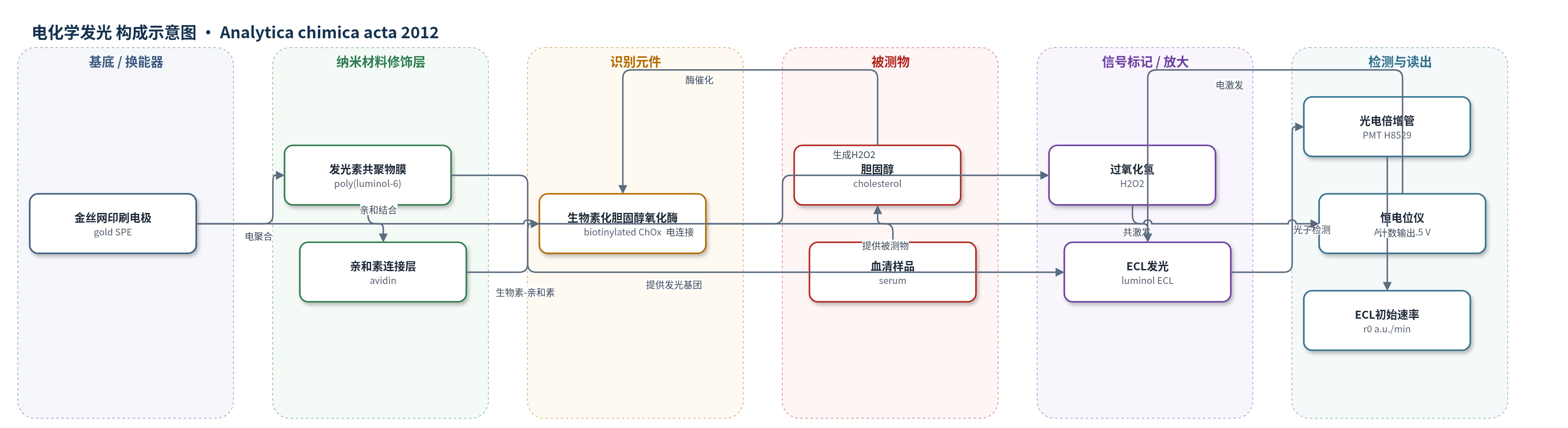
点击图片查看大图 · 依据论文自动绘制
传感器类型
电化学发光(ECL)生物传感器
检测对象
胆固醇(cholesterol);样品基质:血清(serum),标准液为 pH 9.5 磷酸盐缓冲液
检测原理
胆固醇氧化酶(ChOx)识别并催化胆固醇与溶解氧反应,生成 5-胆甾烯-3-酮和过氧化氢(H2O2)。H2O2 扩散至电极表面的聚(发光素-生物素化吡咯)共聚物中,在 0.5 V 脉冲电位下与发光素(luminol)发生电氧化/共激发,产生波长约 440 nm 的电化学发光(ECL)光子。光电倍增管(PMT)将光子转换为计数信号,并以连续脉冲的初始速率 r0 作为分析信号。由于酶催化持续产生 H2O2,且共聚物膜将酶与发光基团紧密组装,信号随胆固醇浓度呈对数增加,r0 = 2.7 ln(x) + 29.6,从而实现低浓度胆固醇检测。
检测灵敏度
LOD: 1.47 × 10⁻⁵ M;线性范围: 1.5 × 10⁻⁵–8.0 × 10⁻⁴ M;斜率: 2.7 ± 0.3;R^2 = 0.947;LOQ: 1.50 × 10⁻⁵ M
效应效果
空白 RSD 11.5%(n=5),9.0×10^-5 M 与 2.0×10^-4 M 胆固醇 RSD 为 7.9% 和 14.1%;4 ℃避光保存约 1 个月。尿酸淬灭 ECL,尿素增强信号,ZnSO4 消除尿酸干扰,尿素经空白校正。与 Roche Hitachi-912 法比较,3 份血清 p 值均大于 5%,均值 RSD 低于 8%,分析约 4 min。相比旧传感器(线性 2.5×10^-5–1.0×10^-4 M、LOD 2.3×10^-5 M、RSD 7.8%),本方法线性更宽、LOD 相近但重现性略低,适合一次性筛查。
传感器的构成
- 基底/换能器电极:金丝网印刷电极(gold SPE),经 1.0 M 乙酸伏安活化,作为导电基底与 ECL 激发界面
- 信号/换能修饰层:聚(发光素-生物素化吡咯)共聚物(poly(luminol-biotinylated pyrrole),化合物 6/luminol = 1:10),提供 ECL 发光基团与生物素位点
- 亲和连接层:亲和素(avidin),过量滴加,桥接共聚物生物素与生物素化酶
- 识别元件:生物素化胆固醇氧化酶(biotinylated ChOx),由 ChOx 与 biotin vinyl sulfone 偶联,催化胆固醇氧化
- 信号读出:光电倍增管(PMT, H8529)与 USB 计数单元(C8855),配合 Autolab PGSTAT 128N 记录 ECL 初始速率
中文摘要
本文报道了一种基于金丝网印刷电极的一次性电化学发光胆固醇生物传感器。检测层由发光素(luminol)与经点击化学合成的不同生物素化吡咯单体在 pH 7.0 磷酸盐缓冲液中经循环伏安电聚合形成共聚物,其中生物素化吡咯与发光素摩尔比为 1:10,单体总浓度 10^-3 mol/L,循环 5 次,从而获得具有新电致发光性质的导电聚合物换能层。识别层采用生物素化胆固醇氧化酶(ChOx),该酶先与生物素乙烯砜偶联,再通过亲和素–生物素相互作用固定于共聚物表面。传感器以计时电流模式在 0.5 V 激发电位、脉冲间隔 10 s、pH 9.5 条件下测定 ECL 酶促初始速率。该一次性器件对胆固醇的线性范围为 1.5×10^-5–8.0×10^-4 mol/L,检出限为 1.47×10^-5 mol/L,在 9.0×10^-5 mol/L 和 2.0×10^-4 mol/L 时准确度分别为 7.9% 和 14.1%(n=5)。与参考方法相比,血清样品中胆固醇测定结果令人满意。
英文摘要
An electrochemiluminescent cholesterol disposable biosensor has been prepared by the formation of assembled layers on gold screen-printed cells. The detection layer is based on the electro-formation of new luminol copolymers with different synthesized biotinylated pyrroles prepared by click-chemistry, offering a new transduction layer with new electroluminescent properties on biosensors. The electrochemiluminescence (ECL) luminol copolymers are electroformed by cyclic voltammetry (five cycles) at pH 7.0 uses a10(-3)M biotinylated pyrrole-luminol ratio of 1:10 in PBS buffer. With respect to the recognition layer, cholesterol oxidase was biotinylated by incubation with biotin vinyl sulfone, and immobilized on the copolymer by avidin-biotin interaction. The analytical signal of the biosensor is the ECL enzymatic initial rate working in chronoamperometric mode at 0.5V excitation potential with 10s between pulses at pH 9.5. The disposable device offers a cholesterol linear range from 1.5×10(-5)M to 8.0×10(-4)M with a limit of detection of 1.47×10(-5)M and accuracy of 7.9% for 9.0×10(-5)M and 14.1% for 2.0×10(-4)M, (n=5). Satisfactory results were obtained for cholesterol determination in serum samples compared to a reference procedure.