组成图示
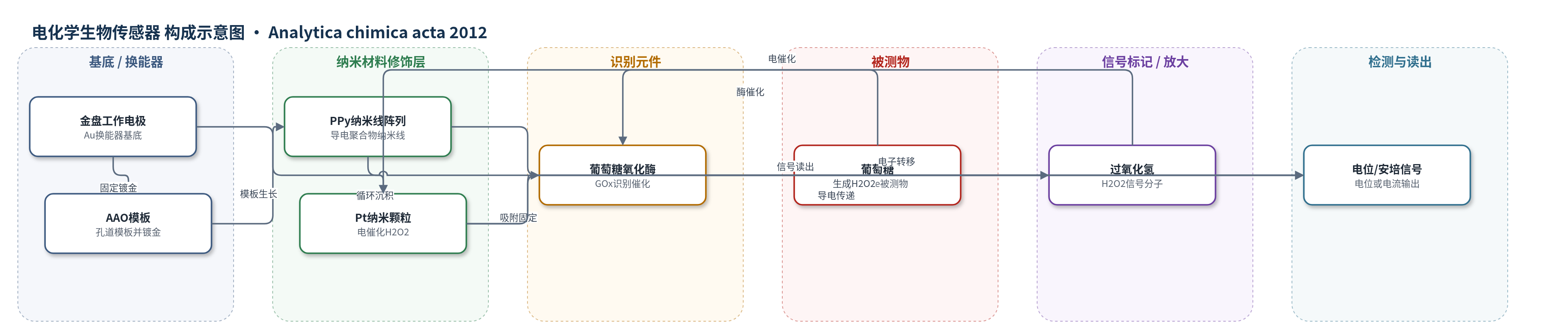
点击图片查看大图 · 依据论文自动绘制
传感器类型
电化学生物传感器
检测对象
葡萄糖(glucose);样品基质:0.05 M磷酸盐缓冲液(pH 7)
检测原理
葡萄糖在吸附的葡萄糖氧化酶(GOx)催化下与氧气反应生成葡萄糖酸和过氧化氢(H2O2)。H2O2扩散至铂纳米颗粒(PtNPs)表面发生电催化氧化或还原,产生电子转移。聚吡咯纳米线阵列(PPyNWA)作为导电通道将电子传递至金盘工作电极。电位法中,H2O2浓度随葡萄糖浓度升高而升高,使指示电极电位按Nernst关系下降,斜率40.5 mV/decade;安培法中,在700 mV下H2O2被氧化产生阳极电流,电流随葡萄糖浓度线性增加。纳米线阵列的高比表面积和PtNPs的电催化作用共同提高电子转移与信号响应。
检测灵敏度
电位法: LOD: 5.6 μM;线性范围: 10 μM-1000 μM;灵敏度: 40.5 mV/decade;R^2 = 0.9936。安培法: LOD: 27.7 μM;线性范围: 0.1-9 mM;灵敏度: 34.7 μA cm−2 mM−1(700 mV);R^2 = 0.9977。
效应效果
该文未报告选择性、抗干扰、稳定性、重现性(RSD)和实际样品加标回收率。与纳米材料葡萄糖传感器相比,电位法检出限5.6 μM优于AuNW的46 μM、Au修饰CNT的20 μM和PPyNT的108 μM;安培法灵敏度34.7 μA cm−2 mM−1高于Pt修饰PPy–GOx的9.9、AuNW的15.6和PPyNT的7.4 μA cm−2 mM−1,检出限27.7 μM优于AuNW的46 μM和PPyNT的108 μM。安培法响应时间约7 s,电位法稳定时间超过100 s。作者认为电位法适合10 μM-1 mM低浓度,安培法适合0.1-9 mM高浓度,两者可互补用于葡萄糖检测。
传感器的构成
- 基底/换能器电极:金盘工作电极(Au)与阳极氧化铝模板(AAO),AAO经真空镀金导电并固定于金盘上,提供导电基底与孔道模板
- 纳米材料修饰层:聚吡咯纳米线阵列(PPyNWA),在AAO孔内恒电流聚合吡咯形成约20 nm直径纳米线,提供导电通道和酶吸附位点
- 纳米材料修饰层:铂纳米颗粒(PtNPs),循环伏安沉积于PPyNWA表面,增强电子转移和过氧化氢电催化
- 识别元件:葡萄糖氧化酶(GOx),吸附于PPyNWA–PtNPs表面,催化葡萄糖氧化
- 信号标记物:无外加标记物;酶催化产物过氧化氢(H2O2)作为电化学信号分子
- 反应底物/电子供体:葡萄糖(glucose),在GOx催化下氧化并产生H2O2
中文摘要
本文报道了一种新型葡萄糖生物传感器,其以在阳极氧化铝(AAO)模板中制备的有序聚吡咯纳米线阵列(PPyNWA)为基底,经铂纳米颗粒(PtNPs)修饰后表面吸附葡萄糖氧化酶(GOx)构建而成。循环伏安法揭示了PPyNWA–GOx、PPyNWA–PtNPs和PPyNWA–PtNPs–GOx电极在电化学性质上的显著差异;其中PPyNWA–PtNPs–GOx电极表现出主要由PtNPs修饰引起的直接电子转移证据。优化制备条件为:吡咯浓度0.2 M、电流密度0.1 mA cm−2、聚合时间600 s,在−200至200 mV范围内以50 mV s−1扫速循环沉积PtNPs 20次。电位法检测葡萄糖的灵敏度为40.5 mV/decade,线性范围为10 μM-1000 μM(R^2=0.9936);安培法在700 mV下的灵敏度为34.7 μA cm−2 mM−1,线性范围为0.1-9 mM(R^2=0.9977)。电位法检出限为5.6 μM,安培法检出限为27.7 μM。
英文摘要
A novel glucose biosensor, based on the modification of well-aligned polypyrrole nanowires array (PPyNWA) with Pt nanoparticles (PtNPs) and subsequent surface adsorption of glucose oxidase (GOx), is described. The distinct differences in the electrochemical properties of PPyNWA-GOx, PPyNWA-PtNPs, and PPyNWA-PtNPs-GOx electrodes were revealed by cyclic voltammetry. In particular, the results obtained for PPyNWA-PtNPs-GOx biosensor showed evidence of direct electron transfer due mainly to modification with PtNPs. Optimum fabrication of the PPyNWA-PtNPs-GOx biosensor for both potentiometric and amperometric detection of glucose were achieved with 0.2 M pyrrole, applied current density of 0.1 mA cm(-2), polymerization time of 600 s, cyclic deposition of PtNPs from -200 mV to 200 mV, scan rate of 50 mV s(-1), and 20 cycles. A sensitivity of 40.5 mV/decade and a linear range of 10 μM to 1000 μM (R(2)=0.9936) were achieved for potentiometric detection, while for amperometric detection a sensitivity of 34.7 μA cm(-2) mM(-1) at an applied potential of 700 mV and a linear range of 0.1-9 mM (R(2)=0.9977) were achieved. In terms of achievable detection limit, potentiometric detection achieved 5.6 μM of glucose, while amperometric detection achieved 27.7 μM.