组成图示
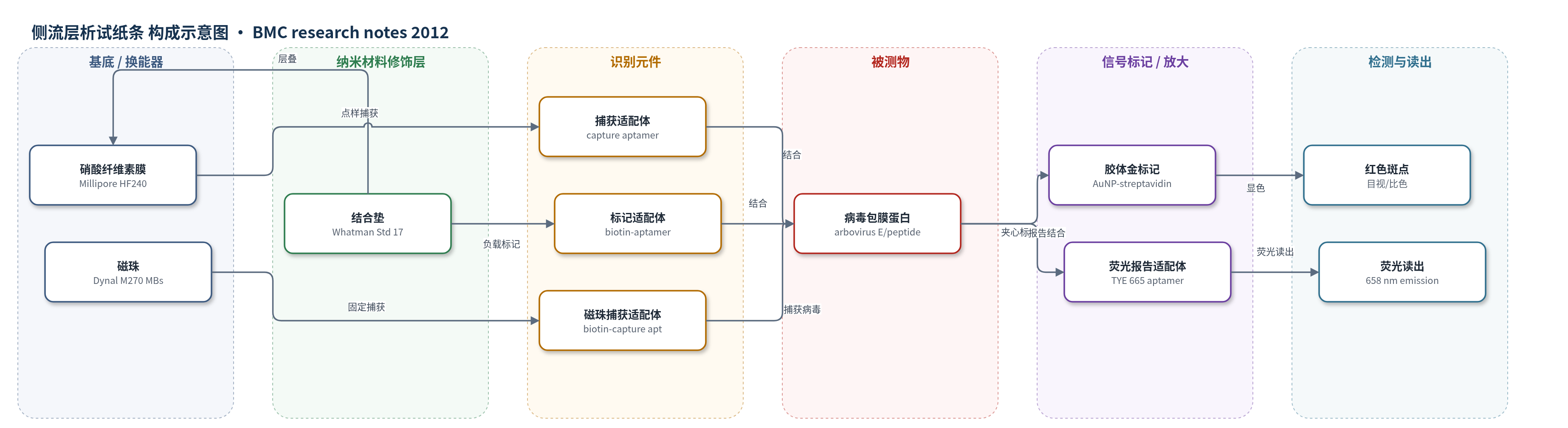
点击图片查看大图 · 依据论文自动绘制
传感器类型
侧流层析试纸条
检测对象
基孔肯雅病毒 E1a 肽(Chikungunya E1a peptide)、克里米亚-刚果出血热病毒包膜肽/灭活全病毒(CCHF envelope peptides / inactivated CCHF virus)、登革热病毒 1–4 型 E 抗原(dengue type 1–4 E antigen)、蜱传脑炎病毒 CE/gE(TBEV CE/gE)、西尼罗河病毒 E 蛋白(WNV E protein);样品基质:PBS(重组蛋白/合成肽/灭活病毒悬液)
检测原理
检测基于 DNA 适配体对虫媒病毒包膜蛋白或肽的特异性识别。侧流层析中,样品中的病毒包膜蛋白/肽随液体流动,先与结合垫上 5'-biotin-aptamer-streptavidin-colloidal gold 标记物结合,再被硝酸纤维素膜上点样的 capture aptamer-streptavidin 捕获,形成夹心复合物;胶体金聚集在检测线处产生红色斑点,斑点强度随目标物量增加。荧光磁珠夹心中,capture aptamer 经 biotin-streptavidin 固定于 Dynal M270 磁珠,病毒被捕获后,5'-TYE 665 reporter aptamer 结合病毒包膜蛋白,645 nm 激发下 658 nm 发射荧光增强,荧光峰高随病毒量增加。该体系无酶催化放大,主要依赖双适配体夹心、胶体金聚集和荧光染料信号。
检测灵敏度
原文未报告 LOD、线性范围、灵敏度斜率或 R^2。
效应效果
ELASA 背景吸光度低于 0.4,作者按 405 nm 吸光度排序适配体亲和力,如 ChE-17R 2.608、TBEV-2R 2.719、WNV-19F 2.607、DE1-8R 2.651、Gn6-25R 1.940。侧流试纸条在 PBS 中约 1 μg 重组蛋白/肽、室温 5 min 时,ChE 17R/20R 与 TBEV 2F/8R 组合可显色;同一适配体自配对因表位竞争失败。荧光磁珠夹心检测 150 ng 灭活 CCHF 病毒时,组合 20(Gn6-25R 捕获、Gn6-17F-TYE 665 报告)658 nm 荧光峰最高,显微镜证实阳性红色荧光强于零对照。原文未报告 RSD、回收率或 ELISA/qPCR 对比。
传感器的构成
- 支撑/卡壳层:DCN 压力敏感粘性背衬与塑料卡壳,固定各功能垫并支撑试纸条。
- 样品垫:Whatman GB002 sample pad,浸 0.05 M Tris-HCl、0.15 mM NaCl、0.25% Triton X-100,导入样品。
- 结合垫:Whatman Standard 17 conjugate pad,负载 5'-biotin-aptamer-streptavidin-colloidal gold 标记物。
- 分析膜:Millipore High Flow 240 nitrocellulose membrane,点样 capture aptamer-streptavidin 作为捕获识别元件。
- 吸收垫:Whatman 470 wicking pad,驱动液体层析。
- 信号标记物:colloidal gold-streptavidin 与生物素适配体结合,形成可见红色斑点。
- 封闭剂:1 μM biotin,封闭未结合 streptavidin 位点。
- 磁珠捕获基底:Dynal M270 tosyl-coated magnetic beads (MBs),经 streptavidin 固定捕获适配体,用于荧光夹心检测。
- 荧光报告标记:5'-TYE 665 dye reporter aptamer,结合病毒后提供 658 nm 荧光信号。
中文摘要
核酸适配体已显示可结合病毒包膜蛋白并抑制病原病毒感染。本文报道针对多种高致病性虫媒病毒(包括基孔肯雅、克里米亚-刚果出血热、登革热、蜱传脑炎和西尼罗河病毒)的重组包膜蛋白、合成肽及灭活全病毒进行 DNA 适配体库开发与筛选的初步工作。作者利用磁珠 SELEX 获得候选适配体,通过酶联适配体吸附试验(ELASA)按 405 nm 吸光度对相对亲和力排序,并对序列与二级结构进行共性分析,寻找可能的共识结合位点。部分高亲和、高特异适配体在侧流层析试纸条和荧光适配体-磁珠夹心检测中表现出诊断潜力。文中还指出某些适配体可能结合病毒包膜蛋白,具有被动免疫或预防应用潜力。
英文摘要
BACKGROUND: Nucleic acid aptamers have long demonstrated the capacity to bind viral envelope proteins and to inhibit the progression of pathogenic virus infections. Here we report on initial efforts to develop and screen DNA aptamers against recombinant envelope proteins or synthetic peptides and whole inactivated viruses from several virulent arboviruses including Chikungunya, Crimean-Congo hemorrhagic fever (CCHF), dengue, tickborne encephalitis and West Nile viruses. We also analyzed sequence data and secondary structures for commonalities that might reveal consensus binding sites among the various aptamers. Some of the highest affinity and most specific aptamers in the down-selected libraries were demonstrated to have diagnostic utility in lateral flow chromatographic assays and in a fluorescent aptamer-magnetic bead sandwich assay. Some of the reported aptamers may also be able to bind viral envelope proteins in vivo and therefore may have antiviral potential in passive immunity or prophylactic applications.
RESULTS: Several arbovirus DNA aptamer sequences emerged multiple times in the various down selected aptamer libraries thereby suggesting some consensus sequences for binding arbovirus envelope proteins. Screening of aptamers by enzyme-linked aptamer sorbent assay (ELASA) was useful for ranking relative aptamer affinities against their cognate viral targets. Additional study of the aptamer sequences and secondary structures of top-ranked anti-arboviral aptamers suggest potential virus binding motifs exist within some of the key aptamers and are highlighted in the supplemental figures for this article. One sequence segment (ACGGGTCCGGACA) emerged 60 times in the anti-CCHF aptamer library, but nowhere else in the anti-arbovirus library and only a few other times in a larger library of aptamers known to bind bacteria and rickettsia or other targets. Diagnostic utility of some of the aptamers for arbovirus detection in lateral flow chromatographic assays and a fluorescent sandwich assay on the surface of magnetic microbeads is also demonstrated.
CONCLUSIONS: This article catalogues numerous DNA aptamer sequences which can bind various important pathogenic arboviruses and have, in some cases, already demonstrated diagnostic potential. These aptamer sequences are proprietary, patent-pending, and partially characterized. Therefore, they are offered to the scientific community for potential research use in diagnostic assays, biosensor applications or for possible passive immunity and prophylaxis against pathogenic viruses.