组成图示
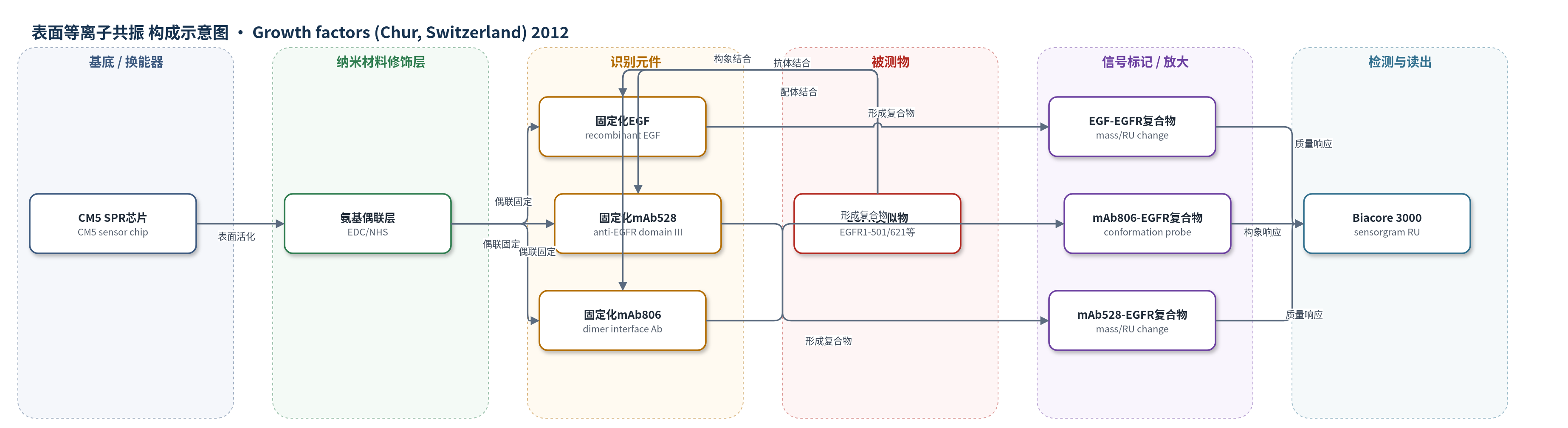
点击图片查看大图 · 依据论文自动绘制
传感器类型
表面等离子共振(SPR)生物传感器
检测对象
EGFR 细胞外域类似物(EGFR1–501、EGFR1–501-Fc、EGFR1–621、EGFR1–621-albumin、EGFR1–621-GFP、RFP-EGFR1–621-GFP、YFP-linker-EGFR1–621-GFP),样品基质为纯化重组蛋白溶液/Biacore HBS 运行缓冲液;细胞表面实验为 BaF/3 细胞膜 EGFR/erbB2 异二聚体。
检测原理
将重组 EGF 或抗 EGFR 单克隆抗体 mAb528、mAb806 通过 EDC/NHS 氨基偶联固定于 CM5 SPR 芯片。EGFR 类似物随 HBS 缓冲液流过表面,与固定化 EGF 或抗体结合后增加界面质量,SPR 响应单位(RU)随结合量变化。mAb528 识别域 III,可被 EGF 竞争;mAb806 识别二聚界面附近构象表位。EGF 结合 EGFR1–501-Fc 后诱导二聚界面构象改变,使 mAb806 结合下降。数据用两态构象变化模型拟合,得到 ka1/kd1 与 ka2/kd2,从而区分结合与构象转变。
检测灵敏度
—
效应效果
SPR 实验采用 100 µL/min 流动、140 µL 进样、1000–3600 s 解离,并用 10 mM Glycine pH 2.0 再生。EGFR 类似物与固定化 EGF 的 KD1 为 21–710 nM,EGFR1–501 为 62 nM,EGFR1–621 为 460 nM;与 mAb528 的 KD 为 0.9–19 nM,EGFR1–501-Fc 最紧(0.9 nM)。EGF 存在时 EGFR1–501-Fc 对 mAb806 结合显著下降。细胞表面 FACS 显示 erbB2 使 mAb806 结合增加约 4 倍,EGF 处理后 mAb806/mAb3B10 结合消失;高亲和 EGF 结合位点由 13% 增至 97%,KD1 约 0.3 nM。
传感器的构成
- 基底/换能器:CM5 传感器芯片(SPR 芯片),提供表面等离子共振换能并记录结合响应。
- 化学修饰层:EDC/NHS 氨基偶联化学(ethyl-Ni-dimethylaminopropyl-carbodiimide 与 N-hydroxysuccinimide),将 EGF 或抗体共价固定到芯片表面。
- 识别元件1:固定化重组人 EGF,捕获 EGFR 类似物并监测配体结合。
- 识别元件2:固定化单克隆抗体 mAb528,识别 EGFR 域 III/配体结合区,用于竞争性结合监测。
- 识别元件3:固定化单克隆抗体 mAb806,识别二聚界面附近构象表位,用于监测 EGF 诱导构象变化。
- 结合/信号层:EGFR 类似物(EGFR1–501、EGFR1–501-Fc、EGFR1–621 等)与固定化 EGF/抗体结合,引起界面质量变化。
- 运行/再生体系:HBS 缓冲液(10 mM HEPES pH 7.4、3.4 mM EDTA、0.15 mM NaCl、0.005% Tween 20)与 10 mM Glycine pH 2.0,维持结合并再生表面。
中文摘要
表皮生长因子受体(EGFR)激酶激活需要配体结合其细胞外域(ECD)。已有晶体结构显示 EGFR-ECD 可呈 tethered 单体或配体存在下的 untethered back-to-back 二聚体。本研究利用 Biacore 表面等离子共振生物传感器分析不同 C 端延伸的截短 EGFR1–501-ECD 和全长 EGFR1–621-ECD 类似物,发现即使单体状态下,C 端延伸也可改变配体结合位点构象。识别二聚界面的单克隆抗体 mAb806 与截短 EGFR1–501-Fc 融合蛋白的结合在 EGF 存在时降低,提示发生构象变化。在细胞表面,erbB2 的存在增加 mAb806 对 EGFR 的结合;EGF 处理后 EGFR:erbB2 异二聚体界面构象改变。作者提出,配体诱导预形成的激酶非活性 EGFR 二聚体/异二聚体发生构象变化,进而形成激酶活性四聚体,激酶激活通过 EGFR 二聚体间不对称相互作用实现。
英文摘要
The activation of the epidermal growth factor receptor (EGFR) kinase requires ligand binding to the extracellular domain (ECD). Previous reports demonstrate that the EGFR-ECD can be crystallized in two conformations - a tethered monomer or, in the presence of ligand, an untethered back-to-back dimer. We use Biosensor analysis to demonstrate that even in the monomeric state different C-terminal extensions of both truncated (EGFR(1-501))-ECD and full-length EGFR(1-621)-ECD can change the conformation of the ligand-binding site. The binding of a monoclonal antibody mAb806, which recognizes the dimer interface, to the truncated EGFR(1-501)-Fc fusion protein is reduced in the presence of ligand, consistent with a change in conformation. On the cell surface, the presence of erythroblastosis B2 (erbB2) increases the binding of mAb806 to the EGFR. The conformation of the erbB2: EGFR heterodimer interface changes when the cells are treated with epidermal growth factor (EGF). We propose that ligand induces kinase-inactive, pre-formed EGFR dimers and heterodimers to change conformation leading to kinase-active tetramers, where kinase activation occurs via an asymmetric interaction between EGFR dimers.