组成图示
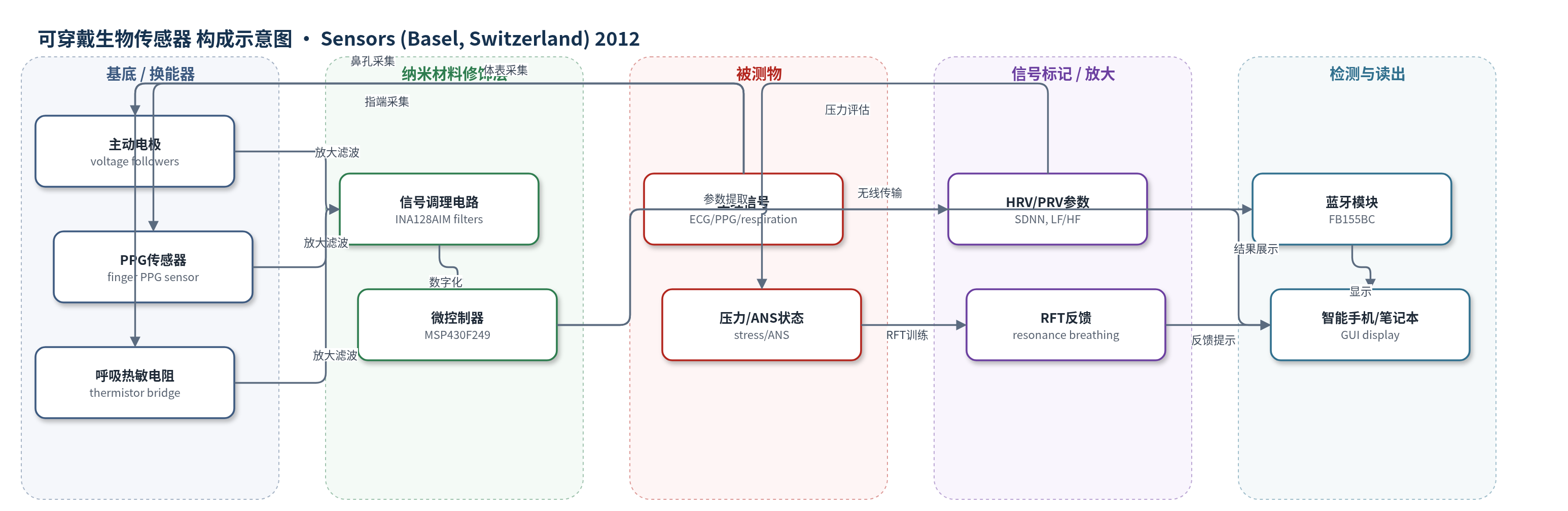
点击图片查看大图 · 依据论文自动绘制
传感器类型
可穿戴生物传感器
检测对象
心电信号(ECG)、光电容积脉搏波信号(PPG)、呼吸信号(respiration);样品基质:人体体表、指端与鼻孔(in vivo)
检测原理
系统通过主动电极、PPG 传感器和鼻孔热敏电阻分别采集体表 ECG、指端 PPG 与呼吸温度信号。弱信号经 INA128AIM 放大、Butterworth/Bessel 滤波和 60 Hz 陷波后,由 MSP430F249 数字化。软件用自适应阈值提取 RR/PP 间期,用峰谷检测提取呼吸周期,计算 SDNN、rMSSD、LF、HF、LF/HF、TP 和相干比 CR。HRV 反映自主神经调节:压力升高时交感增强、副交感抑制,SDNN/TP 下降、LF/HF 升高;RFT 以个体共振频率(约4–7次/min)慢呼吸增加呼吸性窦性心律不齐(RSA)振幅,从而提升 HRV 并恢复交感-迷走平衡。
检测灵敏度
RR/PP 间期检测率: 99.3%
效应效果
系统采用 60 Hz 陷波、右腿驱动、3M 形态学滤波等抑制工频、共模与运动伪差;与 LAXTHA PolyG-A 在 512 Hz 同步采集下,ECG、PPG、呼吸及 HRV/PRV 曲线高度相似。电池寿命约 10 h(9 V/350 mAh)、5 h(3.7 V 太阳能/350 mAh)、3.5 h(3 V/250 mAh)。3 周 RFT 后,SDNN 由 27.8±3.8 ms 升至 55.3±6.1 ms(约1.99倍),TP 由 998±254.7 ms² 升至 1966±689.1 ms²,LF/HF 由 6.41±1.52 降至 1.92±0.35,CR 由 0.87±0.21 升至 1.74±0.32,提示交感下降、副交感增强,适合失业人群压力管理。
传感器的构成
- 电极/换能层:主动电极(voltage followers)与右腿驱动,采集体表 ECG 并抑制电极-皮肤阻抗不平衡和共模噪声
- 信号调理层:INA128AIM 仪表放大器、二阶 Butterworth 高通、五阶 Bessel 低通、60 Hz Twin-T 陷波和反相放大器,放大滤波 ECG/PPG/呼吸信号
- 呼吸传感层:双热敏电阻(thermistors)桥式电路与 LM324 放大器,检测鼻孔前呼吸引起的温度变化
- 脉搏传感层:PPG 传感器(指端光电容积脉搏波传感器),采集脉搏信号并经相同调理电路输出
- 主控通信层:MSP430F249 微控制器与 FB155BC 蓝牙模块,完成数据采集、处理与无线传输
- 扩展接口层:20-pin 扩展口、USB/RS232 接口,连接其他生物传感器、电池或计算机/智能手机
- 电源层:3.3/5/9/12 V 适配器接口、9 V 350 mAh 电池、3 V 250 mAh 纽扣电池、3.7 V 350 mAh 太阳能充电电池,提供静态与动态场景供电
- 软件算法层:生物信号监测、分析与 RFT 生物反馈模块,提取 HRV/PRV/呼吸参数并显示反馈
中文摘要
当前研究致力于发展情绪控制与压力释放方法。生物反馈作为心理生理学的应用分支,可满足临床与非临床需求。可穿戴医疗设备使生命体征的无感监测和新兴生物反馈服务得以普及。全球衰退使失业成为严重社会问题,因此将生物反馈技术与可穿戴技术结合用于失业人群压力管理具有重要意义。本文描述了一种基于集成多生物传感器平台与共振频率训练(RFT)生物反馈策略的可穿戴生物反馈系统,用于失业人群压力管理。与商业系统相比,多受试者现场实验表明,该系统隐蔽、易佩戴,并能提供动态 RFT 生物反馈。此外,借助该系统对失业人群进行 3 周 RFT 生物反馈训练前后自主神经系统(ANS)调节变化的比较研究。结果表明,RFT 生物反馈结合可穿戴技术可显著提高总体心率变异性(HRV),表现为交感活动降低、副交感活动增强和 ANS 同步性增加。3 周 RFT 呼吸训练后,失业人群的 ANS 调节功能和应对能力约提高一倍,并趋向动态平衡。
英文摘要
Currently considerable research is being directed toward developing methodologies for controlling emotion or releasing stress. An applied branch of the basic field of psychophysiology, known as biofeedback, has been developed to fulfill clinical and non-clinical needs related to such control. Wearable medical devices have permitted unobtrusive monitoring of vital signs and emerging biofeedback services in a pervasive manner. With the global recession, unemployment has become one of the most serious social problems; therefore, the combination of biofeedback techniques with wearable technology for stress management of unemployed population is undoubtedly meaningful. This article describes a wearable biofeedback system based on combining integrated multi-biosensor platform with resonance frequency training (RFT) biofeedback strategy for stress management of unemployed population. Compared to commercial system, in situ experiments with multiple subjects indicated that our biofeedback system was discreet, easy to wear, and capable of offering ambulatory RFT biofeedback.Moreover, the comparative studies on the altered autonomic nervous system (ANS) modulation before and after three week RFT biofeedback training was performed in unemployed population with the aid of our wearable biofeedback system. The achieved results suggested that RFT biofeedback in combination with wearable technology was capable of significantly increasingoverall HRV, which indicated by decreasing sympathetic activities, increasing parasympathetic activities, and increasing ANS synchronization. After 3-week RFT-based respiration training, the ANS's regulating function and coping ability of unemployed population have doubled, and tended toward a dynamic balance.