组成图示
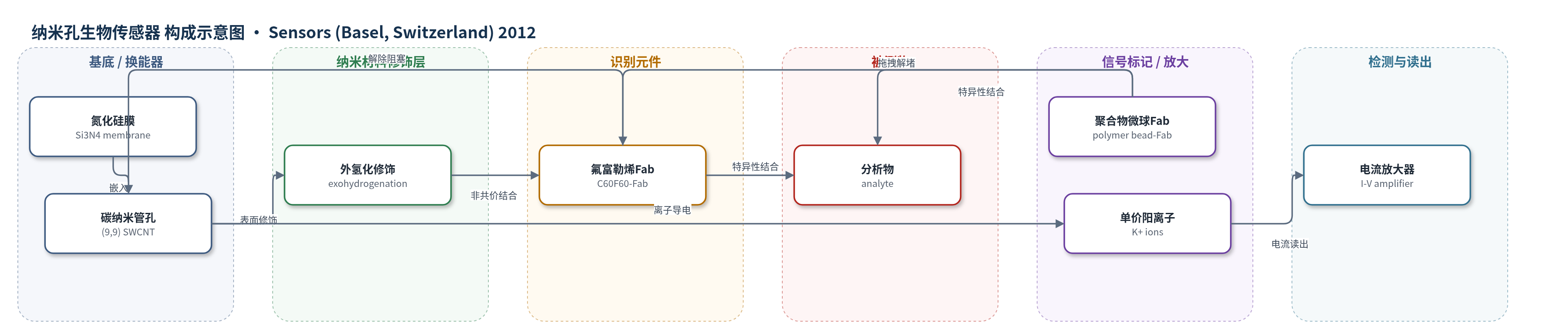
点击图片查看大图 · 依据论文自动绘制
传感器类型
纳米孔生物传感器
检测对象
未指定具体分析物(analyte,泛指可被Fab片段识别的生物/环境分子);样品基质:溶液储液(reservoir,如缓冲液/生物或环境样品)
检测原理
该设计以功能化碳纳米管孔为离子通道换能器。无分析物时,C60F60氟富勒烯通过静电和范德华作用非共价结合在(9,9)外氢化碳纳米管入口,完全阻塞孔道,K+无法跨膜导电,基线电流接近零。注入分析物后,分析物同时与氟富勒烯表面Fab片段和溶液中聚合物微球表面互补Fab片段结合,形成交联复合物。较大微球在流动中受到拖拽力,当拖拽力超过氟富勒烯-碳纳米管结合力时,将氟富勒烯从入口拉出,孔道开放。开放孔道允许单价阳离子(K+)在外氢化负电荷孔中传导,200 mV下单管电流约82 pA,相当于5.1×10^8个离子/秒。电流大小随开放通道数增加,而开放通道数与分析物结合事件相关;通过电流-电压放大器记录跨膜电流,理论上可分辨单个通道开放事件,实现单分子水平检测。
检测灵敏度
原文未报告实验LOD、线性范围、灵敏度斜率或R^2;模拟报告:Kd(C60F60)=37 pM,Kd(C60F36)=87 µM,单管200 mV电流82 pA。
效应效果
本文为计算/概念验证设计,未提供实验选择性、抗干扰、稳定性、RSD或实际样品回收率。模拟显示(9,9)外氢化碳纳米管对K+选择性导电,Cl-能垒约20 kT,几乎不导电;C60F60结合能深25.6 kT,自发开闭概率约10^-8,背景噪声低。单管在200 mV下电流82 pA,比ICSTM生物传感器单通道4 pA高20倍;电流随K+浓度呈Michaelis-Menten型,200 mV下约127 pA饱和,半最大浓度277 mM。作者认为该膜可高密度集成(约2.5×10^11 cm^-2),1 µm^2含约2500个通道,且可施加至1 V电压,有望比ICSTM更灵敏并直接测量电流,实现单分子检测。
传感器的构成
- 基底/膜:硅氮化物膜(silicon-nitride membrane)或其他膜,承载功能化碳纳米管孔并分隔两储液
- 换能器/纳米管:外氢化(9,9)单壁碳纳米管(exohydrogenated (9,9) SWCNT),氢端终止,形成选择性单价阳离子导电孔
- 修饰层:外氢化区域(exohydrogenated sections),在管外表面形成负电荷孔道,降低K+能垒
- 识别/阻塞元件:氟富勒烯(fluorofullerene,C60F60或C60F36,优选C60F60),非共价结合于纳米管入口并阻塞孔道
- 识别元件:Fab片段(Fragment antigen-binding fragment),经羟基、PEG-生物素和链霉亲和素偶联到氟富勒烯,特异性结合分析物
- 信号放大/机械元件:可溶性聚合物微球(polymer bead,半径约15 nm),表面修饰互补Fab片段/抗体,与分析物交联后提供拖拽力
- 信号离子:单价阳离子(K+),孔开放后跨膜导电产生电流
- 读出装置:电流-电压放大器(current-to-voltage amplifier),测量跨膜离子电流;可选隐马尔可夫模型/波动分析处理信号
中文摘要
碳纳米管为开发高灵敏度分子检测器提供了新途径,已有基于纳米管的传感器达到10^-11 M检出限。本文提出一种生物传感器设计,由嵌入氮化硅或其他膜中的功能化碳纳米管孔、氟富勒烯—Fab片段偶联物以及表面修饰互补Fab片段的聚合物微球组成。分子动力学和随机动力学模拟表明,(9,9)外氢化碳纳米管的导电能力比离子通道开关ICSTM生物传感器高20倍,氟富勒烯可非共价结合并阻塞纳米管入口,解离常数可低至37 pM。无分析物时,氟富勒烯封闭孔道,聚合物微球在储液中漂浮;注入分析物后,氟富勒烯和微球上的Fab片段与分析物交联,较大微球所受拖拽力将氟富勒烯从入口拉出,使单价阳离子跨膜导电。若两储液间密封良好,该设计可检测单个通道开放,即单个分析物分子,因而具有高灵敏度。
英文摘要
Carbon nanotubes offer exciting opportunities for devising highly-sensitive detectors of specific molecules in biology and the environment. Detection limits as low as 10(-11) M have already been achieved using nanotube-based sensors. We propose the design of a biosensor comprised of functionalized carbon nanotube pores embedded in a silicon-nitride or other membrane, fluorofullerene-Fragment antigen-binding (Fab fragment) conjugates, and polymer beads with complementary Fab fragments. We show by using molecular and stochastic dynamics that conduction through the (9, 9) exohydrogenated carbon nanotubes is 20 times larger than through the Ion Channel Switch ICS(TM) biosensor, and fluorofullerenes block the nanotube entrance with a dissociation constant as low as 37 pM. Under normal operating conditions and in the absence of analyte, fluorofullerenes block the nanotube pores and the polymer beads float around in the reservoir. When analyte is injected into the reservoir the Fab fragments attached to the fluorofullerene and polymer bead crosslink to the analyte. The drag of the much larger polymer bead then acts to pull the fluorofullerene from the nanotube entrance, thereby allowing the flow of monovalent cations across the membrane. Assuming a tight seal is formed between the two reservoirs, such a biosensor would be able to detect one channel opening and thus one molecule of analyte making it a highly sensitive detection design.