组成图示
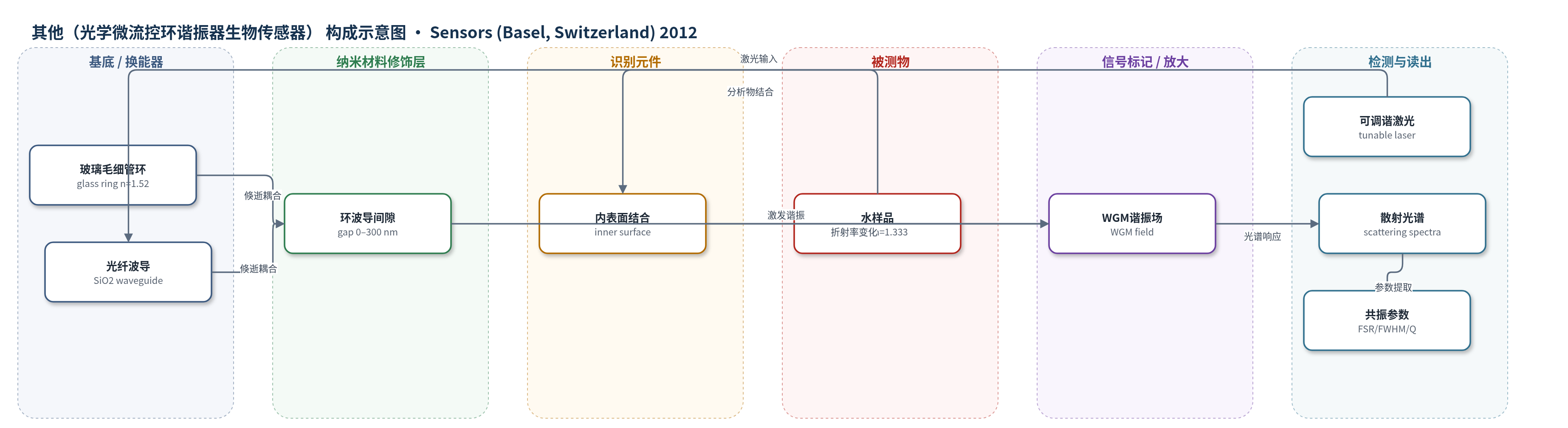
点击图片查看大图 · 依据论文自动绘制
传感器类型
其他(光学微流控环谐振器生物传感器)
检测对象
未指定具体分析物(analyte);样品基质:水(water)
检测原理
OFRR 以玻璃毛细管环作为光学谐振腔,光在环内以回音壁模式(WGM)沿外边界多次循环。可调谐激光经 SiO2 光纤波导输入,通过环与波导之间的纳米间隙发生倏逝场耦合,激发环内 WGM。若分析物结合到环内表面或改变局部流体折射率,会改变 WGM 感受到的有效折射率和等效环厚度,使共振波长/频率发生偏移。数值模型用有限元法求解 Maxwell 方程,提取共振频率、FSR、FWHM、Q 和 F;高 Q 窄线宽与多次光-样品相互作用提供信号放大,使折射率变化转化为可测光谱位移。
检测灵敏度
—
效应效果
该文为数值模拟,未报告选择性、抗干扰、稳定性、RSD、实际样品回收率或与 ELISA/HPLC/qPCR 的对比。模拟显示共振频率主要由环直径决定,间隙、厚度和波导宽度影响很小;FSR 随环直径增大单调下降。间隙宽度从 0 增至 300 nm 时,FWHM 降低约一个数量级,Q 和 F 增加约十倍。波导宽度存在最优范围 2.25–2.75 μm,环厚度变化使 FWHM、Q、F 约变化 2 倍。作者认为 OFRR 可低样品消耗、高集成密度地检测纳米颗粒、病毒及化学/生物分子。
传感器的构成
- 基底/谐振腔:玻璃毛细管环谐振器(glass capillary ring resonator, OFRR ring),外直径100 μm、壁厚3 μm、折射率1.52,形成WGM光学谐振腔。
- 耦合波导:光学纤维波导(optical fiber waveguide, SiO2),宽度2 μm、折射率1.4682,输入激光并倏逝耦合至环。
- 耦合间隙:环与波导间间隙(gap, g),0–300 nm,控制倏逝耦合强度、FWHM、Q和F。
- 样品介质:水(water, n=1.333),填充环内腔,作为分析物所在流体介质。
- 外部环境:空气(air, n=1.0),包围环和波导,决定边界条件与电磁场分布。
- 识别元件:玻璃毛细管内表面(glass capillary inner surface),原文未指定抗体/适配体等具体识别材料,仅假设分析物结合改变局部折射率。
- 信号标记物:无标记光学读出(label-free optical readout),不引入荧光、酶或纳米标记物。
- 激励/读出:可调谐激光(tunable laser, 1530–1560 nm)与散射光谱(scattering spectra),激发WGM并提取共振参数。
中文摘要
本文对光流控环谐振器(OFRR)生物传感器在回音壁模式(WGM)下的光学特性进行了数值表征。OFRR 由玻璃毛细管环、光纤波导以及二者之间的间隙构成,光在环内以 WGM 传播,实现微小型化并延长光与样品的有效相互作用时间。研究采用 COMSOL Multiphysics 有限元法求解 Maxwell 方程,考察环直径、环厚度、波导宽度和间隙宽度对共振频率、自由光谱范围(FSR)、半高全宽(FWHM)、精细度(F)和质量因子(Q)的影响。结果表明,共振频率主要受环直径控制,而间隙宽度、环厚度和波导宽度对共振频率影响可忽略;FWHM、Q 和 F 最受间隙宽度影响,并受环直径、波导宽度和环厚度中等影响。模拟还表明,对给定环谐振器存在波导宽度最优范围,在本研究中约为 2.25–2.75 μm。
英文摘要
The opto-fluidic ring resonator (OFRR) biosensor is numerically characterized in whispering gallery mode (WGM). The ring resonator includes a ring, a waveguide and a gap separating the ring and the waveguide. Dependence of the resonance characteristics on the resonator size parameters such as the ring diameter, the ring thickness, the waveguide width, and the gap width between the ring and the waveguide are investigated. For this purpose, we use the finite element method with COMSOL Multiphysics software to solve the Maxwell's equations. The resonance frequencies, the free spectral ranges (FSR), the full width at half-maximum (FWHM), finesse (F), and quality factor of the resonances (Q) are examined. The resonant frequencies are dominantly affected by the resonator diameter while the gap width, the ring thickness and the waveguide width have negligible effects on the resonant frequencies. FWHM, the quality factor Q and the finesse F are most strongly affected by the gap width and moderately influenced by the ring diameter, the waveguide width and the ring thickness. In addition, our simulation demonstrates that there is an optimum range of the waveguide width for a given ring resonator and this value is between ~2.25 μm and ~2.75 μm in our case.